

Table of Contents
- NMN vs NR for Cognitive Performance: What the Research Shows
- How NMN and NR Work: NAD+ Pathways and Brain Energy
- NMN Benefits for Brain Health and Cognition
- NR Benefits for Brain Health and Cognition
- Human Studies: Cognitive Outcomes and Evidence Gaps
- NMN vs NR Side Effects and Safety Considerations
- Bioavailability and Brain Exposure: Which Reaches Your Brain?
- Choosing Between NMN and NR for Cognitive Support
- Frequently Asked Questions
Last Updated: October 20, 2026
NMN vs NR for Cognitive Performance: What the Research Shows
When it comes to supporting brain health and cognitive function, two NAD+ precursors dominate the conversation: nicotinamide mononucleotide (NMN) and nicotinamide riboside (NR). Both compounds promise to boost cellular energy and enhance mental performance, but they work through different pathways and show distinct patterns in human studies. The picture is more nuanced than most supplement guides suggest.
The core question isn’t whether NAD+ matters for your brain, it does. NAD+ is essential for cellular energy production, DNA repair, and mitochondrial function. Both NMN and NR claim to raise NAD+ levels, but the critical gap in the current evidence is this: higher blood NAD+ doesn’t automatically translate to better cognition in humans. Animal studies show impressive results. Human studies show promise, but they’re limited in scope, duration, and the cognitive measures they track.
Here’s what separates a useful comparison from marketing hype: understanding which precursor actually reaches your brain tissue, what the human evidence actually shows about cognitive outcomes, and where the limitations in current research leave you as a decision-maker.
How NMN and NR Work: NAD+ Pathways and Brain Energy
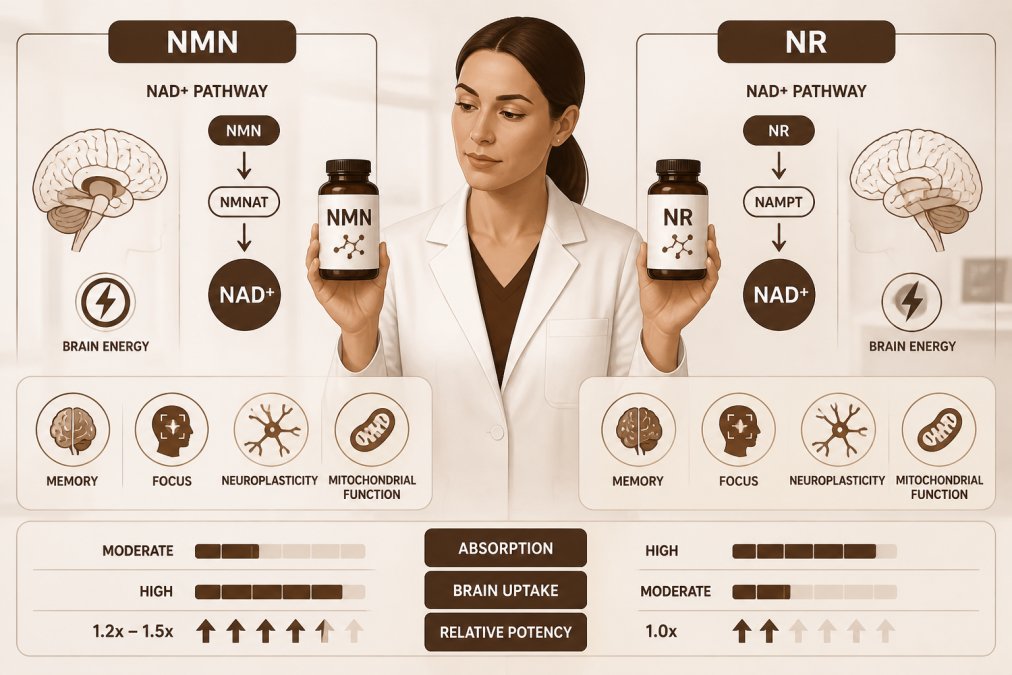
NMN absorption and conversion to NAD+
NMN (nicotinamide mononucleotide) enters cells through a specific transporter protein called Slc12a8 (Slc12a8 is a nicotinamide mononucleotide transporter). Once inside the cell, it’s converted directly to NAD+ through a single enzymatic step, making it theoretically more efficient than NR. The absorption process happens primarily in the small intestine, though bioavailability varies significantly between individuals.
The practical implication: NMN’s direct pathway to NAD+ sounds advantageous on paper. Some researchers hypothesized that fewer conversion steps meant faster NAD+ elevation. However, the human evidence on whether this translates to better outcomes remains limited. Most human studies using NMN have focused on metabolic markers rather than cognitive performance specifically.
NR absorption and conversion to NAD+
NR (nicotinamide riboside) follows a different route. It enters cells through equilibrative nucleoside transporters (ENTs) and requires multiple enzymatic steps to convert to NAD+. This longer pathway initially seemed like a disadvantage, but NR’s multi-step conversion may actually provide more regulatory control over NAD+ production in specific tissues.
The absorption profile differs too. NR appears to have broader tissue distribution and may accumulate in tissues differently than NMN. For brain health specifically, this distinction matters because the two precursors may reach neuronal tissue at different rates and concentrations.
Brain NAD+ levels and neuronal energy metabolism
Both NMN and NR aim to support NAD+ in mitochondria, where it fuels ATP production, the energy currency neurons depend on. Neurons are metabolically demanding cells, consuming roughly 20% of the body’s energy despite representing only 2% of body weight (Brain power). This energy demand drives the interest in NAD+ precursors as potential cognitive support.
However, a critical gap exists in the current research: most human studies measure blood NAD+ levels, not brain NAD+ levels. Animal studies show that NMN and NR can increase NAD+ in brain tissue, but translating those findings to humans requires direct measurement. The blood-brain barrier restricts what enters the brain, so higher systemic NAD+ doesn’t guarantee higher brain NAD+. This is an essential distinction for evaluating cognitive claims.
NMN Benefits for Brain Health and Cognition
NMN has generated significant interest in the longevity and cognitive performance community, largely driven by animal research showing benefits for neuronal energy metabolism and healthy aging. In mice and other model organisms, NMN supplementation has been associated with improved cognitive function, enhanced mitochondrial performance in neurons, and protection against age-related cognitive decline.
The human evidence is more limited. A small number of human studies have examined NMN’s effects on metabolic markers and physical performance, but dedicated cognitive performance studies in humans remain sparse. Most human research on NMN has focused on metabolic health, exercise capacity, and vascular function rather than brain function directly. This doesn’t mean NMN won’t support cognition, it means the specific cognitive evidence in humans is still developing.
The mechanism makes biological sense: if NMN raises neuronal NAD+ and improves mitochondrial function, cognitive benefits should follow. But “makes sense” and “proven in humans” are different standards.
NR Benefits for Brain Health and Cognition
NR has a slightly longer track record in human research, partly because it was identified as a naturally occurring NAD+ precursor earlier than NMN. Several human studies have examined NR’s effects on metabolism, physical performance, and aging markers. A few studies have touched on cognitive or neurological outcomes, though again, dedicated cognitive performance trials remain limited.
One advantage NR holds in the literature is more published human safety data. Because NR has been studied in humans for longer, clinicians and researchers have more confidence in its tolerability profile at various dosages. This doesn’t make NR cognitively superior to NMN, it simply means the safety foundation is more established.
Like NMN, NR’s mechanism for supporting brain health is theoretically sound: raising NAD+ fuels neuronal energy production and supports mitochondrial function. The practical gap remains the same: animal data looks promising, but human cognitive outcome data is limited for both precursors.
Human Studies: Cognitive Outcomes and Evidence Gaps
This is where the conversation needs to get honest, and where most NMN vs NR comparisons fall apart. The human evidence for either precursor improving cognitive performance is preliminary. More importantly, almost no published human trial has directly compared NMN against NR on cognitive outcomes. What exists is a patchwork of separate studies, mostly designed around metabolic or safety endpoints, with cognition appearing as a secondary or exploratory measure.
What the human trials actually measure
When cognitive testing does appear in NAD+ precursor research, it typically relies on a small set of standardized instruments. The most common include:
- The Montreal Cognitive Assessment (MoCA), a brief screening tool scored out of 30, often used to detect mild cognitive impairment. A change of 1-2 points is generally considered within test-retest noise for healthy adults.
- The Mini-Mental State Examination (MMSE), a 30-point screen historically used in older-adult cohorts; it is insensitive to subtle changes in high-functioning adults.
- Trail Making Test Parts A and B, measures processing speed and executive switching; reported in seconds to completion.
- Digit Span and verbal fluency tasks, short-term memory and language retrieval.
- Computerized batteries such as CogState or the NIH Toolbox Cognition Battery, favored in newer trials because they reduce practice effects and allow repeated administration.
- Subjective questionnaires, self-reported brain fog, mental clarity, or fatigue, often on a 0-10 or Likert scale. These are the measures most likely to show a positive signal, and the least reliable.
A recurring problem is that trials rarely pre-specify a primary cognitive endpoint. When cognition is secondary, the study is not powered to detect the small effects that a supplement is plausibly capable of producing. A trial designed to detect a 20% change in blood NAD+ may have no realistic chance of detecting a 0.1 standard deviation change in processing speed.
Direct head-to-head evidence: essentially absent
As of the most recent published literature, there is no large, well-powered randomized controlled trial that randomizes participants to NMN versus NR and measures cognitive performance as a primary outcome. This is the single most important fact for anyone comparing the two. Claims that one precursor is “better for cognition” are extrapolations from separate studies, animal models, or mechanistic reasoning, not from direct human comparison.
What does exist falls into three buckets:
- Separate NMN trials with metabolic, vascular, or physical-function endpoints, some of which include cognitive sub-tests.
- Separate NR trials with similar designs, a few of which have included neurological or cognitive secondary measures.
- Observational and open-label data where participants self-report subjective improvements, with no placebo control.
Effect sizes: small, inconsistent, and often unreported
Where cognitive results are reported, the pattern is consistent with what you would expect from underpowered secondary analyses: small point estimates, wide confidence intervals, and inconsistent direction across domains. Some trials report modest improvements in attention or processing speed; others report no difference from placebo; a few report numerical improvements that do not reach statistical significance. Many papers do not report effect sizes at all, which makes cross-study comparison nearly impossible.
This matters for interpretation. A statistically significant result in a 30-person, 8-week trial is not the same as a clinically meaningful cognitive benefit. The field has not yet established a minimal clinically important difference for most of these endpoints in healthy adults, so even a positive result is hard to translate into a real-world expectation. Rigorous scrutiny of these metrics remains essential when evaluating the broader efficacy of supplements for health span, as long-term physiological outcomes often diverge from the transient markers observed in short-term cognitive studies.
Why the evidence is thin: structural limitations
Several design features limit what the current human literature can tell you:
- Sample sizes are typically in the tens, not the hundreds. Small trials are prone to both false positives and false negatives.
- Duration is usually 8-12 weeks. Neurocognitive change, if it occurs at all, may require longer exposure, and longer trials raise cost and dropout.
- Participant selection skews toward healthy, often younger adults, who have limited room for improvement on ceiling-limited tests. Older adults and people with subjective cognitive decline are underrepresented.
- Placebo response is substantial in cognitive trials, especially for subjective measures like brain fog.
- Blood NAD+ is not brain NAD+. Human trials cannot biopsy brain tissue, so they rely on blood or urine metabolites as proxies. A rise in blood NAD+ does not establish a rise in brain NAD+, and neither establishes improved cognition.
- Funding and conflicts of interest vary. Some trials are funded by ingredient manufacturers or supplement companies, which does not invalidate the data but warrants scrutiny of endpoint selection and reporting.
What would change the picture
A definitive answer would require a randomized, placebo-controlled, double-blind trial with cognitive performance as the pre-specified primary endpoint, a sample sized to detect a realistic effect, a duration of at least six months, and parallel NMN and NR arms. No such trial has been published. Until one is, the honest position is that neither precursor has demonstrated superior cognitive outcomes in humans, and the comparison remains mechanistic and provisional.
The absence of head-to-head cognitive trials is not a minor caveat, it is the central finding. Any claim that NMN or NR is “better for cognition” is an inference, not a demonstrated result.
NMN vs NR Side Effects and Safety Considerations
Both NMN and NR are generally well-tolerated at typical supplementation dosages. The safety profile for each is reasonably favorable based on available human studies, though long-term safety data beyond a few years remains limited.
Common side effects reported with both precursors are mild and infrequent: occasional gastrointestinal discomfort, headache, or nausea in some individuals. These effects are typically dose-dependent and often resolve with consistent use or dose adjustment. Neither precursor is associated with serious adverse events in published human trials at standard dosages.
An important consideration: if you’re taking other medications or have underlying health conditions, consulting with a qualified healthcare provider before starting either precursor is essential. Some medications interact with NAD+ metabolism, and certain conditions, such as autoimmune disorders or specific metabolic disorders, may warrant caution. This is where telemedicine platforms like Ascend Vitality can provide value: connecting you with practitioners who can review your medical history and current medications before recommending NAD+ precursors.
One distinction worth noting: NR has been studied in humans for slightly longer, so the safety database is marginally larger. Neither precursor has shown serious safety concerns, but the longer track record with NR may appeal to those who prioritize established safety data.
Bioavailability and Brain Exposure: Which Reaches Your Brain?
Bioavailability, how much of a supplement actually gets absorbed and becomes available to cells, is often cited as a key difference between NMN and NR. In theory, NMN’s direct conversion pathway should offer superior bioavailability. In practice, the picture is more complex.
Oral bioavailability of NMN in humans appears modest. Studies suggest that 30-50% of oral NMN may be absorbed intact, with the remainder either metabolized in the gut or converted to other compounds. NR shows similar bioavailability challenges, though some research suggests NR may have slightly broader tissue distribution.
The critical gap, again, is brain exposure. Neither precursor has been directly measured in human brain tissue during supplementation studies. Animal research suggests both can cross the blood-brain barrier and increase brain NAD+, but the efficiency of this process in humans, and whether typical supplementation dosages achieve meaningful brain NAD+ elevation, remains unclear.
This distinction matters because if a precursor doesn’t reach brain tissue in sufficient concentrations, its cognitive effects would be limited regardless of its theoretical advantages. Current evidence doesn’t definitively establish that either NMN or NR achieves brain NAD+ elevation at levels comparable to what animal studies use.
| Precursor | Absorption Route | Conversion Steps | Blood Bioavailability | Brain Evidence | Safety Track Record |
|---|---|---|---|---|---|
| NMN | Direct transporter | 1 step to NAD+ | Modest (30-50%) | Animal data only | Shorter human history |
| NR | Equilibrative transporters | Multiple steps to NAD+ | Modest (similar range) | Animal data only | Longer human history |
Choosing Between NMN and NR for Cognitive Support
Most NMN vs NR guides end with a soft recommendation and a disclaimer. A more useful approach is a decision framework that separates what the evidence supports from what it does not, and then weighs the practical factors, goals, safety, cost, and product quality, that actually determine whether a supplement is worth trying.
Step 1: Clarify what you are trying to achieve
The evidence base looks different depending on your goal:
- General healthy aging and cellular energy support, both precursors have reasonable mechanistic support and emerging human biomarker data. This is the strongest case for either.
- Subjective mental clarity or brain fog, the evidence is weak and heavily reliant on self-report. A trial is reasonable, but expectations should be modest and time-limited.
- Diagnosed or suspected cognitive impairment, neither precursor is a treatment. This is a conversation for a clinician, and supplements should not displace evaluated care.
- Athletic or physical performance, outside the scope of cognition, but relevant because much of the human NMN and NR literature is actually here, not in brain outcomes.
Step 2: Weigh the evidence quality, not the marketing
When you read a study cited in support of either precursor, ask:
- Was it randomized and placebo-controlled?
- Was cognition a pre-specified primary endpoint, or a secondary afterthought?
- How many participants, and for how long?
- Were participants healthy adults, older adults, or people with impairment?
- Who funded the trial, and did the authors disclose conflicts?
- Were effect sizes reported, and were they clinically meaningful?
A study that fails the first two questions should not drive a purchasing decision, regardless of how it is summarized on a product page.
Step 3: Compare safety and tolerability honestly
Both NMN and NR are generally well tolerated in published human trials at commonly studied doses, with mild and infrequent reports of gastrointestinal discomfort, headache, or nausea. NR has a somewhat longer human safety record, which is a legitimate tiebreaker for risk-averse users. Neither has multi-year safety data. Anyone who is pregnant, breastfeeding, taking medications that affect NAD+ metabolism, or managing a chronic condition should consult a clinician before starting either.
Step 4: Factor in cost and product quality
Price per gram varies widely across brands and is not a reliable proxy for quality. More useful checks:
- Third-party testing for identity, potency, and contaminants, look for a certificate of analysis (COA) available from the seller.
- Dose transparency, the label should state the actual amount of NMN or NR per serving, not a proprietary blend.
- Stability and packaging, NAD+ precursors are sensitive to moisture and heat; blister packs or desiccant-lined bottles are preferable to loose powder in a warm environment.
- Regulatory status, NMN’s status as a dietary supplement ingredient has been contested in the U.S. market, and availability has shifted; buyers should verify current legal status and sourcing rather than assume continuity.
Step 5: Set a realistic trial and exit plan
If you decide to try either precursor, treat it as a time-limited experiment rather than an open-ended commitment:
- Choose a dose within the range used in published human trials, not an extreme dose.
- Track a small number of concrete outcomes, sleep quality, subjective focus, and one objective measure such as a reaction-time app, rather than relying on a general sense of well-being.
- Set a review point at 8-12 weeks, matching typical trial durations.
- Discontinue if there is no perceived benefit or if any adverse effect appears.
A practical bottom line
There is no evidence-based reason to choose NMN over NR, or NR over NMN, specifically for cognitive performance. The choice comes down to tolerability, human safety track record, product quality, cost, and clinician guidance. NR has the longer human safety record; NMN has more recent research attention. Neither has demonstrated cognitive superiority in a head-to-head trial, and anyone who tells you otherwise is extrapolating beyond the data.
Use the same standard you would apply to any supplement: pre-specify what you expect to change, how you will measure it, and when you will stop. That discipline is more valuable than any single ingredient choice.
Frequently Asked Questions
Can NMN or NR actually improve memory and cognitive performance in humans?
Human studies on NMN and NR for cognition are limited. Animal research shows both precursors support cellular energy and neuronal function, but direct evidence of memory or focus improvement in people remains sparse. A few human trials have measured NAD+ levels and some markers of brain function, but large-scale randomized controlled trials measuring actual cognitive outcomes, such as memory tests or processing speed, are still needed. Current evidence suggests potential, not proven benefit.
Is NMN or NR better for brain health and cognitive decline prevention?
Neither has been proven superior for preventing cognitive decline in humans. NMN may have slightly better bioavailability and brain penetration in animal models, while NR has more human safety data. Both increase NAD+ levels, which supports mitochondrial function and neuronal energy metabolism. The choice depends on your priorities: if bioavailability is key, NMN may edge ahead; if you prioritize established safety data, NR has a longer track record in human supplementation.
What are the side effects of NMN vs NR, and are they safe?
Both NMN and NR are generally well-tolerated at typical dosages. Common mild side effects include nausea, headache, and digestive discomfort, though these are infrequent. NR has more extensive human safety data from longer-term use. Neither is considered unsafe at standard doses, but long-term safety profiles in humans remain incomplete. If you take other medications or have underlying health conditions, consult a qualified healthcare provider before starting either supplement to rule out interactions.
How long does it take for NMN or NR to affect cognitive performance?
This is unclear from human research. Animal studies suggest NAD+ changes occur within hours to days, but measurable cognitive effects typically require weeks to months of consistent use. Most human trials run 8-12 weeks, yet many do not measure cognition directly. If you’re considering either supplement for brain health, plan for at least 8-12 weeks of consistent use before expecting noticeable changes, and discuss realistic timelines with your healthcare provider.