
Last Updated: August 12, 2026
Sildenafil vs Tadalafil: Quick Comparison
Sildenafil and tadalafil are both PDE-5 inhibitors used to treat erectile dysfunction, but they differ significantly in duration, onset time, and dosing flexibility. At Ascend Vitality, we help patients understand these distinctions so they can work with their healthcare provider to choose the medication that best fits their lifestyle and medical needs. Sildenafil works quickly but requires timing before sexual activity, while tadalafil offers a longer window of effectiveness and a daily dosing option that some patients prefer.
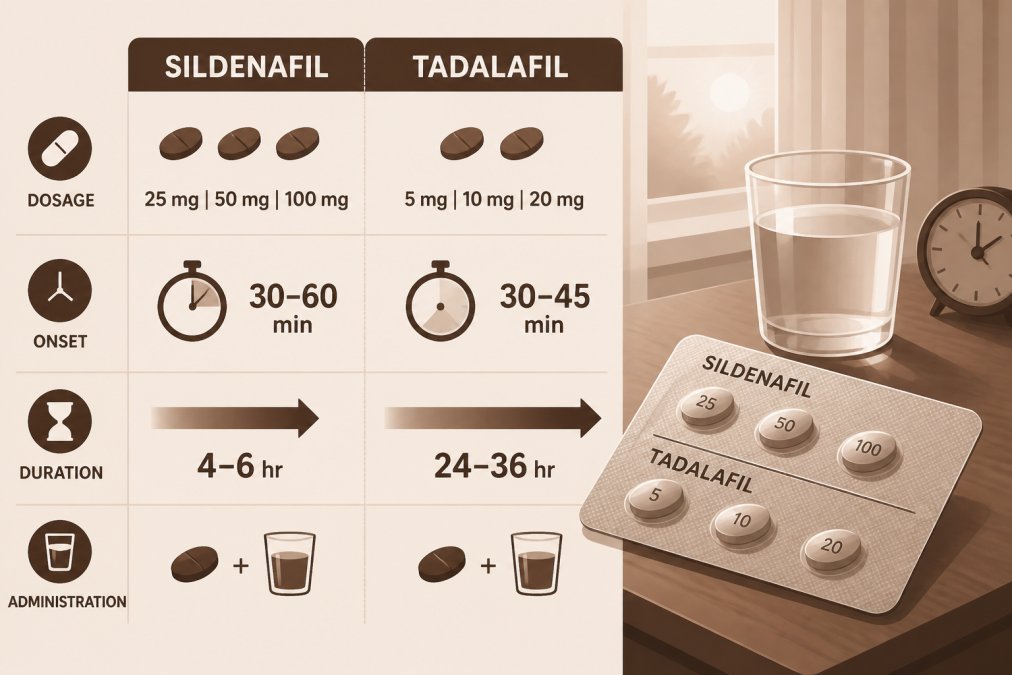
| Characteristic | Sildenafil | Tadalafil |
|---|---|---|
| Onset of Action | 30-60 minutes | 30-45 minutes (on-demand); 2-3 days (daily) |
| Duration | 4-6 hours | 24-36 hours (on-demand); continuous (daily) |
| Dosage Range | 25-100 mg | 5-20 mg |
| Food Impact | High-fat meals delay absorption | Minimal food interaction |
| Dosing Strategy | On-demand only | On-demand or daily |
| Common Side Effects | Headache, flushing, indigestion | Headache, back pain, muscle aches |
| Half-Life | 3-5 hours | 17-21 hours |
What Are PDE-5 Inhibitors and How They Work
PDE-5 inhibitors block phosphodiesterase type 5, an enzyme that breaks down cyclic guanosine monophosphate (cGMP) in the penis. By inhibiting this enzyme, these drugs allow cGMP to accumulate, triggering smooth muscle relaxation and increased blood flow to penile tissue. This vasodilation is essential for achieving and maintaining an erection in response to sexual stimulation.
Both sildenafil and tadalafil operate through this identical pathway but have different chemical structures, leading to different absorption rates, metabolism patterns, and duration of action. Importantly, these medications don’t cause spontaneous erections; they enhance the body’s natural erectile response when sexual activity is anticipated or occurring.
Many men find their response to sildenafil and tadalafil improves after the first few doses as confidence increases. Psychological factors, including performance anxiety, can significantly impact outcomes, so patience and realistic expectations matter.
Sildenafil vs Tadalafil Duration: Which Lasts Longer
Sildenafil reaches peak blood levels within 30-60 minutes and maintains effectiveness for approximately 4-6 hours. This short window means timing is critical: patients typically take it 30-60 minutes before anticipated sexual activity.
Tadalafil has a significantly longer half-life of 17-21 hours. The on-demand version reaches peak levels in 30-45 minutes but remains effective for 24-36 hours, giving patients much more flexibility. They can take tadalafil several hours before sexual activity without worrying about it wearing off.
For daily dosing, tadalafil offers continuous therapeutic benefit. A low daily dose (2.5-5 mg) maintains steady-state levels, allowing spontaneous sexual activity without advance planning. This regimen appeals particularly to men in committed relationships with regular sexual activity. Some men report better results after several weeks of daily tadalafil use.
Tadalafil’s longer action also allows for multiple episodes of sexual activity within a single dose window, which some men and their partners find advantageous.
Dosage, Administration, and Onset of Action
Sildenafil comes in standard doses of 25, 50, and 100 mg. Most patients start with 50 mg taken orally 30-60 minutes before sexual activity. Absorption is significantly delayed with high-fat meals, so clinicians recommend taking it on an empty stomach or after a light meal for optimal onset.
Tadalafil for on-demand use comes in 10 and 20 mg tablets, typically taken 30-45 minutes before sexual activity. For daily dosing, the standard dose is 2.5 or 5 mg once daily. Unlike sildenafil, tadalafil is not significantly affected by food intake, giving patients more flexibility in administration timing.
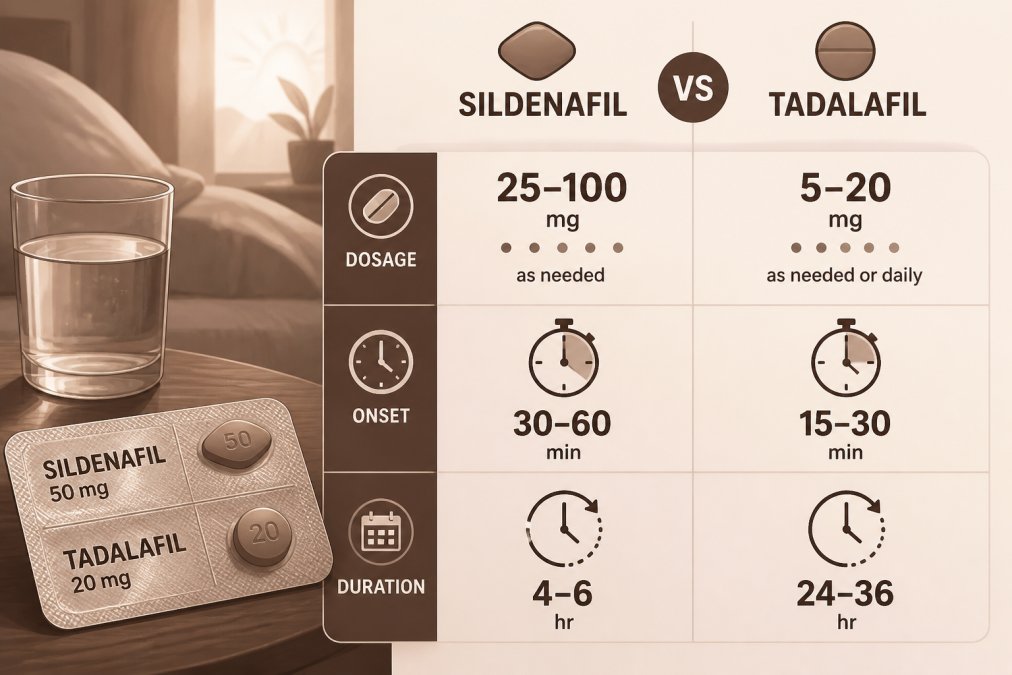
Both medications reach therapeutic levels within 30-60 minutes, though individual variation is significant. Factors affecting onset include stomach contents, liver function, age, and concurrent medications.
For on-demand dosing, the practical difference in onset between sildenafil and tadalafil is negligible. The real advantage of tadalafil is the extended duration, which eliminates the need to time medication intake precisely before sexual activity.
Side Effects of Sildenafil and Tadalafil: What to Expect
Both medications share a similar side effect profile because they work through the same mechanism, but frequency and severity differ. Common sildenafil side effects include headache (15-20% of users), flushing (10-15%), indigestion (5-10%), and nasal congestion (5-10%). These effects are generally mild and tend to decrease with repeated use.
Tadalafil users report a different pattern. Headache remains common, but back pain and muscle aches occur more frequently with tadalafil (10-15% of users), possibly related to its longer duration and continuous presence in the bloodstream. Dyspepsia and nasal congestion occur less frequently with tadalafil than with sildenafil.
Rare but serious adverse reactions include priapism (a prolonged, painful erection lasting more than 4 hours), which is a medical emergency. Sudden vision or hearing loss has been reported with PDE-5 inhibitors, though a direct causal relationship hasn’t been definitively established. Patients experiencing these symptoms should seek immediate medical evaluation.
Both medications can cause transient decreases in blood pressure, particularly when combined with nitrates (used for angina). This interaction can lead to dangerous hypotension and is an absolute contraindication.
Never combine sildenafil or tadalafil with nitrate medications (such as nitroglycerin, isosorbide dinitrate, or isosorbide mononitrate). This combination can cause severe, potentially life-threatening drops in blood pressure. Always inform your healthcare provider about all medications you’re taking before starting a PDE-5 inhibitor.
Drug Interactions and Contraindications
The most critical drug interaction involves nitrates. Patients taking any form of nitrate therapy should not use sildenafil or tadalafil because the combination can cause severe hypotension.
Other significant interactions include concurrent use of certain alpha-blockers (used for benign prostatic hyperplasia or hypertension). Medications like doxazosin, terazosin, and tamsulosin can potentiate the blood pressure-lowering effects of PDE-5 inhibitors. Careful dose adjustment and monitoring are necessary.
Ritonavir and other protease inhibitors used in HIV treatment significantly inhibit the metabolism of sildenafil and tadalafil, leading to dangerously high drug levels. Dose adjustments are essential. Similarly, other CYP3A4 inhibitors (including certain antifungals, antibiotics, and grapefruit juice) can increase PDE-5 inhibitor concentrations.
Absolute contraindications include recent myocardial infarction, unstable angina, uncontrolled hypertension, and certain cardiac arrhythmias. Severe hepatic or renal impairment also contraindicates use or requires significant dose adjustment.
Relative contraindications, conditions requiring caution but not necessarily prohibiting use, include diabetes, hypertension, hyperlipidemia, and smoking.
Can You Mix Sildenafil and Tadalafil Together
Combining sildenafil and tadalafil is generally not recommended because both medications work through the same mechanism (PDE-5 inhibition). Using them simultaneously would likely produce additive effects on blood pressure and side effects without proportional improvements in erectile function. The risk of hypotension, headache, and other adverse effects would increase substantially.
There are no established dosing guidelines for concurrent use because it’s not standard clinical practice. A patient who finds one medication inadequate would typically either increase the dose of that medication or switch to the alternative rather than combine them.
Do not attempt to combine sildenafil and tadalafil without explicit instruction from your healthcare provider. The additive effects on blood pressure and other physiological parameters could be dangerous. If one medication isn’t working adequately, discuss dose adjustment or switching to the alternative with your physician.
Daily vs On-Demand Dosing: Which Strategy Works Best
The choice between daily and on-demand dosing depends on sexual activity patterns, psychological comfort, and lifestyle preferences. Both approaches are clinically effective but create different psychological and practical experiences.
On-Demand Dosing: Flexibility and Control
On-demand dosing works well for men with infrequent or unpredictable sexual activity. Sildenafil’s 4-6 hour window requires advance planning, most men take it 30-60 minutes before anticipated sexual activity. This timing requirement can create “anticipatory anxiety”: the need to predict sexual activity in advance and manage medication timing around it.
Tadalafil’s 24-36 hour on-demand window substantially reduces this mental load. A man can take a 10 or 20 mg dose without knowing exactly when sexual activity will occur and remain therapeutically covered for the next day or more. This flexibility appeals to men who value spontaneity or whose sexual activity is unpredictable. The extended window also accommodates multiple episodes of sexual activity within a single dose period.
However, on-demand dosing carries a subtle psychological cost: each sexual encounter requires a conscious decision to “take medication.” Some men report this ritual creates a minor psychological barrier or reminds them of erectile dysfunction at moments they’d prefer to feel natural.
Daily Dosing: Spontaneity and Psychological Relief
Daily tadalafil dosing (2.5-5 mg once daily) is designed for men in committed relationships with regular sexual activity. This regimen maintains continuous therapeutic levels, eliminating the need to time medication around sexual activity. Many men report that daily dosing produces a meaningful psychological shift: sexual activity feels more natural and spontaneous because medication is already present.
This psychological benefit extends beyond convenience. Men using daily tadalafil often report reduced performance anxiety because they know therapeutic medication is continuously present. For men whose erectile dysfunction was partly driven by anxiety, this shift can be genuinely therapeutic.
Daily dosing also eliminates medication-related timing decisions from the relationship dynamic. Sexual activity can initiate naturally without either partner needing to pause for medication.
After 2-3 weeks of daily tadalafil, some patients notice additional improvement in erectile function beyond what on-demand dosing provides. This improvement may reflect improved vascular function from sustained PDE-5 inhibition, reduced anxiety from continuous medication coverage, or both.
Daily dosing does require consistent daily adherence. Men must remember to take medication every day, regardless of sexual activity frequency. For men with irregular sexual patterns, daily dosing may feel wasteful or burdensome. Insurance coverage and out-of-pocket cost also factor in; daily dosing requires consistent medication use, which may cost more depending on formulary status.
Sildenafil does not have an established daily dosing regimen comparable to tadalafil’s. The medication’s shorter half-life makes daily dosing impractical.
Practical Comparison: Activity Patterns and Preference
| Dosing Strategy | Best For | Psychological Advantage | Practical Trade-Off |
|---|---|---|---|
| Sildenafil on-demand | Infrequent sexual activity; men who prefer minimal daily medication | Medication only when needed; no daily adherence burden | Requires advance planning; shorter window limits spontaneity |
| Tadalafil on-demand | Moderate sexual activity; men who want flexibility without daily dosing | Extended window reduces planning burden; multiple episodes possible in one dose window | Still requires conscious decision before sexual activity |
| Tadalafil daily | Regular sexual activity; men in committed relationships; those seeking maximum spontaneity | Eliminates medication timing decisions; reduces performance anxiety; feels most natural; cumulative benefit possible | Requires daily adherence; may feel wasteful if sexual activity is infrequent; higher total medication cost |
Cost Considerations
On-demand dosing typically involves taking medication only when needed, potentially using less medication overall if sexual activity is infrequent. Daily tadalafil requires consistent daily use regardless of sexual activity frequency, which may cost more depending on insurance coverage. However, some insurance plans cover daily tadalafil at a lower per-dose cost than on-demand dosing, making daily use more economical for men with regular sexual activity. Discuss cost implications with your healthcare provider and insurance plan before committing to a dosing strategy.
Many men benefit from starting with on-demand dosing to assess efficacy and side effect tolerance, then transitioning to daily dosing if sexual activity is regular and on-demand timing becomes burdensome. This sequential approach allows you to experience both strategies and choose based on real-world preference.
Choosing Between Sildenafil and Tadalafil: Key Factors
The decision between sildenafil and tadalafil should be individualized based on medical history, sexual activity patterns, side effect tolerance, and lifestyle preferences.
Timing and Flexibility
If you want maximum flexibility and don’t mind planning medication use, sildenafil’s 4-6 hour window is adequate for scheduled sexual encounters. If you prefer not to time medication around sexual activity, tadalafil’s 24-36 hour on-demand window is superior. If you’re in a relationship with regular sexual activity and value spontaneity, daily tadalafil is worth considering, many men report that continuous medication coverage feels more natural than on-demand dosing.
Food Interactions
Sildenafil requires careful attention to food intake. High-fat meals significantly delay absorption and reduce peak blood levels, potentially reducing efficacy. Most clinicians recommend taking sildenafil on an empty stomach or after a light meal for optimal onset.
Tadalafil’s minimal food interaction is a substantial practical advantage. You can take tadalafil with or without food, with or without alcohol (in moderation), without worrying about absorption delays. This flexibility is particularly valuable for men whose sexual activity is spontaneous or unpredictable.
Side Effect Profile
Both medications share similar side effects because they work through the same mechanism, but frequency and severity differ:
- Headache: Common with both (15-20% for sildenafil, 10-15% for tadalafil). If you’re sensitive to headaches, sildenafil may carry slightly higher risk.
- Flushing: More common with sildenafil (10-15%) than tadalafil. Flushing typically decreases with repeated use.
- Indigestion: More common with sildenafil (5-10%) than tadalafil. If you have a history of acid reflux, tadalafil may be better tolerated.
- Back pain and muscle aches: More common with tadalafil (10-15%), particularly in the lower back. If you have a history of back pain, sildenafil may be preferable.
- Nasal congestion: Occurs with both but is less frequent with tadalafil.
Individual variation is significant; if one medication causes unacceptable side effects, the other often produces a different profile that may be tolerable.
Cardiovascular Status
Both medications are generally safe for men with well-controlled cardiovascular disease, but individual assessment is essential. Men with significant cardiac history should use whichever medication their cardiologist recommends after careful evaluation. Absolute contraindications (such as concurrent nitrate use) apply equally to both medications.
Cost and Insurance
Depending on your insurance plan, one medication may have significantly better coverage or lower out-of-pocket cost. Generic sildenafil and generic tadalafil are both widely available and relatively affordable. Discuss copay and coverage details with your insurance plan before starting treatment.
Previous Experience
If you’ve tried one medication before, your experience matters. Some men respond better to one agent than the other. However, past side effects shouldn’t completely rule out a medication; side effects that were problematic at one dose might be tolerable at a lower dose or may diminish with repeated use. If you experienced inadequate efficacy with one medication, the other often produces better results.
Transitioning Between Medications: A Practical Guide
If you try one medication and experience unacceptable side effects or inadequate efficacy, switching to the other is a reasonable next step. Most men find an effective option after trying one or both medications with appropriate dose adjustment.
If switching from sildenafil to tadalafil:
- Timing: You can switch immediately. Sildenafil’s short half-life means it clears quickly.
- Dose selection: Start with tadalafil 10 mg on-demand, taken 30-45 minutes before sexual activity. If efficacy is inadequate after 2-3 attempts, increase to 20 mg. If interested in daily dosing, start with 2.5 mg daily for 2-3 weeks before assessing efficacy.
- Side effect assessment: Give tadalafil at least 2-3 attempts before concluding it’s ineffective. If you experienced headache or flushing with sildenafil, tadalafil may produce a different profile that’s more tolerable.
If switching from tadalafil to sildenafil:
- Timing: If you were using on-demand tadalafil, you can switch immediately. If you were using daily tadalafil, wait at least 24 hours after your last dose before starting sildenafil.
- Dose selection: Start with sildenafil 50 mg, taken on an empty stomach or after a light meal, 30-60 minutes before sexual activity. If efficacy is inadequate, increase to 100 mg. If side effects are problematic, reduce to 25 mg.
- Food management: Remember that high-fat meals significantly delay sildenafil absorption. Ensure you’re taking it on an empty stomach or after a light meal.
If neither medication works adequately:
- Dose optimization: Ensure you’ve tried adequate doses. Sildenafil should be tried at 100 mg; tadalafil should be tried at 20 mg on-demand or 5 mg daily for at least 2-3 weeks.
- Psychological factors: Erectile dysfunction often has a psychological component. Performance anxiety, relationship stress, or depression can reduce medication efficacy. Discussing these with your healthcare provider may be as important as optimizing medication.
- Alternative treatments: If PDE-5 inhibitors are ineffective or contraindicated, other treatments exist, including vacuum erection devices, penile injections (alprostadil), and other medications.
Most men find an effective medication and dose after trying one or both PDE-5 inhibitors with appropriate adjustment. If your first choice doesn’t work, switching to the alternative is a reasonable next step, don’t assume PDE-5 inhibitors won’t work for you based on a single medication trial.
Working with Your Healthcare Provider
Many patients benefit from working with a healthcare provider who can assess their individual medical situation, discuss these factors, and monitor response to treatment. This personalized approach is more effective than self-selection based on general information. Your provider can also help you navigate insurance coverage, discuss cost options, and adjust doses or switch medications based on your real-world experience.
Conclusion
Sildenafil and tadalafil represent two effective but distinct approaches to treating erectile dysfunction through PDE-5 inhibition. Sildenafil offers rapid onset and a shorter duration suitable for men with infrequent sexual activity, while tadalafil provides extended effectiveness and a daily dosing option for men seeking spontaneity and continuous therapeutic coverage. Both medications carry similar contraindications and require careful evaluation of cardiovascular status and concurrent medications.
The choice between these medications should be made in consultation with a qualified healthcare provider who understands your complete medical history. Ascend Vitality connects you with specialized care providers who can assess your individual needs, discuss the advantages and limitations of each medication, and monitor your response to treatment. Whether you ultimately choose sildenafil, tadalafil, or another treatment approach, professional medical guidance ensures you receive safe, effective care tailored to your specific situation.
Frequently Asked Questions
What happens when you take tadalafil and sildenafil together?
Taking both PDE-5 inhibitors simultaneously increases the risk of serious adverse reactions, including severe hypotension, priapism, and cardiovascular complications. Combining these medications is not recommended and should never be done without explicit physician approval. If you’re considering switching between sildenafil and tadalafil, consult your healthcare provider about safe transition timing based on each drug’s half-life and your individual health profile.
Which is better to take, sildenafil or tadalafil?
Neither is universally ‘better’, the choice depends on your lifestyle and preferences. Sildenafil works faster (30-60 minutes) but lasts 4-6 hours, making it ideal for planned encounters. Tadalafil takes 30 minutes to 2 hours but lasts up to 36 hours, offering flexibility for spontaneity or daily low-dose use. Your physician can help determine which aligns with your sexual health goals and medical history.
How long do sildenafil and tadalafil work?
Sildenafil typically remains effective for 4-6 hours after administration, with peak efficacy around 60 minutes. Tadalafil’s therapeutic window extends to 24-36 hours, with effectiveness beginning within 30 minutes to 2 hours. The extended duration of tadalafil makes it suitable for daily dosing regimens, while sildenafil’s shorter half-life is better suited to on-demand use before specific occasions.
Do sildenafil and tadalafil require a prescription?
Yes, both sildenafil and tadalafil are prescription medications in the United States. They require evaluation by a licensed healthcare provider to ensure they’re appropriate for your health status, especially given potential contraindications with nitrates and other cardiovascular medications. Online platforms like Ascend Vitality connect you with qualified physicians who can review your medical history and issue prescriptions delivered discreetly to your home.