

3-3-3 Rule vs Intermittent Fasting: Side-by-Side Comparison
When evaluating dietary approaches for weight loss and metabolic health, the 3-3-3 rule vs intermittent fasting comparison reveals two fundamentally different philosophies about creating a caloric deficit. The 3-3-3 rule emphasizes three balanced meals daily, while intermittent fasting concentrates eating into specific windows and leverages extended fasting periods. Success depends on matching the protocol to individual metabolism, work schedule, and psychological barriers to adherence.
Quick Comparison Table
| Aspect | 3-3-3 Rule | Intermittent Fasting |
|---|---|---|
| Meal Frequency | Three meals daily | 1-2 eating windows per day |
| Caloric Structure | Distributed across meals | Concentrated in eating window |
| Fasting Windows | None (continuous eating) | 12-20 hours typically |
| Hunger Management | Frequent small meals | Extended fasts train appetite suppression |
| Metabolic Approach | Daily caloric deficit | Caloric deficit + fasting adaptation |
| Ease of Social Eating | High (aligns with social meals) | Moderate (requires planning) |
| Sustainability | High for traditional eaters | High for naturally skippers |
| Adherence Rate | Better for frequent meal eaters | Better for those who dislike breakfast |
Understanding the 3-3-3 Diet Plan Rules
The 3-3-3 rule is a structured eating framework designed to simplify caloric deficit creation while maintaining stable blood sugar and consistent energy throughout the day. You eat three balanced meals spaced roughly three hours apart, ensuring each meal contains protein, carbohydrates, and healthy fats.
How the 3-3-3 Rule Works
A typical 3-3-3 day might look like breakfast at 7 AM, lunch at noon, and dinner at 6 PM. Each meal should contain approximately one-third of your daily caloric intake. The appeal lies in simplicity and alignment with traditional social meal structures. If your family eats dinner together at 6 PM, the 3-3-3 rule doesn’t create friction like fasting might.
The “three hours” spacing is flexible. What matters is consistency and finding a schedule you can sustain for months, not weeks.
Caloric Deficit and Daily Eating Patterns
Weight loss requires a caloric deficit, and the 3-3-3 rule creates one through portion control and meal composition rather than meal timing. If your maintenance calories are 2,400 per day, a 3-3-3 approach might target 1,800-2,000 calories split as 600-667 per meal. This distribution keeps hunger manageable because you’re eating frequently enough that your stomach never feels completely empty.
Research shows that people eating three meals per day experience fewer cravings than those attempting extreme caloric restriction in fewer eating windows. Your body doesn’t enter a “deprivation mindset” when you know another meal is coming in three hours. The eating pattern also supports stable energy for physical activity, a person doing strength training at 5 PM has eaten lunch at noon and can fuel that workout without fasting.
Intermittent Fasting Schedules for Beginners
Intermittent fasting is a time-restriction strategy that concentrates eating into a specific window and fasts during remaining hours. The core principle leverages the theory that extended fasting periods allow insulin levels to drop sufficiently that your body shifts toward fat burning.
Popular Fasting Protocols Explained
The most common protocol is 16:8, fasting for 16 hours and eating within an 8-hour window. Someone practicing 16:8 might skip breakfast, eat their first meal at noon, and finish eating by 8 PM. Other protocols include 5:2 (eating normally five days, restricting calories to 500-600 on two non-consecutive days) and OMAD (one meal a day).
Each protocol works through the same mechanism: caloric deficit. A 16:8 faster eating 2,000 calories in an 8-hour window creates the same deficit as a 3-3-3 eater consuming 2,000 calories across three meals, assuming both maintain the same total intake.
Intermittent fasting doesn’t require eating fewer total calories to work, it works because most people naturally eat fewer calories when they have fewer eating opportunities. If you eat the same total calories in a compressed window, [weight loss](/oral-peptides-womens-weight-loss/) won’t accelerate compared to traditional meal timing.
Fasting Windows and Meal Frequency
The fasting window is the period where you consume zero calories (though black coffee, tea, and water are typically allowed). During this window, your insulin levels drop, and theoretically, your body becomes more efficient at burning stored fat. Meal frequency within the eating window varies, some people eat one large meal, others eat multiple smaller meals. Research suggests meal frequency within the eating window doesn’t significantly impact weight loss outcomes; total caloric intake matters most.
Is the 3-3-3 Rule Effective? Evidence and Outcomes
The 3-3-3 rule’s effectiveness for weight loss is well-established because it’s fundamentally a caloric deficit approach with structure. The real question is whether the 3-3-3 structure produces more sustainable weight loss than alternatives.
Weight Loss and Body Composition Results
Studies comparing meal frequency show minimal differences in total weight loss when total calories are equal. However, body composition outcomes may differ. The 3-3-3 approach, combined with adequate protein intake, supports muscle retention during a caloric deficit. Research suggests that distributed protein intake across multiple meals optimizes muscle protein synthesis better than concentrated protein in one or two meals. A person following 3-3-3 might lose 20 pounds over 12 weeks and retain most of their muscle, appearing more toned than someone who lost the same weight through more aggressive fasting.
Metabolic Health Markers
The 3-3-3 rule maintains more stable blood glucose throughout the day, which appeals to people managing prediabetes or metabolic syndrome. Intermittent fasting produces different metabolic effects, extended fasting periods lower insulin levels more dramatically. However, this benefit appears largely driven by the caloric deficit and weight loss, not the fasting itself. When researchers compare isocaloric fasting to traditional meal timing, the metabolic advantage of fasting largely disappears.
Pros and Cons of 3-3-3 Diet vs Intermittent Fasting
3-3-3 Rule: Advantages and Limitations
The primary advantage is simplicity and social compatibility. You eat three meals, like most humans throughout history. You can eat with family, attend restaurant dinners, and participate in workplace lunches without explaining your dietary approach.
The second advantage is sustained energy for active people. Athletes and those doing intense training often perform better with fuel distributed throughout the day. The third advantage is lower barrier to entry, you don’t need to learn about fasting windows or manage hunger during extended fasting periods.
The limitations are equally real. The 3-3-3 rule requires discipline at every meal. Additionally, if you naturally skip breakfast or eat late dinners, forcing yourself into a 3-3-3 structure creates unnecessary friction.
The biggest mistake people make with 3-3-3 is treating it as permission to eat anything in three meals. The rule still requires caloric discipline. A person eating 2,400 calories across three meals won’t lose weight if their maintenance is 2,400 calories.
Intermittent Fasting: Advantages and Limitations
The primary advantage is simplicity of decision-making. You don’t eat during fasting hours; the decision is made. This removes the temptation to snack or graze. For people with weak impulse control around food, this structure is liberating.
The second advantage is flexibility within the eating window. You can eat what you want during your eating hours without worrying about meal timing or macronutrient distribution. The third advantage is potential appetite suppression, many people report that fasting reduces their overall appetite and hunger hormones by week 3-4.
The limitations are substantial. Intermittent fasting is difficult for people with active jobs, athletes, or those prone to overeating in their eating window. If you work a physical job and fast until 2 PM, your energy and performance suffer. Additionally, intermittent fasting creates social friction, you can’t eat breakfast with your family or participate in office lunches.
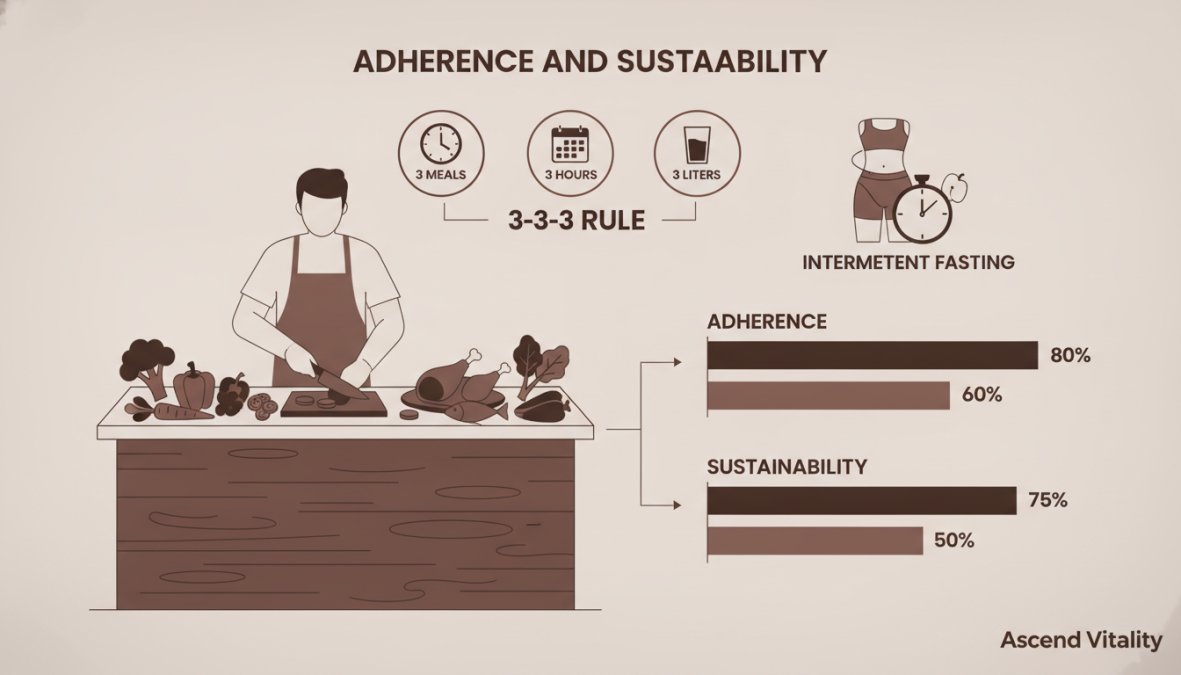
Adherence and Sustainability: Which Approach Lasts?
Both approaches produce weight loss when calories are controlled. The winner is whichever you actually stick to for months and years.
Hunger Management and Psychological Barriers
The 3-3-3 rule manages hunger through frequent eating. Your stomach never fully empties, and hunger signals remain moderate. This suits people who experience intense hunger or have a history of restrictive dieting followed by binge eating.
Intermittent fasting manages hunger differently, it trains your body to tolerate extended periods without food. Your hunger hormones adapt, and by week 4, many people report that fasting feels normal. The psychological barrier for 3-3-3 is boredom. The psychological barrier for intermittent fasting is the first 2-3 weeks, when your body protests the new schedule.
Long-Term Compliance and Lifestyle Fit
Research into long-term dietary compliance shows that the best diet is the one you’ll follow for years. People maintaining weight loss long-term reported choosing approaches that aligned with their natural eating patterns, not approaches that required constant willpower.
If you naturally skip breakfast and prefer eating fewer, larger meals, intermittent fasting will feel sustainable. If you naturally eat three meals and enjoy frequent eating, the 3-3-3 rule will feel sustainable. Fighting your natural inclinations produces short-term compliance followed by burnout.
Choose 3-3-3 if: You eat breakfast regularly, enjoy frequent meals, have an active job or training schedule, or have a history of intense hunger between meals.Choose intermittent fasting if: You naturally skip breakfast, prefer simplicity, have a sedentary job, or find constant eating decisions exhausting.
Isocaloric Comparison: Calorie Restriction vs Fasting Windows
When researchers compare an isocaloric diet (same total calories) between a 3-3-3 approach and an intermittent fasting approach, the weight loss results are nearly identical. A meta-analysis examining intermittent fasting versus continuous calorie restriction found no significant difference in weight loss or fat loss when total calories were equal.
This is crucial because it means the “best” approach isn’t determined by physiology; it’s determined by psychology. Your metabolism doesn’t care whether you eat at 12 PM and 6 PM or 7 AM, 12 PM, and 6 PM. Your adherence does care. Your hunger management does care. Your energy levels do care.
The implication: stop searching for the metabolically superior approach and start identifying which approach you’ll actually follow.
Choosing Your Protocol: Individualized Selection Framework
Rather than asking “which is better?” ask “which is better for me?”
Assessment Criteria for Your Lifestyle
Work Schedule: If your job is physically demanding, the 3-3-3 rule likely suits you better. If your job is sedentary, either approach works. If you have irregular hours, intermittent fasting’s flexibility may be advantageous.
Social Eating: If you have frequent business lunches or family dinners, the 3-3-3 rule minimizes friction. If you’re comfortable explaining your eating pattern, intermittent fasting works fine.
Hunger Patterns: If you experience intense hunger or have a history of binge eating, the 3-3-3 rule’s frequent meals provide safety. If you rarely feel hungry or naturally skip meals, intermittent fasting aligns with your body’s preferences.
Training Schedule: If you do intense strength training or endurance sports, the 3-3-3 rule’s distributed fuel supports performance. If you do light activity or prefer fasted training, intermittent fasting works.
Common Myths About Fasting and Meal Timing
Myth 1: Eating frequently boosts metabolism. False. Your metabolic rate is determined primarily by body composition, age, and genetics, not meal frequency.
Myth 2: Fasting puts you in ketosis immediately. Your body enters ketosis after roughly 12-16 hours of fasting, but this doesn’t mean fat burning is accelerated. You burn fat because you’re in a caloric deficit.
Myth 3: You can’t build muscle while fasting. False. You can build muscle on intermittent fasting if you consume adequate protein during your eating window and do resistance training.
Myth 4: Skipping breakfast slows your metabolism. False. Skipping breakfast doesn’t harm your metabolism or metabolic rate.
Myth 5: The 3-3-3 rule is scientifically proven superior. False. Its effectiveness comes from creating a caloric deficit and supporting adherence, not from meal timing itself.
Medical Support and Professional Guidance
Both the 3-3-3 rule and intermittent fasting can be implemented safely for most people, but certain populations should consult healthcare providers first. People with diabetes (especially those on insulin), a history of eating disorders, or pregnant or nursing individuals should seek medical guidance before starting either approach.
Professional support ensures the approach is safe for you, adjusts the protocol if side effects emerge, and provides accountability that significantly improves long-term results. Research consistently shows that medically-supported weight loss programs produce better sustained outcomes than self-directed approaches, regardless of which eating pattern you choose.
The choice between the 3-3-3 rule and intermittent fasting isn’t about which is objectively superior, it’s about which fits your life, preferences, and psychology. Both create weight loss through caloric deficit. Both can be sustained long-term. The real decision is identifying which approach you’ll actually follow for months, not which one sounds better in theory. If you’re struggling to choose or want personalized guidance based on your health markers, professional support can assess your individual needs and provide oversight throughout your journey.
Frequently Asked Questions
What is the 3-3-3 rule for weight loss?
The 3-3-3 rule is a daily calorie restriction method that divides your eating into three structured meals with consistent portion sizes. It emphasizes regular meal frequency to manage hunger hormones and maintain steady energy levels throughout the day. This approach relies on a consistent caloric deficit achieved through portion control rather than time-restricted eating windows, making it straightforward for those who prefer predictable meal schedules.
How does intermittent fasting differ from the 3-3-3 rule?
Intermittent fasting uses designated fasting windows and eating periods (like 16:8 or 4:3 protocols) rather than daily calorie restriction. While both create a caloric deficit for weight loss, intermittent fasting emphasizes when you eat, whereas the 3-3-3 rule focuses on meal frequency and portion consistency. Fasting regimens may influence hunger hormones and metabolic health markers differently, though both can be effective for fat mass reduction when sustained.
Which approach is easier to sustain long-term?
Adherence depends on individual lifestyle and psychology. The 3-3-3 rule suits those who prefer regular meal structure and struggle with hunger during fasting windows. Intermittent fasting appeals to people who find fewer eating periods simpler and enjoy the flexibility of fasting windows. Research on fasting regimens shows sustainability relates more to personal fit than the protocol itself, the best approach is the one you can maintain consistently while managing hunger and meeting nutritional needs.
Can you combine the 3-3-3 rule with intermittent fasting?
Yes, some people integrate both approaches by using intermittent fasting windows (like 16:8) while maintaining structured, portion-controlled meals during eating periods. This hybrid method combines time-restricted eating with meal frequency discipline. However, combining protocols requires careful planning to ensure adequate protein intake, micronutrient density, and overall caloric balance. Consulting a healthcare provider is recommended before merging multiple fasting regimens.