

Table of Contents
- Why Timing Matters for NAD Supplements
- Circadian Rhythm and NAD+ Metabolism: The Biological Clock Connection
- Morning vs. Night: What the Evidence Says About NAD Supplements
- NAD+ Dosage Guidelines: How Much and How Often
- Fasted vs. Fed: Does Stomach State Change Absorption?
- NAD+ Side Effects and Safety: What to Watch For
- Form-Factor Timing: Sublingual, Oral, and IV NAD+
- Age, Exercise, and Supplement Stacking: Timing Adjustments That Matter
- Fasted vs. Fed: Does Stomach State Change Absorption?
- NAD+ Side Effects and Safety: What to Watch For
- Form-Factor Timing: Sublingual, Oral, and IV NAD+
- Age, Exercise, and Supplement Stacking: Timing Adjustments That Matter
- Frequently Asked Questions
Last Updated: September 26, 2026
Why Timing Matters for NAD Supplements
NAD+ is a coenzyme your cells use to convert food into energy, and its levels fall as you age. The best time to take NAD supplements is generally in the morning, when natural NAD+ production peaks and precursor absorption is most efficient. This guide from Ascend Vitality covers circadian biology, dosage, form factor, and how NAD supplements interact with your daily regimen.
Timing does not work like a light switch. NAD+ is not a stimulant that hits in 20 minutes and fades by lunch; it supports cellular energy through precursor pathways that build over days and weeks. The “best” time is the one you can repeat every day without fail.
Get the timing roughly right and stay consistent, and you capture most of the benefit. Chasing a perfect window while skipping doses is worse than an imperfect schedule you never miss.
Consistency beats precision. A daily NAD+ routine at 7 AM you never skip outperforms a “perfectly timed” dose you take three days a week.
Circadian Rhythm and NAD+ Metabolism: The Biological Clock Connection
Your circadian rhythm is the internal 24-hour clock governing sleep, hormones, body temperature, and metabolism. NAD+ metabolism is wired directly into that clock: the same enzymes that build NAD+ also regulate the proteins controlling your sleep-wake cycle.
Research into NAD+ and biological aging, such as work published through NIH’s National Institute on Aging, has mapped how NAD+ levels rise and fall across the day. In most people, cellular NAD+ peaks in the morning and declines through the afternoon and evening. Dosing a precursor when your natural levels are already climbing works with that curve rather than against it.
The real mechanism is alignment: you want precursor availability to match the windows when your cells are most actively using NAD+ for repair and energy production.
Morning vs. Night: What the Evidence Says About NAD Supplements
Morning dosing aligns with your body’s natural NAD+ peak, while evening dosing risks interfering with the wind-down phase your cells need for sleep.

The Case for Morning Dosing
NAD+ supports mitochondrial function, the process your cells use to generate ATP. Mitochondria are most active during waking hours, so morning NAD supplements make precursors available when demand peaks.
Most clinicians who work with NAD+ therapy land on a morning window, often within the first few hours of waking, or a broader morning-to-early-afternoon range. The dose should be early enough to support daytime energy but not so late it bleeds into your sleep window. Aligning your oral supplementation with these natural circadian rhythms mirrors the systemic approach found in IV therapy benefits, which can provide a more direct method for addressing cellular fatigue.
When Evening Dosing Backfires
A common mistake is treating NAD+ like a sleep aid. It supports cellular energy production, which for some people means feeling wired when they should be winding down.
The risk is not danger but sleep disruption in people sensitive to stimulation. Poor sleep then undermines metabolic health and cellular repair, the exact processes you are trying to support.
Taking NAD+ precursors within a few hours of bedtime can disrupt sleep in sensitive individuals. The consequence is a net negative: you lose the recovery benefit you were chasing in the first place.
NAD+ Dosage Guidelines: How Much and How Often
Dosage depends on the precursor, so there is no universal number. The three most common are nicotinamide riboside (NR), nicotinamide mononucleotide (NMN), and plain nicotinamide. They are not interchangeable.
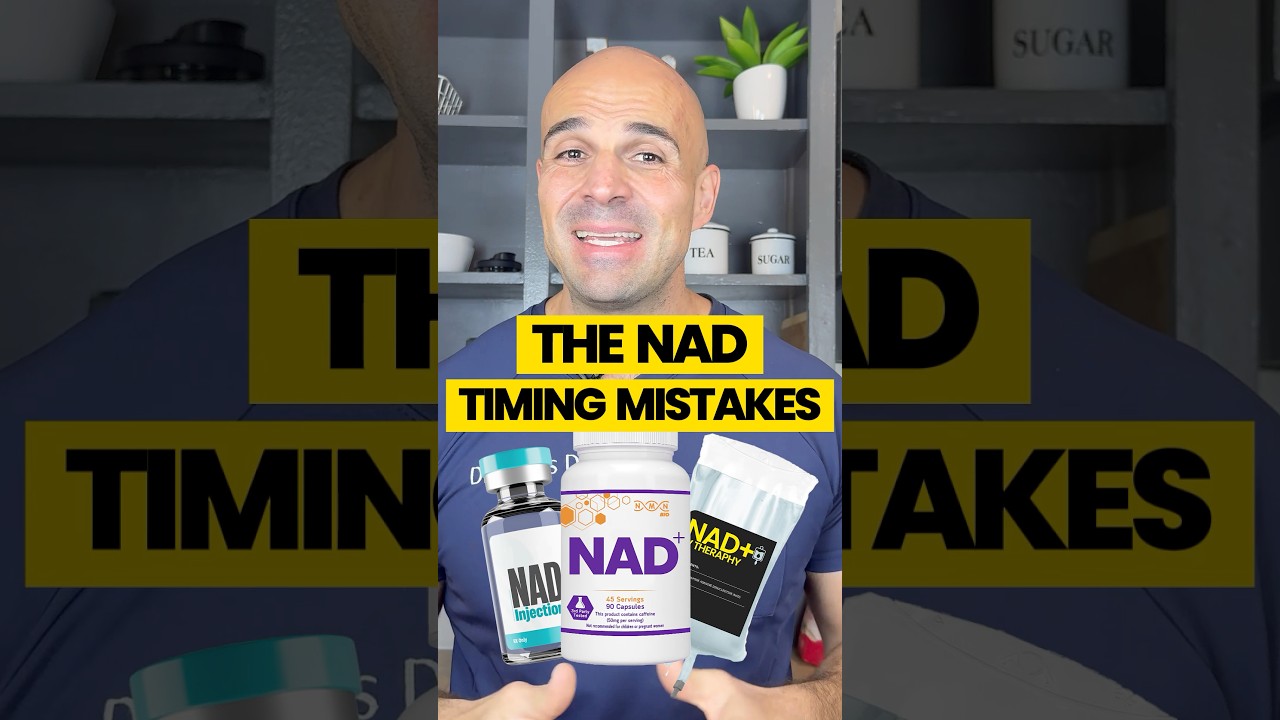
Are You Taking NAD+ at The Right Time? ⏰🤔 #peptides
Dr. Jones, DC
A practical framework looks like this:
- NR (nicotinamide riboside). Commonly sold in 125 mg, 250 mg, and 300 mg capsules. Many users land in the 250-600 mg per day range, often split into two doses. NR is the most studied of the oral precursors, so the dosing conversation tends to be more settled than for NMN.
- NMN (nicotinamide mononucleotide). Commonly sold in 125 mg, 250 mg, and 500 mg capsules. Many users land in the 250-500 mg per day range. NMN is typically taken as a single morning dose, which is part of why it dominates the timing conversation.
- Nicotinamide. Older and cheaper, but at higher doses it can inhibit the very enzymes (sirtuins and PARPs) you are trying to support. This is the one precursor where more is genuinely not better, and where a clinician’s input matters most.
What matters more than hitting an exact milligram target is choosing a dose you can take consistently and adjusting with professional guidance.
Why frequency and timing are the same question
NAD+ precursors have a short half-life in the bloodstream, hours, not days. That fact drives most timing advice: a single large morning dose and a split morning-plus-early-afternoon dose produce different curves of precursor availability across your waking hours.
The ‘take it in the morning’ rule really means ‘take it early enough that a second dose still lands before mid-afternoon.’ A 7 AM and 1 PM split keeps precursor availability elevated through the working day; a 7 AM and 6 PM split pushes the second half into your wind-down window, where sleep complaints come from.
A simple titration schedule
- Weeks 1-2: Start at the lower end of whatever range your product or clinician suggests. Take it at the same time every morning. Do not change anything else.
- Weeks 3-4: If you tolerate it well and notice nothing negative, consider moving toward the middle of the range. If you are splitting doses, add the second dose now, not earlier.
- Ongoing: Keep the time fixed. Same window each morning trains your routine and reduces missed doses.
- Quarterly: Reassess. Baseline levels and needs shift with age, activity, and health status.
If you are working with a medical provider, they may adjust your dose based on how you respond and any labs they order. Do not stack multiple NAD+ precursors on your own without guidance, because more is not automatically better, and because the precursors compete for some of the same conversion enzymes.
Pick the precursor first, then the dose, then the time. Reversing that order is how people end up taking an NMN dose at 9 PM and wondering why they are awake at midnight.
Fasted vs. Fed: Does Stomach State Change Absorption?
Stomach state matters less for NAD+ than it does for many supplements, but it is not irrelevant. Some precursors are taken on an empty stomach to support absorption rate, while others are better tolerated with food.
The fasted-state argument centers on bioavailability. Taking a supplement on an empty stomach can support faster absorption into the bloodstream for some compounds. The trade-off is tolerability: some people experience nausea or stomach discomfort when they dose fasted.
Here is the practical call. If you tolerate it, taking NAD supplements in the morning before breakfast fits neatly into a fasted window and pairs well with the circadian logic. If it upsets your stomach, take it with a light meal. The absorption difference is usually smaller than the difference between taking it daily and forgetting it half the week.
| Scenario | Best Approach | Why |
|---|---|---|
| No stomach sensitivity | Fasted, first thing in the morning | Supports absorption rate and matches circadian peak |
| Mild nausea when fasted | With a light breakfast | Tolerability matters more than a marginal absorption gain |
| Taking other morning meds | Space them per your provider’s guidance | Avoids interaction and absorption conflicts |
| Late riser with a tight routine | Within one hour of waking | Preserves the morning window without disrupting your schedule |
NAD+ Side Effects and Safety: What to Watch For
NAD+ supplements are generally well tolerated, but “generally” is doing real work in that sentence. Reported side effects include nausea, stomach upset, fatigue, and headache, and they tend to show up more often with higher doses or fasted dosing in sensitive people.
The most discussed concern is sleep disruption, which circles back to timing. If you notice you are falling asleep later or waking more during the night, move your dose earlier before you change anything else. That single adjustment resolves the issue for many people.
Safety also depends on your health context. If you take prescription medications, have a thyroid condition, or manage a chronic illness, talk to a qualified professional before starting. NAD+ precursors can interact with other supplements and medications, and no online guide can assess your specific situation. For general safety framing, the FDA’s guidance on dietary supplements is a reasonable starting reference, but your own clinician is the authority here.
Change one variable at a time. If you are troubleshooting sleep or stomach issues, adjust only the timing first. Changing dose, form, and timing at once tells you nothing about what actually caused the problem.
Form-Factor Timing: Sublingual, Oral, and IV NAD+
How you take NAD+ changes when you should take it. This is the angle most timing guides ignore entirely, and it matters.
- Oral capsules pass through the digestive system, so absorption is slower and less complete. Take them with the fasted-versus-fed trade-off in mind, and expect the effect to build over weeks.
- Sublingual forms dissolve under the tongue and enter the bloodstream more directly, which can mean faster onset. Morning dosing still makes sense, but the window is a little more forgiving.
- IV therapy delivers NAD+ straight into the bloodstream under professional supervision. Timing is set by your provider, and sessions are scheduled rather than self-administered.
The takeaway: match your timing strategy to your delivery method, not to a generic rule. A sublingual dose and an oral capsule do not behave the same way, so the “ideal” hour shifts with the form.
Age, Exercise, and Supplement Stacking: Timing Adjustments That Matter
Three factors change the timing calculus more than most people realize: your age, when you train, and what else you take.
Age-specific timing protocols
NAD+ levels decline with age, but not linearly, and the timing implication differs between a 35-year-old and a 65-year-old.
In your 30s and early 40s. Baseline NAD+ is still relatively robust, so the goal is maintenance, not rescue. A single morning dose at roughly the same time each day is usually enough. The main risk is inconsistency, travel, late nights, and skipped weekends erode the routine more than any timing error.
In your 50s. The decline becomes more noticeable and sleep architecture more fragile. This is when evening dosing backfires most often, a 6 PM dose tolerated at 40 may keep you up at 55. Move the dose earlier, not later, as you age.
In your 60s and beyond. Absorption efficiency tends to decline, which is why sublingual and IV forms get more attention in this group. Many people also take prescription medications, raising the interaction stakes. A rigid, early, consistent window, and a clinician who knows your medication list, matters most here.
Exercise timing
If you train in the morning, dosing 30-60 minutes beforehand can support the session’s energy demands, the precursor needs time to convert.
If you train in the evening, take your NAD+ in the morning anyway and let the effect build, rather than dosing right before a late workout and risking stimulation at bedtime. The workout itself is a strong enough NAD+ stimulus; you do not need to stack the supplement on top of it at 8 PM.
Supplement stacking: the part most guides skip
NAD+ precursors are rarely taken alone. The common stacks are NR or NMN with resveratrol, and NR or NMN with trimethylglycine (TMG). Each changes the timing picture.
NAD+ + resveratrol. Resveratrol is often taken with a fat source because it is poorly absorbed alone, and many users take it in the morning alongside the NAD+ precursor. Both target the same sirtuin pathways, so the same window keeps the signals aligned. Taking resveratrol late in the evening, after a 7 AM NAD+ dose, splits the pair for no clear benefit.
NAD+ + TMG. TMG (trimethylglycine) supports methylation, because high-dose nicotinamide can consume methyl groups. It is typically split across the day with meals, so it does not need to be pinned to your NAD+ window. Take the NAD+ precursor in the morning and TMG with meals as directed.
NAD+ + stimulants. If you already take a stimulant-heavy stack, caffeine, green tea extract, yohimbine, or a pre-workout, adding NAD+ at night is a recipe for poor sleep. Space your supplements and introduce one at a time.
Do not add a second NAD+ precursor to ‘top up’ your stack. NR and NMN compete for some of the same conversion enzymes, so stacking them does not simply add their effects, it can waste both. Pick one precursor, then build the rest of the stack around it.
For a broader look at how supplements interact with the body’s daily rhythms, Harvard Health’s coverage of circadian rhythm and health is a useful primer.
If you want personalized guidance rather than a general framework, Ascend Vitality connects you with licensed providers who can review your health history, medications, and goals before recommending a protocol. That matters most when you are stacking supplements or managing a chronic condition, where a one-size-fits-all answer can do more harm than good.
Fasted vs. Fed: Does Stomach State Change Absorption?
Stomach state matters less for NAD+ than it does for many supplements, but it is not irrelevant. Some precursors are taken on an empty stomach to support absorption rate, while others are better tolerated with food.
The fasted-state argument centers on bioavailability. Taking a supplement on an empty stomach can support faster absorption into the bloodstream for some compounds. The trade-off is tolerability: some people experience nausea or stomach discomfort when they dose fasted.
Here is the practical call. If you tolerate it, taking NAD supplements in the morning before breakfast fits neatly into a fasted window and pairs well with the circadian logic. If it upsets your stomach, take it with a light meal. The absorption difference is usually smaller than the difference between taking it daily and forgetting it half the week.
| Scenario | Best Approach | Why |
|---|---|---|
| No stomach sensitivity | Fasted, first thing in the morning | Supports absorption rate and matches circadian peak |
| Mild nausea when fasted | With a light breakfast | Tolerability matters more than a marginal absorption gain |
| Taking other morning meds | Space them per your provider’s guidance | Avoids interaction and absorption conflicts |
| Late riser with a tight routine | Within one hour of waking | Preserves the morning window without disrupting your schedule |
NAD+ Side Effects and Safety: What to Watch For
NAD+ supplements are generally well tolerated, but “generally” is doing real work in that sentence. Reported side effects include nausea, stomach upset, fatigue, and headache, and they tend to show up more often with higher doses or fasted dosing in sensitive people.
The most discussed concern is sleep disruption, which circles back to timing. If you notice you are falling asleep later or waking more during the night, move your dose earlier before you change anything else. That single adjustment resolves the issue for many people.
Safety also depends on your health context. If you take prescription medications, have a thyroid condition, or manage a chronic illness, talk to a qualified professional before starting. NAD+ precursors can interact with other supplements and medications, and no online guide can assess your specific situation. For general safety framing, the FDA’s guidance on dietary supplements is a reasonable starting reference, but your own clinician is the authority here.
Form-Factor Timing: Sublingual, Oral, and IV NAD+
How you take NAD+ changes when you should take it. This is the angle most timing guides ignore entirely, and it matters.
- Oral capsules pass through the digestive system, so absorption is slower and less complete. Take them with the fasted-versus-fed trade-off in mind, and expect the effect to build over weeks.
- Sublingual forms dissolve under the tongue and enter the bloodstream more directly, which can mean faster onset. Morning dosing still makes sense, but the window is a little more forgiving.
- IV therapy delivers NAD+ straight into the bloodstream under professional supervision. Timing is set by your provider, and sessions are scheduled rather than self-administered.
The takeaway: match your timing strategy to your delivery method, not to a generic rule. A sublingual dose and an oral capsule do not behave the same way, so the “ideal” hour shifts with the form.
Age, Exercise, and Supplement Stacking: Timing Adjustments That Matter
Three factors change the timing calculus more than most people realize: your age, when you train, and what else you take.
Age. NAD+ levels decline with age, and older adults may benefit from a slightly earlier and more rigid dosing window to support baseline levels.
Frequently Asked Questions
What is the best time of day to take NAD supplements?
Most clinical protocols and supplement manufacturers recommend taking NAD supplements in the morning, ideally between 8 AM and 2 PM. This aligns with your body’s natural circadian rhythm, when NAD+ levels and enzyme activity peak. Morning dosing supports cellular energy production during waking hours and reduces the risk of sleep disruption that some users experience with evening doses. Consistency matters more than hitting an exact minute, so pick a time you can stick with daily.
Can taking NAD+ at night interfere with sleep quality?
Yes, for some people. NAD+ precursors support mitochondrial function and cellular energy production, which can feel stimulating. Taking them in the evening may delay sleep onset or reduce sleep depth in sensitive individuals. If you prefer evening dosing for convenience, try shifting to morning for two weeks and compare your sleep quality. If you experience insomnia or vivid dreams after evening doses, move your supplement to before noon.
Is it better to take NAD+ on an empty stomach or with food?
Sublingual forms absorb best on an empty stomach because nothing competes for absorption under the tongue. Oral capsules can be taken with or without food, though a small meal may reduce mild nausea some users report. If you take NAD+ with food, avoid high-fat meals immediately before or after, as they can slow absorption rate. The most important factor is consistent dosing, not perfect fasting.
What should you avoid taking with NAD supplements?
Avoid stacking NAD+ precursors with high-dose niacin (vitamin B3) because both compete for the same absorption pathways and can cause flushing. Some users also report interactions with blood thinners, so consult your prescribing doctor before combining. Alcohol and high-sugar meals can reduce NAD+ availability by increasing oxidative stress. If you take prescription medications, review your full supplement list with a healthcare provider before starting NAD+.
Timing your NAD+ dose is one variable in a larger picture that includes dosage, form, and your own health context, and getting it right is easier with professional oversight than guesswork. Ascend Vitality connects you with specialized care pathways, including medically-supported programs and prescriptions delivered directly to you, with discreet solutions for wellness and vitality concerns. Get started with Ascend Vitality and build a NAD+ routine matched to your body, not a generic blog post.