

Last Updated: June 29, 2026
Understanding NAD IV therapy billing codes and CPT guidelines is essential for healthcare providers offering infusion services. According to CMS Medicare guidelines for infusion therapy billing, proper code selection directly impacts reimbursement rates and compliance audits. This guide helps practitioners navigate coding NAD+ infusions, from service classification through denial management.
Why Accurate Coding Matters for NAD+ Infusions
Improper code selection leads to claim denials, payment delays, and compliance risks. NAD+ therapy sits in a gray area between established infusion codes and emerging wellness treatments, making documentation and code selection critical. A single NAD+ infusion might qualify for multiple code combinations depending on duration, patient status, and whether it’s combined with other services. Most practices make costly mistakes by defaulting to the same code for every patient without evaluating whether initial versus subsequent status applies or whether add-on codes are appropriate.
Track your most common billing scenarios in a spreadsheet. Document which codes you used, session duration, payer approval status, and payment received. After three months, you’ll see patterns revealing which combinations your payers accept most reliably.
CPT Code Definitions for IV Infusion Services
CPT codes for infusion services standardize how providers report IV therapy to insurance companies. Understanding the hierarchy from initial service codes to add-on codes is foundational to accurate billing.
CPT 96360 vs. 96361: Initial and Subsequent Services
CPT 96360 is the code for the initial infusion service, the first infusion in a treatment series. It covers the first 31 minutes of infusion time and includes setup and clinical oversight. If your NAD+ infusion runs 31 minutes or longer, CPT 96360 is the base code regardless of whether the session continues beyond that threshold.
CPT 96361 is the add-on code for each additional 31-minute increment. This code should never be used alone; it only applies when total infusion time exceeds 31 minutes. A 62-minute session requires CPT 96360 plus one unit of CPT 96361. A 90-minute session requires CPT 96360 plus two units of CPT 96361.
Initial service means the first infusion in the treatment plan. Subsequent service applies to all follow-up infusions within the same treatment series. The code structure changes based on this designation.
The 31-minute threshold is your anchor point. Any infusion under 31 minutes uses only the initial code (96360) or subsequent code (96367). Any infusion exceeding 31 minutes requires add-on codes (96361 or 96368) for each additional 31-minute block.
Add-On Codes and Time-Based Billing Requirements
CPT 96361 is the add-on code when reporting an initial infusion exceeding 31 minutes. CPT 96368 is the add-on code for subsequent infusions exceeding 31 minutes. Each unit represents one additional 31-minute increment.
Time-based billing requires accurate documentation of start and stop times. Your clinical notes must clearly show when the infusion began and ended. Document exact times: “Infusion started 2:15 PM, completed 3:47 PM” gives you a verifiable 92-minute session supporting both CPT 96360 and one unit of CPT 96361. Payers may deny add-on codes if you estimate duration rather than documenting actual elapsed time.
Rounding rules vary by payer. Some allow rounding to the nearest 15-minute increment, while others require the full 31 minutes documented before allowing the add-on code. Check your primary payers’ policies before assuming rounding is acceptable.
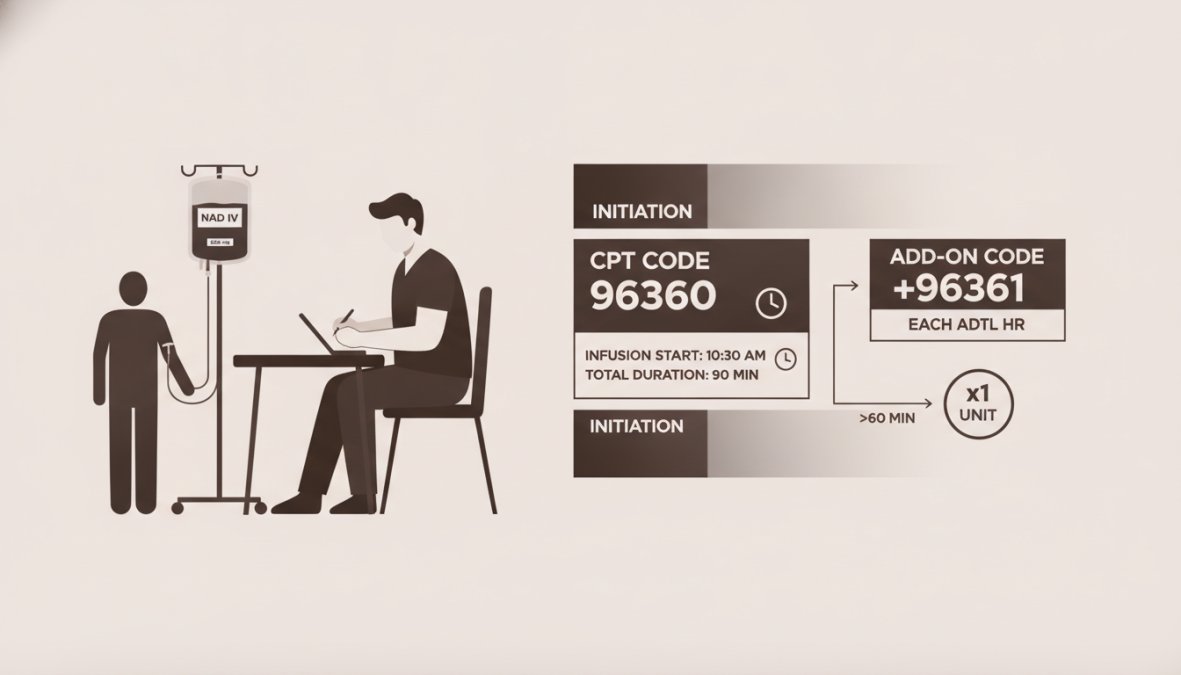
IV Infusion CPT Coding Hierarchy and Service Classification
The CPT coding hierarchy establishes which codes apply based on service type and patient status.
Determining Initial vs. Subsequent Infusion Status
Initial infusion status applies only to the first infusion in a new treatment plan. Once documented with an initial code, all follow-up infusions within that treatment series use subsequent codes. The distinction persists throughout the entire treatment plan, even if weeks pass between sessions.
When a patient completes a course of treatment and returns months later for a new clinical reason, that’s a new plan. If a patient receives weekly NAD+ infusions indefinitely, every infusion after the first uses the subsequent code. Document the treatment plan clearly in your clinical notes so your billing team applies the correct code on each claim.
Using initial codes repeatedly for the same patient is one of the fastest ways to trigger a billing audit. Payers have automated systems that flag this pattern. Once flagged, they’ll often request a full medical record review, creating processing delays and potential recoupment demands.
Hydration Infusion Requirements and 31-Minute Thresholds
The 31-minute threshold determines whether add-on codes apply. CMS requires that hydration infusions run at least 31 minutes to qualify for hydration-specific codes. If your NAD+ infusion runs only 15 minutes, it may not meet the medical necessity threshold for that code category.
If your typical NAD+ sessions run 20 minutes, you may need to use injection codes rather than infusion codes. If extending sessions to meet the 31-minute requirement, document the clinical reason for the longer duration. Payers scrutinize sessions appearing designed solely to meet billing thresholds.
The 31-minute rule applies to total infusion time, not preparation time. Only the time the substance actively infuses counts toward the threshold.
Medical Necessity for NAD Therapy: Documentation and Coding
Medical necessity is the foundation of defensible NAD+ billing. Without clear clinical justification documented in the patient’s chart, payers will deny claims regardless of correct code selection.
ICD-10 Diagnosis Codes and Clinical Justification
Your diagnosis code selection must align with the clinical reason for NAD+ therapy. Common ICD-10 codes include codes for fatigue, cognitive decline, mitochondrial dysfunction, or chronic pain. Avoid vague diagnosis codes. “G89.29 – Other chronic pain” is stronger than “R53.83 – Other fatigue” when the patient’s actual condition is chronic pain.
Document specific clinical findings supporting the diagnosis. Your chart note should include: chief complaint, relevant medical history, current symptoms, physical exam findings, and why NAD+ therapy is appropriate. Write: “Patient reports persistent cognitive fog affecting work performance for 6 months despite adequate sleep and normal thyroid function. NAD+ infusion initiated to support mitochondrial energy production and cognitive function.”
Precertification and Payer Policy Alignment
Many commercial payers now require precertification (prior authorization) before administering NAD+ infusions. Check your major payers’ policies before the patient’s first visit. Some payers have specific criteria: minimum age, documentation of failed conservative treatments, or specific diagnoses only.
Obtain precertification in writing before the infusion when required. Verbal approvals create billing disputes when the payer later denies the claim. Include the precertification number in your claim submission.
When payer policy explicitly excludes NAD+ therapy, don’t bill insurance. Offer the patient a cash-pay option with transparent pricing instead. Billing insurance for excluded services results in denials and compliance issues.
Documentation Requirements for Infusion Services
Billing audits focus heavily on documentation. If your clinical notes don’t support the codes you’ve billed, you’ll face denials and recoupment requests.
Clinical Documentation Standards and Audit Compliance
Your infusion documentation must include: date and time, start and stop times (exact clock times), substance and dosage, route of administration, patient tolerance and adverse reactions, vital signs if monitored, provider oversight, and clinical outcome. This detail becomes your defense if audited.
Many practices use template formats that capture these elements consistently. Templates ensure nothing is missed and should require exact start/stop times, not estimates. Document who administered the infusion and who provided clinical oversight, as these may be different individuals.
Informed Consent and Documentation Templates
Document informed consent before treatment. Your consent form should explain: what NAD+ is, why it’s recommended, expected benefits and limitations, potential risks or side effects, alternative treatments, and cost if not covered by insurance. Have the patient sign and date the form.
Create a one-page NAD+ infusion form that includes diagnosis, clinical justification, informed consent, and documentation fields for the infusion itself. Include fields for: patient name and date of birth, diagnosis code and description, clinical reason for treatment, infusion date/time, substance and dosage, start time, stop time, any adverse events, patient tolerance, and provider signature.
Cash-Based Practice Billing for IV Therapy
Not all NAD+ infusions are covered by insurance. Many patients choose to pay cash to avoid delays or because their payer excludes the service.
Cash-Pay vs. Insurance Billing Workflow Differences
Cash-pay patients don’t require CPT codes or ICD-10 diagnosis codes. You can bill a flat fee for the infusion service without using medical codes. However, document the service in the patient’s medical record with the same clinical detail as insurance cases.
Cash-pay patients typically pay before or at service, eliminating billing delays. You don’t submit claims, so there’s no precertification process, payer policy restrictions, or denials to manage. Document cash-pay infusions separately so your billing team doesn’t accidentally submit them to insurance.
Pricing Strategy and Patient Financial Counseling
Calculate the cost of NAD+ substance, IV supplies, staff time, clinical oversight, and facility overhead. Most practices mark up direct cost by 100-200% to cover expenses and generate profit margin. Pricing should be competitive but reflect your value.
Provide patients with a written quote before the infusion. Include what’s covered and what’s not. Consider package pricing for patients committing to multiple sessions. A 10% discount for pre-payment of six weekly infusions creates cash flow certainty and encourages patient commitment.
Modifier Usage, Revenue Codes, and Denial Management
Modifiers and revenue codes are specialized billing elements applying in specific scenarios.
Modifier 22 and HCPCS Code Requirements
Modifier 22 (“increased procedural services”) applies when you’ve provided significantly more work than standard infusion service. This might occur with difficult IV access requiring multiple attempts or extended monitoring due to adverse reactions. Modifier 22 requires documentation of what made this service substantially more complex.
When using Modifier 22, include a detailed note explaining increased complexity. For example: “Patient presented with severe anxiety regarding IV placement. Required 15 minutes of counseling before IV insertion. Two failed venipuncture attempts before successful placement. Total procedural time 45 minutes compared to standard 25 minutes.”
HCPCS codes are used for specific substances and supplies. Verify with your payers which HCPCS codes they recognize for NAD+ substance billing. Some payers bundle substance cost into the infusion code, while others require separate HCPCS billing.
Before using Modifier 22, check your top three payers’ policies. Some payers have specific requirements or may not recognize it for infusion services.
Revenue Code 260 and SNF/Home Infusion Billing
Revenue Code 260 is used for IV therapy in facility settings like skilled nursing facilities or home health agencies. If providing NAD+ infusions in an SNF or through a home infusion program, revenue code 260 applies instead of standard CPT codes.
SNF and home infusion billing requires coordination with the facility’s billing department. You may not directly bill insurance; the facility includes your service in their overall bill. Verify the billing arrangement before providing service.
Common Denial Reasons and Appeal Strategies
Medically unnecessary: The payer determined NAD+ therapy isn’t medically justified. Prevention: strengthen clinical documentation before billing with specific clinical findings and why NAD+ is appropriate.
Precertification required but not obtained: The payer requires prior authorization you didn’t request. Prevention: verify precertification requirements before the first infusion.
Incorrect code used: You billed the wrong CPT code. Prevention: verify initial versus subsequent status, confirm the 31-minute threshold was met, and use appropriate add-on codes.
Time documentation insufficient: You didn’t document exact start/stop times. Prevention: mandate exact clock times in your documentation template.
Request the denial reason in writing from the payer. This explanation guides your appeal strategy. Submit appeals promptly with supporting documentation. Appeals without supporting documentation rarely succeed.
NAD IV Therapy Billing Codes: Real-World Scenarios and Compliance
Understanding billing theory is essential, but real-world scenarios reveal where theory breaks down.
Billing Scenario Walkthroughs and Code Selection
Scenario 1: First NAD+ infusion, 45-minute duration
Patient is new and receiving NAD+ infusion for cognitive support. Infusion starts at 2:00 PM, ends at 2:45 PM. Total duration: 45 minutes.
Correct coding: CPT 96360 (initial infusion, first 31 minutes) plus one unit of CPT 96361 (additional 14 minutes). Documentation must show exact start/stop times: “Infusion started 2:00 PM, completed 2:45 PM. Patient tolerated well, no adverse reactions.”
Scenario 2: Subsequent NAD+ infusion, 25-minute duration
Same patient returns one week later for their second infusion, running 25 minutes (10:15 AM to 10:40 AM).
Correct coding: CPT 96367 (subsequent infusion). The infusion doesn’t meet the 31-minute threshold, so no add-on code applies. Document: “Subsequent NAD+ infusion, week 2 of treatment plan. Patient reports improved energy and focus since initial session. Infusion administered 10:15-10:40 AM.”
Scenario 3: NAD+ combined with other infusion services, 60-minute total
Patient receives NAD+ plus hydration solution in the same session. Total infusion time is 60 minutes (first 30 minutes NAD+, then 30 minutes hydration).
Correct coding: If both substances are administered sequentially in the same IV line, you may code this as a single infusion service with appropriate add-on codes. If administered separately (two IV lines or distinct sessions), code each separately. Verify your payer’s policy on combination infusions.
Coding Audit Preparation and Risk Mitigation
Audits are inevitable in medical billing. Prepare proactively by reviewing a random sample of your NAD+ claims from the past 12 months. Pull claim records and corresponding clinical documentation for 10-15 cases. Ask yourself:
- Are the codes I billed supported by clinical documentation?
- Are start/stop times documented with exact clock times?
- Is medical necessity clear from the diagnosis and clinical notes?
- Did I use the correct initial versus subsequent codes?
- Are add-on codes appropriate for documented infusion time?
Correct documentation practices immediately if you find inconsistencies. Maintain a coding compliance log tracking: date of service, patient name, CPT codes billed, ICD-10 diagnosis code, infusion duration, payer, claim status, and any denials. This log shows an auditor that you’re tracking performance and taking compliance seriously.
| Common Audit Finding | Root Cause | Prevention Strategy |
|---|---|---|
| Incorrect initial/subsequent codes | Billing team unfamiliar with treatment plan status | Maintain treatment plan log; flag initial services in system |
| Missing add-on codes | Insufficient time documentation | Require exact start/stop times in clinical template |
| Modifier 22 misuse | Unclear guidelines on when to use | Create written policy; require documentation before billing |
| Medically unnecessary denials | Weak clinical justification | Strengthen pre-infusion assessment and documentation |
| Precertification missed | No verification process | Check all payers’ policies; create precertification checklist |
Conclusion
Accurate NAD IV therapy billing codes and CPT guidelines directly impact your practice’s revenue and compliance standing. The complexity of infusion coding, from distinguishing initial versus subsequent services to applying add-on codes correctly, requires systematic documentation and payer knowledge. Emphasize building strong clinical documentation that supports defensible coding, maintaining clear treatment plan tracking, and verifying payer policies before billing. By implementing the documentation templates, scenario walkthroughs, and compliance practices covered in this guide, your practice can reduce denials, improve reimbursement rates, and maintain audit readiness. Start with a self-audit of your recent NAD+ claims, identify any coding inconsistencies, and update your documentation protocols accordingly.
Frequently Asked Questions
What CPT codes are used for NAD IV therapy billing?
NAD IV therapy typically uses CPT code 96360 for the initial infusion service (first 15 minutes) and CPT code 96361 for each additional 15-minute increment. These are Category I CPT codes for therapeutic, prophylactic, or diagnostic infusions. The specific code selection depends on whether it’s an initial or subsequent service, infusion duration, and whether it qualifies as a hydration infusion (requiring 31+ minutes). Add-on codes like 96365 or 96366 may apply for concurrent infusions. Always verify payer policy and medical necessity documentation.
Is NAD IV therapy considered medically necessary by insurance?
Medical necessity for NAD therapy varies significantly by payer. Most commercial insurance plans do not routinely cover NAD+ infusions for anti-aging or wellness purposes, classifying them as elective. However, some payers may cover NAD therapy when documented for specific clinical conditions (e.g., chronic fatigue, neuropathy, or mitochondrial dysfunction) with appropriate ICD-10 diagnosis codes and clinical justification. Precertification is strongly recommended before treatment. Many patients pursue NAD IV therapy through cash-pay models to avoid insurance denials and maintain privacy.
What documentation is required for IV infusion billing compliance?
Clinical documentation for infusion services must include: patient demographics, infusion start and end times, infusion duration (to support time-based billing), specific medication or solution administered, route of administration, clinical indication (diagnosis code), provider signature, and patient tolerance/response. For NAD+ infusions, document the medical necessity rationale, any adverse reactions, and informed consent. Maintain records of precertification approval if applicable. Audit-ready documentation prevents denials and supports coding compliance during payer audits or coding compliance reviews.
How does cash-based practice billing differ from insurance billing for IV therapy?
Cash-pay IV therapy billing bypasses insurance precertification and medical necessity requirements, allowing providers to offer NAD+ infusions directly to patients without payer approval delays. Cash practices typically charge flat rates per infusion session rather than time-based CPT coding. However, even cash-pay providers should maintain compliant documentation and understand CPT guidelines for potential future insurance submission or coding audit defense. Cash workflows eliminate denial management but require clear patient financial counseling and transparent pricing. Some practices offer both insurance-billable and cash-pay options depending on diagnosis and patient preference.