

Last Updated: May 17, 2026
OpenLoop Health is a B2B telehealth infrastructure provider that powers virtual care programs for digital health companies, employers, and healthcare organizations. At Ascend Vitality, we track the telehealth infrastructure landscape closely because the backbone providers behind virtual care directly shape the quality of care patients receive. Understanding how openloop health operates matters whether you’re evaluating it as a technology partner, researching a provider that uses its network, or considering building your own telehealth program.
Below, we break down exactly how the platform works, what its clinical staffing model looks like, where its security record stands, and how it compares to alternatives. The goal is a complete, honest picture, not a marketing brochure.
What OpenLoop Health Does and Who It Serves
OpenLoop Health is a white-label telehealth infrastructure company that enables other businesses to launch and operate virtual care programs without building clinical or technology systems from scratch. The company does not serve patients directly. Instead, it sits behind the scenes, supplying the clinical workforce, compliance frameworks, and technology layer that digital health companies need to function.

The typical OpenLoop Health customer is a company that wants to offer telehealth services under its own brand. That could be a wellness startup, a direct-to-consumer health platform, an employer benefits program, or a health system expanding into remote care. OpenLoop Health supplies the infrastructure so these organizations can focus on their product and patient experience rather than clinical operations.
The Infrastructure Provider Model vs. Direct-to-Patient Care
The infrastructure provider model is fundamentally different from direct-to-patient telehealth. Companies like Teladoc or MDLive own the patient relationship. OpenLoop Health owns the pipes.
This distinction matters for several reasons. First, the quality of care delivered through any OpenLoop Health-powered platform depends heavily on how the client company designs its patient pathways and clinical protocols. OpenLoop Health provides the clinician network and compliance scaffolding, but the client determines the product experience. Second, patients using a service powered by OpenLoop Health typically interact with a branded interface that gives no indication of the underlying infrastructure provider. This is standard practice in white-label telehealth.
The model creates scalability advantages that are hard to replicate independently. Building a multi-state credentialed clinician network from the ground up takes years and significant capital. Contracting with an infrastructure provider like OpenLoop Health compresses that timeline considerably.
White-Label Telehealth Solutions: OpenLoop Health’s Core Offering
White-label telehealth solutions are pre-built virtual care platforms that client companies brand and deploy as their own product. OpenLoop Health’s core offering in this category covers the clinical layer, the technology layer, and the regulatory layer simultaneously, which is what separates infrastructure providers from simple software vendors.
Most digital health companies underestimate how much of their operational burden sits in these three areas. Software is the visible part. Clinical staffing, multi-state licensing, and payer credentialing are the invisible parts that take the longest to build and carry the most regulatory risk.
Synchronous and Asynchronous Care Delivery Options
OpenLoop Health supports both synchronous care (real-time video or phone consultations) and asynchronous care (store-and-forward messaging, questionnaire-based evaluations, and photo submissions). The distinction matters operationally because asynchronous care scales more efficiently and suits conditions that do not require real-time clinical judgment.
Many direct-to-consumer health platforms, including those operating in weight management, hormone health, and men’s and women’s wellness, rely heavily on asynchronous care models. A patient completes an intake form, a licensed clinician reviews it and issues a prescription or care recommendation, and the interaction is complete without a scheduled appointment. This model reduces cost per patient interaction and increases throughput significantly.
Synchronous care remains essential for complex presentations, follow-up consultations, and situations where a real-time clinical assessment changes the treatment decision. OpenLoop Health’s platform supports both modalities, which gives client companies flexibility to design care pathways appropriate to their specific patient population.
API-Driven Integration and EHR Compatibility
OpenLoop Health’s technology layer is built around API-driven integration, which allows client companies to connect the platform to their existing systems rather than replacing them. This is a practical necessity for healthcare organizations that already operate an EHR or practice management system.
EHR integration in telehealth is genuinely difficult. According to Office of the National Coordinator for Health IT’s interoperability guidance, inconsistent data standards across EHR vendors create significant integration friction. OpenLoop Health’s API-first approach addresses this by creating abstraction layers that reduce direct dependency on any single EHR vendor’s proprietary format.
For companies starting from zero, OpenLoop Health can serve as the primary clinical record environment. For established health systems adding a telehealth channel, the API layer connects the virtual care workflow to existing EHR infrastructure without requiring a full system migration.
Before committing to any telehealth infrastructure provider, request a technical architecture document that specifies exactly which EHR systems have pre-built connectors versus custom API work. Custom integrations typically add 60-90 days to your implementation timeline and carry ongoing maintenance costs.
Clinical Staffing, Credentialing, and Provider Networks
Clinical staffing is the most operationally complex piece of any telehealth infrastructure stack. OpenLoop Health maintains a network of licensed clinicians across multiple states, handling the credentialing, contracting, and compliance verification that would otherwise fall on the client company.
NCQA-Credentialed Clinicians and Multi-State Licensing
NCQA credentialing is the healthcare industry’s standard framework for verifying that clinicians meet defined competency and licensure requirements. An NCQA-credentialed clinician has passed a structured verification process covering education, training, licensure, malpractice history, and clinical competency.
Multi-state licensing is the other half of the equation. A clinician licensed in one state cannot legally treat patients in another state without obtaining licensure in that jurisdiction. The Interstate Medical Licensure Compact (IMLC) has simplified this process for physicians in participating states, but many clinician types and many states still require individual licensure applications. As documented in Federation of State Medical Boards’ IMLC program overview, the compact currently covers physicians in the majority of U.S. states, but coverage is not universal.
OpenLoop Health manages multi-state licensing as part of its infrastructure service, which is one of its clearest value propositions. A digital health company launching nationally would otherwise need to manage dozens of individual state licensure processes across multiple clinician types, a process that can take 12-18 months and requires dedicated compliance staff.
Regulatory Compliance, HIPAA, and Data Security
Regulatory compliance in telehealth spans federal and state layers simultaneously. At the federal level, HIPAA sets the floor for patient data protection. At the state level, each jurisdiction maintains its own telehealth practice standards, prescribing regulations, and licensure requirements. OpenLoop Health’s regulatory support function covers both layers, though the depth of that coverage varies by service tier and contract structure.
This section goes further than most evaluations do. Because the current search landscape around OpenLoop Health is heavily shaped by third-party reporting on security incidents and employee dissatisfaction, any honest assessment of the platform has to address those issues directly rather than burying them in a checklist.
The Data Breach Narrative: What Actually Happened and Why It Matters
OpenLoop Health has been named in connection with data security incidents affecting patient information. Healthcare data breaches are unfortunately common across the industry, the HHS Office for Civil Rights breach portal lists hundreds of covered entities and business associates each year, but they carry specific consequences in telehealth because the data involved often includes sensitive information related to mental health, sexual health, and prescription medications.
According to HHS Office for Civil Rights breach reporting portal, healthcare organizations are required to report breaches affecting 500 or more individuals, and those reports are publicly accessible and searchable by entity name. Any organization evaluating OpenLoop Health as an infrastructure partner should run that search as a first step in due diligence, not as an afterthought.
The reason this matters more for an infrastructure provider than for a direct-to-patient company is scope. A single breach at the infrastructure layer can expose patient data across every client company running on that platform simultaneously. The blast radius is wider than a breach at a single-brand telehealth company, and the reputational consequences cascade to client brands whose patients may not know OpenLoop Health is involved in their care at all.
This is not a reason to automatically disqualify OpenLoop Health. It is a reason to conduct more rigorous security due diligence than you would for a software-only vendor.
Independent Security Audits: What to Request and How to Evaluate the Answers
Most telehealth infrastructure providers claim HIPAA compliance. Fewer can produce third-party audit documentation that verifies those claims. The difference matters enormously, and the way a vendor responds to your documentation request tells you as much as the documents themselves.
A credible security posture for a healthcare infrastructure provider includes all of the following. If any item is missing, ask specifically why before proceeding.
SOC 2 Type II certification covers security, availability, processing integrity, confidentiality, and privacy controls over a minimum 12-month audit period. A SOC 2 Type I report only verifies that controls exist at a point in time, it does not verify that they operated effectively over time. Always ask for Type II specifically, and check the audit period end date. A report more than 18 months old is stale.
Annual penetration testing by an independent security firm should produce an executive summary you can review. Ask whether findings from the prior year’s test were remediated before the next test began. Vendors that cannot answer this question have not closed the loop on known vulnerabilities.
HIPAA Security Rule risk assessment documentation updated within the past 12 months. The Security Rule requires covered entities and business associates to conduct and document a risk analysis. This document should identify the specific threats and vulnerabilities the organization has assessed, not just assert that an assessment was completed.
Business Associate Agreements executed with all subprocessors handling PHI. OpenLoop Health, as a business associate to its client companies, will itself engage subprocessors, cloud hosting providers, EHR vendors, communication platforms, that touch protected health information. Each of those relationships requires its own BAA. Request the subprocessor list and confirm BAA coverage across the chain.
Incident response plan with defined notification timelines. HIPAA requires breach notification to affected individuals within 60 days of discovery. Ask to see the incident response plan and specifically ask what the internal escalation timeline looks like between discovery and client notification. A vendor that notifies you 55 days after discovery has technically complied with HIPAA but has left you with almost no time to manage your own patient communications.
Never assume HIPAA compliance based on marketing language alone. A BAA is a legal agreement, not a compliance certification. Signing a BAA with a vendor does not mean that vendor has the technical controls to actually protect patient data. Always request SOC 2 Type II documentation, and treat a vendor’s reluctance to share it as a significant red flag.
State-Level Telehealth Compliance: The Layer Most Evaluations Skip
Federal HIPAA compliance is the floor, not the ceiling. State telehealth laws introduce a second compliance layer that varies significantly by jurisdiction and changes frequently.
Key state-level variables that affect any OpenLoop Health-powered program include:
- Prescribing restrictions: Several states impose specific requirements on prescribing via telehealth, including mandates for prior in-person examinations for certain drug classes. These rules directly affect the clinical protocols OpenLoop Health’s client companies can operate.
- Informed consent requirements: Some states require telehealth-specific informed consent documentation that differs from standard consent forms.
- Audio-only telehealth permissions: Not all states permit audio-only encounters for all services. Programs that rely on phone consultations rather than video need state-by-state verification.
- Controlled substance prescribing: The DEA’s telehealth prescribing rules for controlled substances have been in flux since the end of the federal public health emergency. Any program involving Schedule III-V medications needs current legal review, not assumptions based on pandemic-era flexibilities.
According to American Telemedicine Association’s telehealth policy and practice standards, the regulatory environment for telehealth continues to evolve rapidly. OpenLoop Health’s regulatory support function should be evaluated not just on its current coverage but on how quickly it updates client-facing guidance when state rules change. Ask specifically: how are clients notified when a state changes a telehealth practice standard that affects their program, and what is the typical lag between the rule change and client notification?
Request a sample of OpenLoop Health’s state compliance update communications before signing a contract. The format, frequency, and specificity of those communications will tell you whether the compliance function is genuinely proactive or primarily reactive.
Payer Coverage, Network Access, and Scalability
Payer coverage is where many telehealth infrastructure models show their limits, and it is also where the build-versus-buy cost comparison becomes most concrete. OpenLoop Health’s network access model is primarily designed for direct-to-consumer cash-pay and employer-sponsored programs rather than traditional insurance billing. Understanding exactly what that means, and what it costs to go the other direction, is the analysis most evaluations skip entirely.
Cash-Pay and Employer Models: Why the Operational Logic Works
Many direct-to-consumer telehealth platforms operate outside traditional payer networks deliberately. The administrative overhead of insurance billing, prior authorization, and claims adjudication significantly increases per-patient cost and slows care delivery. A single prior authorization denial and appeal cycle can consume more staff time than the clinical encounter itself.
Cash-pay and subscription models trade insurance coverage for operational simplicity. In the weight management, hormone health, and men’s and women’s wellness verticals, where OpenLoop Health has significant client concentration, this trade-off is often favorable. Patients in these categories frequently pay out of pocket regardless of insurance status because the services they want are not consistently covered by commercial payers.
Employer-sponsored programs represent a middle path. Self-funded employers can contract directly with telehealth programs outside the traditional payer network, bypassing the credentialing and claims infrastructure entirely while still providing coverage to their employees. OpenLoop Health’s infrastructure is well-suited to this model because the billing relationship is B2B rather than B2C, which removes most of the payer complexity.
The Build-Versus-Buy Cost Reality
This is the angle most OpenLoop Health evaluations ignore, and it is the most important frame for any organization deciding whether to use an infrastructure provider at all.
Building a multi-state telehealth infrastructure independently requires investment across several cost categories that are easy to underestimate:
Clinical licensing and credentialing staff. Managing multi-state licensure applications, renewals, and payer credentialing for a clinician network requires dedicated compliance personnel. A credentialing coordinator managing a network of 20-50 clinicians across 15-20 states is a full-time role, often two. These are not one-time costs, licensure renewals, payer re-credentialing cycles, and state rule changes create ongoing workload.
Legal and regulatory counsel. Telehealth compliance requires ongoing legal review as state rules change. Organizations building independently typically retain healthcare regulatory counsel on either a retainer or project basis. This cost is embedded in OpenLoop Health’s infrastructure fee rather than appearing as a separate line item.
Technology infrastructure. A HIPAA-compliant telehealth platform requires secure video infrastructure, encrypted messaging, audit logging, access controls, and EHR integration. Building this from scratch is a multi-year engineering project. Licensing a white-label platform compresses that timeline but still requires integration work.
Clinician recruitment and onboarding. Building a clinician network independently means sourcing, vetting, contracting, and onboarding clinicians without the benefit of an existing pool. Time-to-first-patient is significantly longer for organizations building independently.
The practical implication is that OpenLoop Health’s infrastructure fee, which is not publicly disclosed and requires a sales engagement to obtain, should be evaluated against the fully-loaded cost of building and maintaining equivalent capabilities independently, not against a software-only licensing fee. Organizations that compare infrastructure provider pricing to SaaS pricing are comparing the wrong things.
When building your internal business case for or against an infrastructure provider, create a five-year total cost of ownership model that includes headcount, legal counsel, technology licensing, and clinician recruitment costs on the build side. Most organizations find the break-even point is earlier than they expected, typically within the first 18-24 months of operation at meaningful patient volume.
Payer Credentialing: The Mechanics and Timeline If You Need It
For organizations that require payer network participation, the scalability picture changes significantly, and the timeline implications are concrete enough to plan around.
Payer credentialing is separate from clinical credentialing and operates on its own timeline. A clinician who is NCQA-credentialed and licensed in a given state still needs to complete a payer-specific credentialing process before billing that payer for services. This process involves the clinician submitting a separate application to each payer, the payer verifying credentials independently, and the payer issuing a provider number that enables billing.
The typical timeline for payer credentialing is 90-180 days per payer per clinician. For a network of 30 clinicians seeking participation with five major commercial payers across 10 states, the combinatorial math produces a credentialing workload that is genuinely difficult to manage without dedicated staff or a vendor that specializes in this function.
OpenLoop Health’s payer credentialing support is limited compared to its clinical staffing and licensing capabilities. Organizations planning to build a traditional insurance-billed telehealth program should pressure-test exactly which payer credentialing support OpenLoop Health provides before assuming the infrastructure covers that layer. SteadyMD, by comparison, has a stronger track record in full-stack payer credentialing support, which makes it a more appropriate choice for organizations where insurance billing is central to the business model.
Scalability: Where OpenLoop Health’s Model Performs and Where It Strains
OpenLoop Health’s scalability advantage is most pronounced in three specific scenarios:
- Rapid geographic expansion in cash-pay programs. A company launching in five states and planning to expand to 25 within 18 months benefits significantly from OpenLoop Health’s existing multi-state clinician network. The alternative, managing 25 individual state licensure processes independently, would require a compliance team and a timeline that most growth-stage companies cannot absorb.
- High-volume asynchronous care programs. Asynchronous care models scale more efficiently than synchronous care because clinician time is not consumed by scheduled appointment slots. OpenLoop Health’s infrastructure supports high-throughput asynchronous workflows, which suits the direct-to-consumer wellness verticals where encounter volume is high and clinical complexity per encounter is relatively low.
- Employer benefit program launches. The B2B contracting model for employer-sponsored programs aligns well with OpenLoop Health’s infrastructure approach. The billing relationship is simpler, the patient population is defined in advance, and the compliance requirements are more predictable than open-market consumer programs.
Where the model strains: complex multi-specialty programs that require tight clinical coordination across specialties, programs with significant controlled substance prescribing that must navigate DEA telehealth rules, and programs that require deep payer network participation from launch. In these scenarios, the infrastructure provider relationship requires more customization and more active management than OpenLoop Health’s standard offering is designed to support.
| Capability | OpenLoop Health | Wheel | SteadyMD |
|---|---|---|---|
| White-label patient experience | Yes | Yes | Limited |
| Multi-state clinician licensing | Yes | Yes | Yes |
| Synchronous + async care | Yes | Yes | Yes |
| EHR API integration | Yes | Yes | Yes |
| Payer credentialing support | Limited | Limited | Yes |
| Employer program support | Yes | Yes | Yes |
| SOC 2 documentation | Request required | Request required | Request required |
| Pricing transparency | No | No | No |
OpenLoop Health’s payer coverage model is a feature, not a limitation, for organizations operating in cash-pay and employer-sponsored verticals. The limitation only becomes material if insurance billing is central to your business model, in which case SteadyMD or a hybrid approach using a dedicated credentialing vendor alongside OpenLoop Health’s clinical infrastructure deserves serious evaluation.
How to Start a Telehealth Business Using OpenLoop Health
Starting a telehealth business using OpenLoop Health as your infrastructure layer follows a defined sequence. The platform is designed for B2B onboarding, meaning the process begins with a sales engagement rather than a self-serve signup.
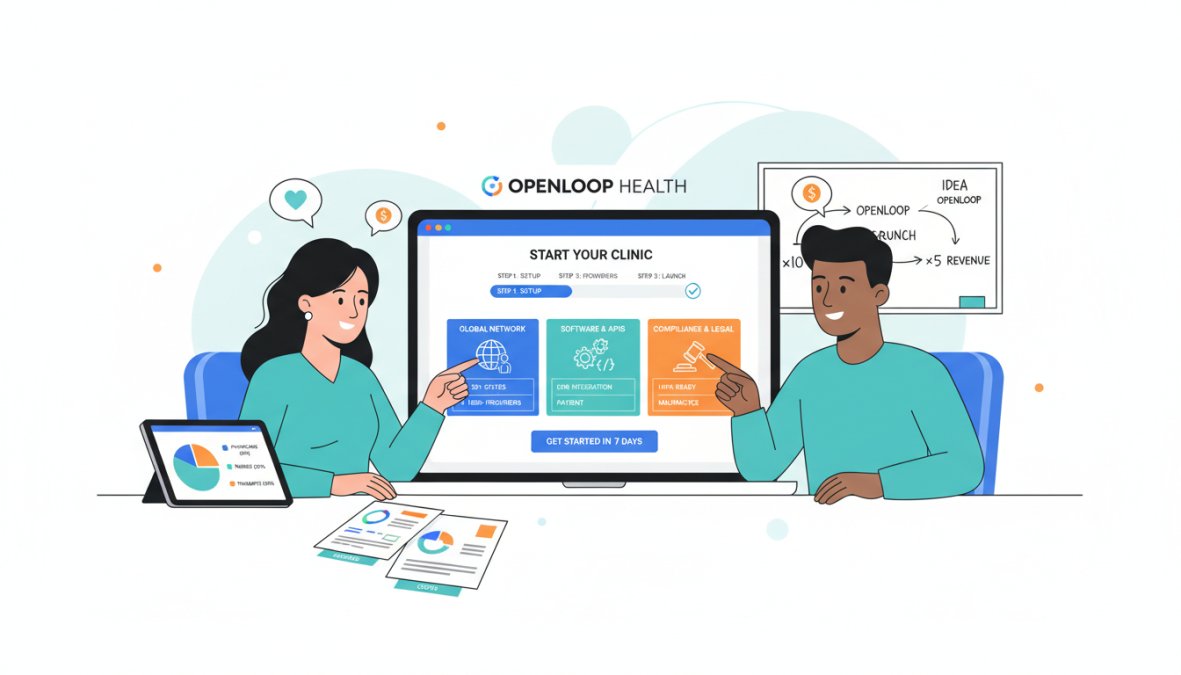
The foundational steps for launching with OpenLoop Health as your backend:
- Define your clinical scope: Which conditions will you treat? Which clinician types do you need? Which states will you operate in at launch?
- Engage OpenLoop Health’s sales team and negotiate a contract that specifies clinical staffing ratios, response time SLAs, and data security documentation requirements
- Complete your BAA and review the subprocessor list for any additional BAAs required
- Design your patient intake and care pathway workflows in collaboration with OpenLoop Health’s clinical operations team
- Integrate the API layer with your patient-facing application or EHR
- Complete state-specific telehealth registration requirements for your business entity
- Conduct a soft launch with a limited patient cohort to validate clinical workflows before scaling
Implementation Timeline: What to Realistically Expect
The honest implementation timeline for launching a telehealth business on OpenLoop Health’s infrastructure is 90-180 days for a straightforward single-specialty, single-state program. Multi-state, multi-specialty programs should plan for 6-12 months.
The variables that most commonly extend timelines are state licensure processing times, EHR integration complexity, and payer credentialing if applicable. State medical boards process licensure applications at different speeds, and many are running 60-120 day backlogs as of 2026.
A common mistake is treating the technology integration as the long pole in the tent. In practice, the clinical and regulatory work almost always takes longer than the software work. Teams that front-load the licensure and credentialing process while building their technology layer in parallel consistently hit launch targets faster than teams that sequence these workstreams.
Provider-Side Experience Optimization
Provider-side experience is the angle most telehealth infrastructure evaluations ignore entirely. A platform that is difficult for clinicians to use produces slower care delivery, higher clinician turnover, and lower care quality.
OpenLoop Health’s clinician-facing workflow should be evaluated on:
- Charting speed: How many clicks does a standard asynchronous encounter require from intake review to prescription issuance?
- Caseload visibility: Can clinicians see their full queue, prioritize by urgency, and flag complex cases easily?
- Communication tools: Is secure messaging between clinicians and patients intuitive, or does it require workarounds?
- Compensation clarity: Are clinicians paid per encounter, per hour, or on a salary basis? Misaligned compensation structures drive throughput problems.
Platforms that optimize for patient experience while neglecting clinician experience tend to see quality problems surface 6-12 months after launch, when clinician dissatisfaction starts affecting care delivery speed and retention.
Provider-side experience optimization is the most overlooked factor in telehealth infrastructure selection. A platform that clinicians find difficult to use will underperform regardless of how good the patient-facing product looks.
OpenLoop Health vs. Alternative Telehealth Infrastructure Providers
The telehealth infrastructure market has consolidated around a handful of serious players. OpenLoop Health competes most directly with Wheel and SteadyMD, with secondary competition from technology-focused vendors like Mend and eVisit that provide platform infrastructure without clinical staffing.
Wheel offers a comparable white-label patient experience with a nationwide clinician network and strong synchronous and asynchronous care support. Wheel’s configurability is a genuine differentiator for companies with complex, multi-specialty care programs. The tradeoff is that pricing is entirely custom and requires enterprise-level engagement, making it difficult to evaluate cost-effectiveness early in the decision process.
SteadyMD has a stronger reputation for regulatory compliance support and full-stack clinical operations, including payer credentialing assistance that OpenLoop Health does not consistently offer. SteadyMD’s primary limitation is its focus on enterprise-scale partnerships, which makes it a difficult fit for early-stage companies with limited initial patient volume.
Mend and eVisit serve a different buyer profile. These platforms provide the technology infrastructure (scheduling, intake, video, EHR integration) without the clinical staffing component. They are better suited to health systems that already have a clinical workforce and need to add a virtual care channel, rather than companies building clinical operations from scratch.
For organizations focused on specific care verticals like weight management, hormone health, or men’s and women’s wellness, the infrastructure provider choice matters less than the clinical protocol design and patient pathway quality. As a practical example, Ascend Vitality delivers medically-supported weight loss, hormone, and wellness programs directly to patients with a care model that prioritizes clinical quality and convenience over infrastructure complexity.
According to American Telemedicine Association’s telehealth policy and practice standards, the regulatory environment for telehealth continues to evolve rapidly, which means infrastructure provider relationships need regular reassessment as state and federal rules change.
The real difference between OpenLoop Health and its alternatives comes down to what your organization needs most. If clinical staffing and multi-state licensing are your primary gaps, OpenLoop Health and SteadyMD are the strongest options. If technology infrastructure and EHR integration are the bottleneck, Mend or eVisit may be more appropriate. If you need a fully configurable white-label patient experience with maximum flexibility, Wheel is worth evaluating seriously.
No infrastructure provider eliminates execution risk. The organizations that launch successful telehealth programs treat the infrastructure provider as one input, not the solution.
Building a telehealth program on any infrastructure platform requires clinical judgment, regulatory discipline, and a clear patient experience strategy that the technology alone cannot provide. For patients seeking high-quality virtual care in weight management, hormone health, and wellness today, Ascend Vitality offers medically-supported programs with prescriptions delivered directly to you, specialized care pathways for both women’s wellness and men’s vitality needs, and the clinical rigor that distinguishes a serious health program from a convenience product. Get started with Ascend Vitality and access targeted online care designed around your specific health goals.
Frequently Asked Questions
What does OpenLoop Health do?
OpenLoop Health is a telehealth infrastructure provider, not a direct-to-patient service. It supplies digital health companies and healthcare organizations with the back-end clinical operations they need to deliver virtual care under their own brand. This includes white-label telehealth solutions, clinical staffing, credentialing, EHR integration, regulatory support, and patient pathways, allowing clients to launch or scale remote care programs without building that infrastructure from scratch.
Is OpenLoop Health a telehealth provider patients can use directly?
No. OpenLoop Health operates as a B2B infrastructure provider, meaning patients typically interact with its clients’ branded platforms rather than with OpenLoop Health directly. Healthcare organizations, digital health startups, and wellness brands license OpenLoop’s clinical workflows, provider network, and technology to power their own virtual care experiences. If you are a patient, you would access care through the brand your provider uses, which may be powered by OpenLoop Health behind the scenes.
How does OpenLoop Health’s business model work?
OpenLoop Health operates on an enterprise partnership model. Digital health companies and health systems contract with OpenLoop to access its end-to-end infrastructure, including NCQA-credentialed clinicians, HIPAA-compliant technology, and regulatory compliance support. Clients white-label the platform under their own brand. Pricing is typically custom and based on the scope of services required, such as clinical staffing volume, geographic coverage, and the level of EHR integration or payer network access needed.
What should I look for in a white-label telehealth solution when starting a telehealth business?
When evaluating white-label telehealth solutions like OpenLoop Health, prioritize HIPAA-compliant infrastructure, multi-state clinical credentialing, EHR integration capabilities, and scalable clinical staffing. Also assess implementation timelines, some platforms can launch a basic virtual care program in weeks, while full-stack deployments with payer coverage and custom patient pathways may take several months. Independent security audit histories and transparent data breach disclosure policies are also important indicators of a trustworthy infrastructure provider.
How does OpenLoop Health handle data security and potential breach risks?
As a HIPAA-compliant infrastructure provider, OpenLoop Health is expected to maintain cybersecurity standards covering data encryption, access controls, and breach notification protocols. Any organization handling protected health information (PHI) is legally required to disclose data breaches and offer identity theft protection to affected individuals. When evaluating OpenLoop or any telehealth infrastructure provider, prospective clients should request documentation of independent security audits, penetration testing results, and their breach response procedures before signing a contract.