
Last Updated: August 7, 2026
What Is GHK-Cu and How It Works for Skin
GHK-Cu is a copper peptide, a naturally occurring compound made of three amino acids bound to copper. The scientific name is glycyl-L-histidyl-L-lysine copper complex. It functions as a signaling molecule that communicates with your skin cells, triggering specific biological responses that address aging at a cellular level.
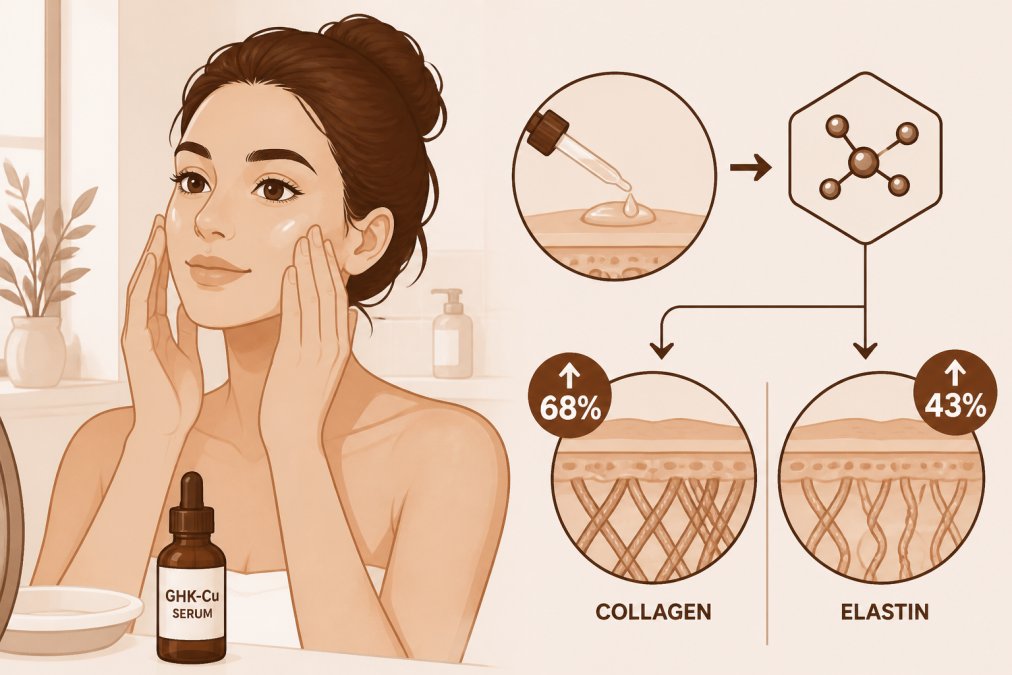
The way GHK-Cu works is straightforward: when applied topically or injected subcutaneously, it binds to copper receptors on skin cells and activates gene regulation pathways. This activation stimulates fibroblasts, the cells responsible for producing collagen and elastin, to increase their output. Unlike surface-level moisturizers that plump skin temporarily, GHK-Cu works through cellular regeneration, actually rebuilding the structural proteins your skin loses with age.
Your skin naturally produces GHK-Cu, but production declines significantly after age 30. By your 50s, you’re producing roughly half what you did in your 20s. This decline directly correlates with visible aging: loss of firmness, increased wrinkle depth, thinner skin texture, and reduced elasticity. Topical GHK-Cu serums and prescription-strength formulations aim to restore what your body no longer produces in sufficient quantities.
The peptide also exhibits antioxidant properties, helping neutralize oxidative stress that accelerates photoaging. It supports the skin barrier, reduces inflammation, and promotes wound healing at the cellular level. These combined mechanisms make GHK-Cu one of the few anti-aging compounds that addresses multiple aging pathways simultaneously rather than targeting a single concern.
At Ascend Vitality, we recognize that peptide therapies like GHK-Cu represent a shift in how people approach anti-aging, moving from topical Band-Aids to treatments that support cellular regeneration. Whether you’re exploring over-the-counter serums or considering prescription-strength options through medical consultations, understanding how GHK-Cu functions helps you make informed decisions about which delivery method suits your skin type and aging concerns.
Benefit 1: Stimulates Collagen and Elastin Production
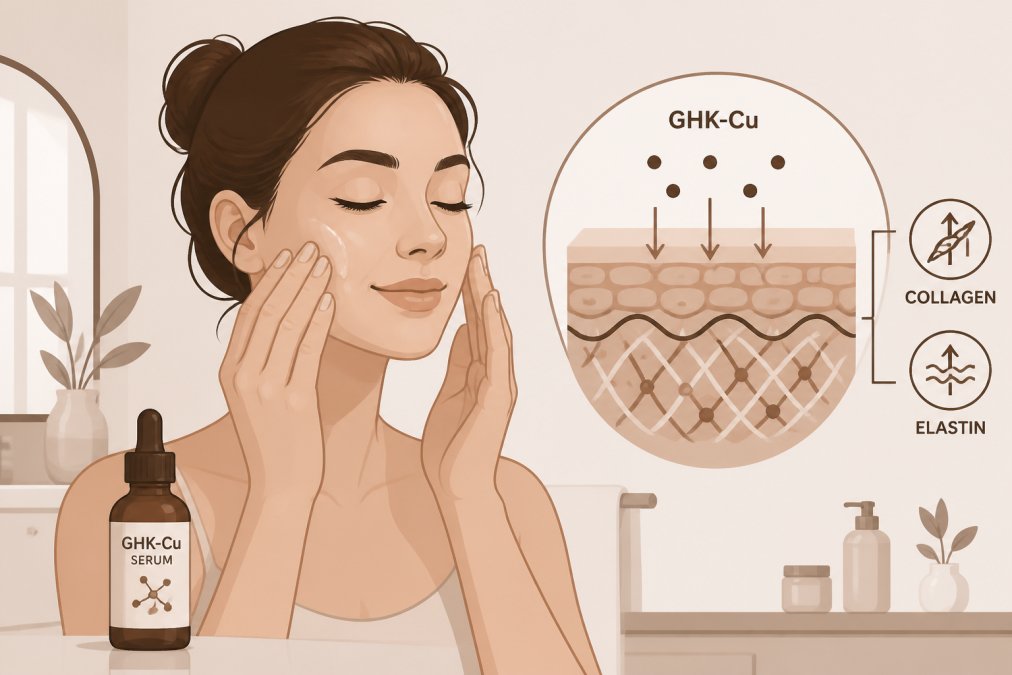
GHK-Cu’s primary mechanism is its ability to signal fibroblasts to increase collagen synthesis. Collagen is the structural protein that gives skin its firmness and bounce. Elastin provides the recoil that lets skin return to its shape after stretching. Both decline with age, and GHK-Cu directly addresses this loss by activating the genes responsible for their production.
When fibroblasts receive the GHK-Cu signal, they ramp up collagen type I and III synthesis, the types most relevant to skin firmness and texture. This isn’t a temporary effect from hydration. The stimulation triggers actual protein production within the cell, meaning the structural changes persist even after you stop using the product. Many users report that benefits continue to improve for weeks after completing a treatment cycle.
Elastin production follows the same pathway. As elastin levels increase, skin regains the ability to stretch and recoil, reducing the appearance of sagging and laxity. This is particularly noticeable around the jawline, neck, and cheeks, areas where skin typically loses definition first.
The practical outcome: skin becomes noticeably firmer within 4-8 weeks of consistent use. Fine lines soften because the skin beneath them is thicker and more supported. The skin takes on a more lifted appearance without any invasive procedures. Users often describe the effect as “plumping from within” because the skin literally becomes denser as collagen and elastin accumulate.
One important note: collagen synthesis takes time. Your body doesn’t produce collagen overnight. Realistic expectations are critical, visible firmness improvements typically appear after 6-12 weeks of daily or near-daily application, depending on your baseline collagen levels and the GHK-Cu concentration you’re using.
Benefit 2: Reduces Fine Lines and Wrinkles Through Skin Remodeling
Fine lines and wrinkles form for two reasons: loss of collagen and elastin (which we covered above), and accumulated damage from sun exposure and oxidative stress. GHK-Cu addresses both through a process called skin remodeling.
Skin remodeling involves breaking down damaged collagen fibers and replacing them with new, functional ones. Your skin naturally does this constantly, but the process slows dramatically with age. GHK-Cu accelerates this remodeling by activating matrix metalloproteinases, enzymes that break down degraded collagen, while simultaneously signaling fibroblasts to produce new, healthy collagen to replace it. The result is a net improvement in skin quality, not just surface hydration.
Wrinkle depth reduction is measurable. Studies on copper peptide formulations show that wrinkle depth can decrease by 15-25% after 12 weeks of consistent use, depending on the initial severity and the concentration of GHK-Cu in the product. Dynamic wrinkles, the lines that form when you move your face, improve first. Static wrinkles, the lines visible at rest, take longer but do improve as collagen density increases.
The mechanism differs from retinoids, which accelerate cell turnover and can cause irritation. GHK-Cu works deeper, at the level of collagen structure itself. This means you get wrinkle improvement without the peeling, redness, or photosensitivity that retinoids often cause. For people with sensitive skin or those who can’t tolerate retinoids, GHK-Cu offers a gentler alternative that still delivers measurable results.
Fine lines around the eyes respond particularly well because the skin there is thinner and more responsive to collagen stimulation. Forehead lines, nasolabial folds, and marionette lines all improve, though the timeline varies. Deeper wrinkles may require higher concentrations or longer treatment duration.
Benefit 3: Improves Skin Density and Firmness
Skin density, the thickness and tightness of the dermis, is one of the most objective measures of skin aging. As you age, your dermis thins by roughly 1% per year after age 30. By your 60s, your skin may be 30-40% thinner than it was at 20. This thinning directly causes sagging, laxity, and a creped appearance.
GHK-Cu reverses this thinning by stimulating collagen deposition in the dermis. Thicker skin is inherently firmer skin. It resists gravity better, holds its shape longer, and has a smoother surface texture because there’s more structural support beneath the epidermis.
Firmness improvement is one of the most noticeable benefits users report. Within 4-6 weeks, skin feels noticeably tighter and more resilient. The jawline appears more defined. Cheeks appear slightly lifted. The overall contour of the face looks more sculpted because the skin is supporting itself better rather than sagging under its own weight.
This benefit compounds over time. Each week of consistent GHK-Cu use adds more collagen to the dermis. After 12 weeks, the cumulative density increase becomes visually obvious. Skin takes on a plumper, more youthful appearance, not from water retention, but from actual structural improvement.
Skin density improvements also enhance the appearance of other products. Once your skin is thicker and firmer, moisturizers and sunscreen sit better on the surface. Makeup applies more smoothly. The skin’s texture becomes more uniform, which naturally reduces the appearance of pores and irregularities.
Benefit 4: Addresses Hyperpigmentation and Photoaging Damage
Photoaging, sun damage accumulated over decades, manifests as hyperpigmentation, rough texture, and loss of radiance. GHK-Cu addresses photoaging through multiple pathways: it reduces inflammation that perpetuates pigmentation issues, supports cellular regeneration to replace damaged cells, and promotes wound healing mechanisms that clear away damaged tissue.
Hyperpigmentation occurs when melanocytes (pigment-producing cells) become overactive, often triggered by UV exposure and inflammation. GHK-Cu’s anti-inflammatory properties calm this overactivity. Additionally, as GHK-Cu stimulates cellular regeneration, new skin cells replace the pigmented, damaged ones, gradually evening out skin tone.
The timeline for hyperpigmentation improvement is typically 8-12 weeks, though some fading appears earlier. Sun spots and age spots don’t disappear completely in all cases, but they noticeably fade. The overall skin tone becomes more even and radiant as damaged surface cells are replaced by healthier ones from below.
Photoaging also damages the skin barrier and reduces radiance. GHK-Cu supports barrier function by promoting the production of barrier-supporting lipids and proteins. As the barrier strengthens, skin holds moisture better, appears more luminous, and feels smoother. The rough, dull texture characteristic of sun-damaged skin gradually smooths and brightens.
For people with significant sun damage, GHK-Cu works best as part of a comprehensive approach that includes strict sun protection going forward. The peptide can’t undo decades of damage instantly, but it accelerates your skin’s natural repair processes. Combined with daily SPF 30 or higher, GHK-Cu helps prevent further damage while repairing existing damage.
Benefit 5: Supports Cellular Regeneration and Wound Healing
GHK-Cu is a potent wound-healing agent. It was originally studied for its ability to accelerate healing in burn victims and surgical wounds. This same mechanism applies to aging skin, it supports the cellular regeneration processes that keep skin looking youthful and resilient.
The peptide activates multiple healing pathways simultaneously. It increases blood flow to treated areas, bringing oxygen and nutrients that support cell function. It stimulates the production of growth factors that signal cells to repair and regenerate. It reduces inflammation that would otherwise slow healing. The combination accelerates your skin’s natural renewal cycle.
This regenerative capacity has practical implications for anti-aging. Skin that regenerates efficiently stays younger-looking longer. Cell turnover increases, meaning dead skin cells are replaced more quickly with fresh ones. The skin’s ability to respond to damage, whether from sun exposure, environmental stress, or minor irritation, improves. Over time, this translates to more resilient skin that ages more slowly.
Users often report that their skin feels healthier overall while using GHK-Cu. Texture improves. Sensitivity decreases. The skin’s natural glow returns. These changes reflect the underlying cellular regeneration happening at a microscopic level.
The wound-healing benefit also means GHK-Cu can be used alongside other treatments. If you’re considering a procedure like microneedling or laser treatment, GHK-Cu can support the healing process afterward. Some practitioners recommend starting GHK-Cu before a procedure to optimize healing capacity, then continuing it during recovery.
Copper Peptide vs Retinol: Which Is Right for Your Skin?
Both GHK-Cu and retinol address anti-aging, but they work through different mechanisms and suit different skin types. Understanding the differences helps you choose the right option, or determine whether using both makes sense for your goals.
Retinol works by accelerating cell turnover. It increases the rate at which your skin sheds dead cells and produces new ones. This faster turnover reveals fresher skin beneath and can improve texture and fine lines. However, retinol causes irritation in many people: redness, peeling, dryness, and photosensitivity are common side effects, especially when starting.
GHK-Cu works by stimulating collagen and elastin production at a deeper level. It rebuilds the structural proteins that retinol doesn’t directly target. GHK-Cu typically causes no irritation, making it suitable for sensitive skin or people who can’t tolerate retinoids.
The practical difference: retinol works faster for improving texture and surface smoothness, but GHK-Cu builds more lasting structural improvements. Retinol’s benefits often plateau after 3-6 months; GHK-Cu benefits continue to accumulate over months and years.
For sensitive skin, reactive skin, or skin with a compromised barrier, GHK-Cu is the better choice. It delivers anti-aging benefits without irritation.
For those who tolerate retinoids well and want aggressive texture improvement, retinol or prescription retinoids (tretinoin) work faster.
For maximum results, many dermatologists recommend using both, but not simultaneously. A common approach is to use GHK-Cu in the evening and a gentle retinoid 2-3 times per week, allowing recovery days between. This combination addresses multiple aging pathways without overwhelming the skin.
| Aspect | GHK-Cu | Retinol |
|---|---|---|
| Primary mechanism | Collagen stimulation | Cell turnover acceleration |
| Irritation risk | Minimal to none | Moderate to high initially |
| Best for sensitive skin | Yes | No |
| Speed of results | 4-8 weeks | 2-4 weeks |
| Photosensitivity | No | Yes |
| Works with other actives | Yes (most) | Limited |
| Long-term structural benefit | High | Moderate |
How to Use GHK-Cu Serum for Best Results
Proper application maximizes GHK-Cu’s effectiveness. The peptide needs consistent contact with skin to trigger the signaling pathways that stimulate collagen production.
Step 1: Start with clean skin. Cleanse with a gentle cleanser and pat dry. Any residual cleanser, oil, or makeup reduces the peptide’s ability to penetrate and bind to skin cells.
Step 2: Apply to damp skin. GHK-Cu absorbs better into slightly damp skin. You don’t need soaking-wet skin, just enough moisture that your skin feels damp to the touch. This hydration layer helps the peptide penetrate without dragging it across dry skin.
Step 3: Use the right amount. Most serums require 2-3 drops for the face and neck. More doesn’t mean better results. Excess serum sits on the surface rather than absorbing. One pump or 2-3 drops is typically sufficient for full face coverage.
Step 4: Apply with gentle pressing motions. Don’t rub or massage vigorously. Press the serum gently into the skin using your fingertips or the back of your hand. This allows absorption without disrupting the skin barrier. Pay special attention to areas of concern: forehead, around the eyes, marionette lines, and jawline.
Step 5: Wait before layering other products. Allow 1-2 minutes for the serum to absorb before applying moisturizer or other products. If you layer immediately, you dilute the serum and reduce its efficacy.
Step 6: Follow with moisturizer and SPF (daytime). GHK-Cu doesn’t replace moisturizer. Layer a hydrating moisturizer over the serum to lock in hydration. In the morning, always follow with SPF 30 or higher. Sun protection is non-negotiable for anti-aging, UV exposure undoes the benefits of peptide therapy.
Frequency: Most users see optimal results with daily application. Some products recommend twice daily (morning and night), while others are formulated for evening use only. Follow the specific product’s instructions. If you’re new to GHK-Cu, start with once daily (evening) for 1-2 weeks, then increase to twice daily if your skin tolerates it well.
Timeline expectations: Visible improvements typically appear within 4-6 weeks, but full benefits take 12 weeks or longer. Consistency matters more than intensity. Daily application for 12 weeks beats sporadic use of a higher concentration.
Storage: GHK-Cu serums are light and oxygen-sensitive. Store in a cool, dark place. Keep the cap tightly sealed. Most serums remain stable for 6-12 months when stored properly.
If you’re using other active ingredients like vitamin C, niacinamide, or hyaluronic acid, apply those first (lightest texture to heaviest), then GHK-Cu serum, then moisturizer. This layering order ensures each ingredient absorbs properly without interfering with the others.
GHK-Cu Side Effects and Safety Considerations
GHK-Cu is generally well-tolerated, but like any active ingredient, it can cause reactions in some people. Understanding potential side effects helps you use it safely.
Mild irritation: Some users experience slight redness, warmth, or tingling immediately after application. This typically subsides within 15-30 minutes and decreases with continued use as skin acclimates. If irritation persists beyond the first week, reduce frequency to every other day.
Sensitivity to other ingredients: GHK-Cu can interact poorly with certain actives. Avoid combining it with direct acids (glycolic acid, salicylic acid) or direct vitamin C in the same routine, as these can destabilize the peptide or cause excessive irritation. If you use these ingredients, apply them on alternate days or in different routines (acids in the morning, GHK-Cu at night).
Allergic reactions: True allergies to GHK-Cu are rare, but they can occur. Signs include persistent redness, swelling, itching, or hives. If you experience these symptoms, discontinue use and consult a dermatologist.
Pregnancy and nursing: Safety data for topical GHK-Cu during pregnancy and nursing is limited. Most dermatologists recommend avoiding it as a precaution, though the risk from topical application is theoretically low. Consult your obstetrician before use if pregnant or nursing.
Medical conditions: If you have a history of copper sensitivity or Wilson’s disease (a copper metabolism disorder), avoid GHK-Cu. The systemic absorption from topical application is minimal, but caution is warranted. Consult your physician before use.
Prescription-strength formulations: If using a compounded GHK-Cu cream or injectable GHK-Cu (available through medical providers), these carry additional considerations. Injected peptides bypass the skin barrier and enter systemic circulation. Work only with qualified healthcare providers who can monitor your response and adjust dosing appropriately.
Drug interactions: Topical GHK-Cu doesn’t interact with oral medications. If you’re considering injectable or prescription-strength GHK-Cu through a medical provider like Ascend Vitality, disclose all medications and supplements to ensure safety.
Do not use GHK-Cu if you have an active skin infection, open wounds, or severe dermatitis. The peptide can be applied once these conditions resolve. Using it on compromised skin may delay healing or increase irritation.
Long-term safety: GHK-Cu has been studied for decades, including in clinical wound-healing applications. Long-term topical use appears safe. The peptide is a naturally occurring compound your body produces, so there’s no concern about introducing a foreign chemical that accumulates in tissue.
Most side effects are mild and temporary. The majority of users tolerate GHK-Cu well and experience no adverse effects beyond initial minor irritation that resolves quickly.
Conclusion
The five benefits of GHK-Cu for skin anti-aging, collagen stimulation, wrinkle reduction, improved density, hyperpigmentation reversal, and cellular regeneration, address multiple aging pathways that single-mechanism treatments can’t touch. Whether you’re exploring over-the-counter serums or considering prescription-strength options, GHK-Cu delivers measurable structural improvements that compound over time.
If you’re ready to move beyond surface-level skincare and address aging at a cellular level, Ascend Vitality connects you with healthcare providers who can recommend the right GHK-Cu formulation for your skin type and anti-aging goals. Through Ascend Vitality’s specialized care pathways, you can access prescription-strength peptide treatments and personalized guidance on how to integrate them into a comprehensive anti-aging routine. Get started with a consultation to determine whether GHK-Cu is the right next step in your skin health journey.
Frequently Asked Questions
How long does it take to see results from GHK-Cu?
Most users notice initial improvements in skin texture and hydration within 2-4 weeks of consistent use. More significant changes in fine lines, firmness, and skin density typically emerge after 8-12 weeks. Results depend on GHK-Cu concentration, application frequency, and your individual skin’s regeneration rate. Consistency matters more than speed; daily application yields better outcomes than sporadic use.
Is GHK-Cu better than retinol for anti-aging?
GHK-Cu and retinol work through different mechanisms. GHK-Cu stimulates collagen synthesis and cellular regeneration at the gene level, while retinol increases cell turnover and collagen remodeling. GHK-Cu is gentler and suitable for sensitive skin, whereas retinol can cause irritation and requires gradual introduction. Many dermatologists recommend using both in a complementary routine, though they should not be applied simultaneously due to stability concerns.
What are the side effects of GHK-Cu?
GHK-Cu is generally well-tolerated with minimal side effects. Some users experience mild redness, slight irritation, or a grainy texture after application, particularly with higher concentrations (3-4%). Rare reactions include contact dermatitis in those with copper sensitivity. Always perform a patch test before full application. If you take medications or have a copper metabolism disorder, consult a healthcare provider before use.
Can you use GHK-Cu with Vitamin C?
Direct combination of GHK-Cu with Vitamin C is not recommended because they can destabilize each other, reducing efficacy. If you use both, apply them at different times: Vitamin C in the morning and GHK-Cu in the evening. Wait at least 10-15 minutes between applications and avoid using them in the same formulation. Some products combine them with stabilizing agents, but these are less common and require careful ingredient review.