
Last Updated: June 7, 2026
The NAD IV therapy vs NAD injections price comparison is one of the most common questions we field at Ascend Vitality, and the answer is more nuanced than most guides admit. The delivery method you choose affects not just your wallet, but how much NAD+ your cells actually receive, how long each session takes, and whether you need to visit a clinic or can self-administer at home. Below, we’ll break down real pricing from actual providers, compare bioavailability between methods, and give you a clear framework for deciding which approach fits your goals and budget.
Here’s what most guides get wrong: they treat price per session as the only variable. The smarter calculation is cost-per-milligram of bioavailable NAD+, which changes the math significantly.
NAD IV Therapy vs NAD Injections: What You’re Actually Comparing
Before getting into pricing, it helps to understand exactly what separates these two delivery methods, because the difference goes well beyond a needle gauge.
What Is NAD+ and Why Does Delivery Method Matter?
Nicotinamide Adenine Dinucleotide (NAD+) is a coenzyme found in every living cell, essential for energy production, DNA repair, mitochondrial function, and cellular regeneration. NAD+ levels decline naturally with age, and supplementing them has become a cornerstone of regenerative medicine and biohacking protocols aimed at improving cognitive function, metabolism, and oxidative stress resilience.
Delivery method matters because NAD+ is a large molecule that does not survive oral digestion intact. When taken by mouth, most of it breaks down before reaching systemic absorption. This is why practitioners turn to either intravenous therapy or subcutaneous injections, both of which bypass the digestive system entirely.
The distinction between these two parenteral routes is where the clinical and financial trade-offs begin.
How IV Infusion and Subcutaneous Injections Work Differently
NAD IV therapy delivers the compound directly into the bloodstream via intravenous infusion, achieving near-complete systemic absorption. Because the molecule enters circulation immediately, practitioners can administer higher doses, typically 250mg to 1,000mg per session, with the body able to handle the load when infused slowly over one to four hours.
Subcutaneous injections deposit NAD+ into the fatty tissue just beneath the skin. Absorption is slower and more gradual, which some practitioners consider an advantage for tolerability, though peak plasma concentrations are lower than with IV delivery. Intramuscular (IM) injections offer a middle ground: faster absorption than subcutaneous, lower peak concentrations than IV.
The practical implication is straightforward. IV delivers more NAD+ faster. Injections deliver less NAD+ more slowly, but at a fraction of the cost and time commitment.
NAD IV Therapy Cost Per Session: Full Pricing Breakdown
The NAD IV therapy cost per session varies considerably depending on dosage tier, clinic type, and geographic market. Understanding the full cost structure, not just the headline price, is essential before committing to a protocol.
In-Clinic IV Pricing by Dosage Tier
Pricing at established wellness clinics scales with dosage. Based on data from providers like Onus IV Therapy + Longevity and Next Health, the general structure looks like this:
- 250mg IV drip: Entry-level dose, typically used for first-time patients or maintenance. Onus IV lists this tier for their IM injection equivalent at $150 per session ($105 for members).
- 300mg IV drip: Mid-range dose. Next Health prices this at $500 per session at their premium longevity centers.
- 500mg to 1,000mg IV drip: High-dose loading protocols. These are the sessions that run two to four hours and command the highest per-session fees at premium clinics.
The price gap between clinics is real and significant. A 300mg session at a standard wellness clinic may cost considerably less than the same dose at a luxury health optimization center, largely because of overhead, amenities, and the level of medical oversight included.
Hidden Costs: Mobile IV Fees, Membership Plans, and Consultation Charges
The session price is rarely the total cost. Several additional charges catch patients off-guard:
- Mobile IV service fees: Concierge IV providers that come to your home or office typically add a travel surcharge on top of the base drip price.
- Initial consultation fees: Many clinics require a physician evaluation before your first infusion, which can add to your first-visit cost.
- Membership plans: Onus IV offers member pricing that reduces the per-session cost, but the membership itself carries a recurring fee. This model only saves money if you’re committing to a regular protocol.
- Ancillary add-ons: Clinics frequently upsell glutathione pushes, vitamin B12, or other co-infusion additives, each billed separately.
A common mistake is budgeting only for the drip itself and then being surprised by the full invoice.
NAD Injection Pricing: Subcutaneous and IM Options Compared
The injection side of the NAD IV therapy vs NAD injections price comparison is where the cost curve drops sharply, particularly through telehealth channels.
At-Home Telehealth Injection Programs
Telehealth platforms have made at-home NAD+ injection programs genuinely accessible. Two providers illustrate the pricing range well.
According to AgelessRx telehealth NAD+ injection program, subcutaneous NAD+ injections start at approximately $18 per shot through their physician-led prescription program. This includes a medical evaluation, compounded NAD+ medication shipped to your home, and a doctor-guided titration schedule. The platform also accepts HSA/FSA payment, which meaningfully reduces the effective out-of-pocket cost for eligible patients.
Ivím Health structures their offering differently: a $74.99 per month membership fee plus approximately $249 per month for the NAD+ injection prescription. That structure includes unlimited virtual provider consultations and 24/7 care team access, which adds value for patients who want ongoing clinical supervision but raises the monthly floor significantly.
In-Clinic Intramuscular Injection Pricing
For patients who prefer clinical administration but want a faster, less expensive alternative to a full IV drip, intramuscular injections offer a practical middle path. Onus IV Therapy lists their IM NAD+ shot at $150 per session, dropping to $105 for members. The session time is a fraction of an IV infusion, typically 15 to 30 minutes, making it viable for patients with time constraints.
The trade-off is dose ceiling. IM injections are generally limited to lower doses than IV protocols, which affects the intensity of the therapeutic effect.
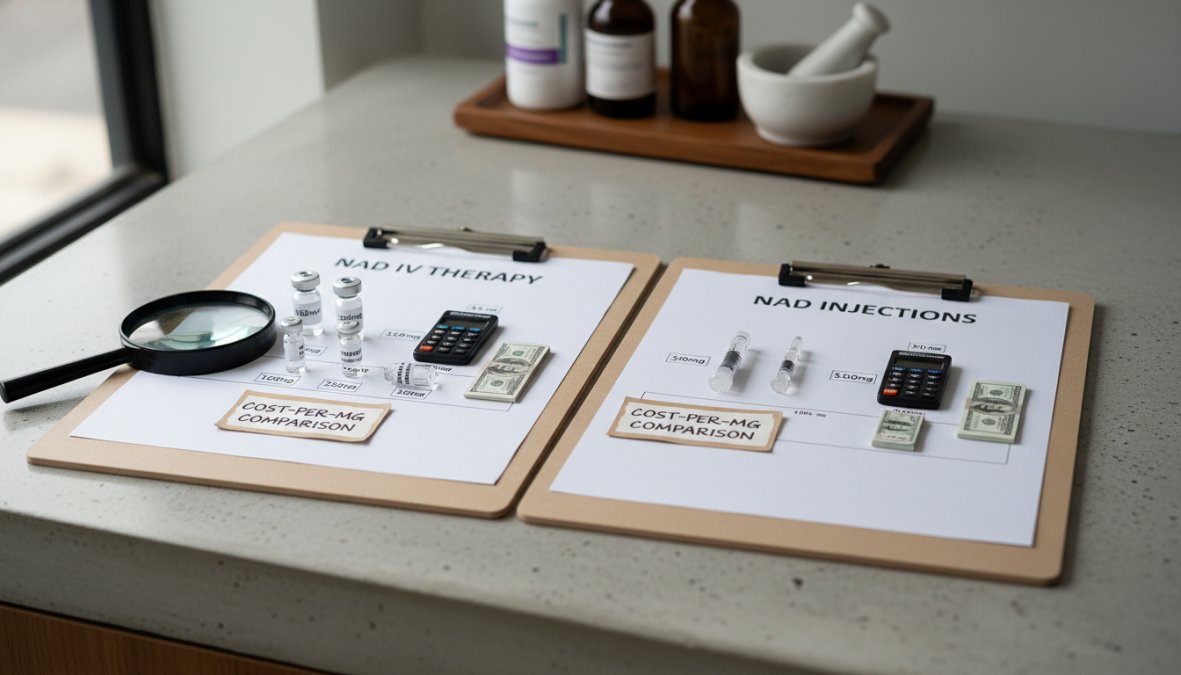
Side-by-Side Cost-Per-mg Comparison Table
This is the calculation that actually matters. The NAD IV therapy vs NAD injections price comparison looks very different when you normalize for dose.
| Delivery Method | Provider Example | Dose | Session Cost | Cost Per mg | Session Time |
|---|---|---|---|---|---|
| IV Drip (premium clinic) | Next Health | 300mg | ~$500 | ~$1.67/mg | 2-3 hours |
| IV Drip (standard clinic) | Onus IV | 250mg | ~$150 (member) | ~$0.60/mg | 1-2 hours |
| IM Injection (in-clinic) | Onus IV | 250mg | $150 ($105 member) | ~$0.60/mg | 15-30 min |
| Subcutaneous (telehealth) | AgelessRx | Varies | From ~$18/shot | Lowest tier | Self-admin |
| Subcutaneous (subscription) | Ivím Health | Weekly | ~$249/mo + $74.99 membership | Mid-range | Self-admin |
The cost-per-mg advantage of subcutaneous telehealth programs is clear. The question is whether lower peak plasma concentrations justify that savings for your specific goals.
If you’re doing a loading protocol (multiple sessions in a short window), the cost difference between IV and injection routes compounds quickly. Run the total cost for your full intended protocol, not just one session, before deciding.
Bioavailability and Absorption: Does the Price Difference Hold Up?
Bioavailability is the percentage of a substance that reaches systemic circulation in an active form. For NAD+ delivery, this is where the price premium for IV therapy finds its justification.

Intravenous therapy achieves close to 100% bioavailability by definition, since the compound enters the bloodstream directly. There is no absorption step, no first-pass metabolism, and no tissue barrier to cross. This is why IV remains the preferred route for high-dose loading protocols in clinical regenerative medicine settings.
Subcutaneous injections, as documented in NIH research on subcutaneous vs intravenous drug delivery bioavailability, absorb more slowly through the interstitial fluid before reaching systemic circulation. Bioavailability is meaningful but lower than IV, and peak concentrations are reduced. For maintenance dosing, this may be entirely adequate. For acute therapeutic goals, the difference is clinically relevant.
The honest answer is that IV therapy’s higher bioavailability does justify a price premium for certain use cases, particularly intensive loading phases. For ongoing maintenance protocols, subcutaneous injections offer sufficient systemic absorption at a fraction of the cost.
This is also where oral precursors like Nicotinamide Riboside (NR) and Nicotinamide Mononucleotide (NMN) fit into the picture. These supplements support NAD+ levels indirectly, and while they cannot match the plasma concentrations achieved by IV infusion, they represent the most affordable long-term maintenance option.
Benefits of NAD IV vs Subcutaneous Injections: Pros and Cons
The benefits of NAD IV vs subcutaneous injections depend almost entirely on what you’re trying to achieve and how much time and money you’re willing to invest.
Pros and Cons of NAD IV Therapy
Pros:
- Near-complete bioavailability with immediate systemic absorption
- Ability to deliver high loading doses (500mg-1,000mg) in a single session
- Professional medical oversight throughout infusion
- Rapid onset of effects, particularly for cognitive function and energy production
- Clinical setting provides monitoring for any infusion reactions
Cons:
- High cost per session, especially at premium wellness clinic locations
- Significant time commitment: one to four hours per infusion
- Requires clinic visit; no at-home option for IV administration
- IV insertion carries a small risk of phlebitis or bruising at the infusion site
- Mobile IV services add cost and logistical complexity
Pros and Cons of NAD Subcutaneous Injections
Pros:
- Significantly lower cost per session, especially through telehealth programs
- Self-administration at home once trained, no clinic visit required
- HSA/FSA eligible through platforms like AgelessRx
- Gradual absorption may improve tolerability for sensitive patients
- Easier to maintain a consistent daily or weekly protocol
Cons:
- Lower peak plasma NAD+ concentrations compared to IV infusion
- Requires comfort with self-injection; not suitable for all patients
- Dose ceiling is lower than IV protocols
- Compounded medications require a valid prescription and physician oversight
- Injection site reactions (redness, mild swelling) are possible
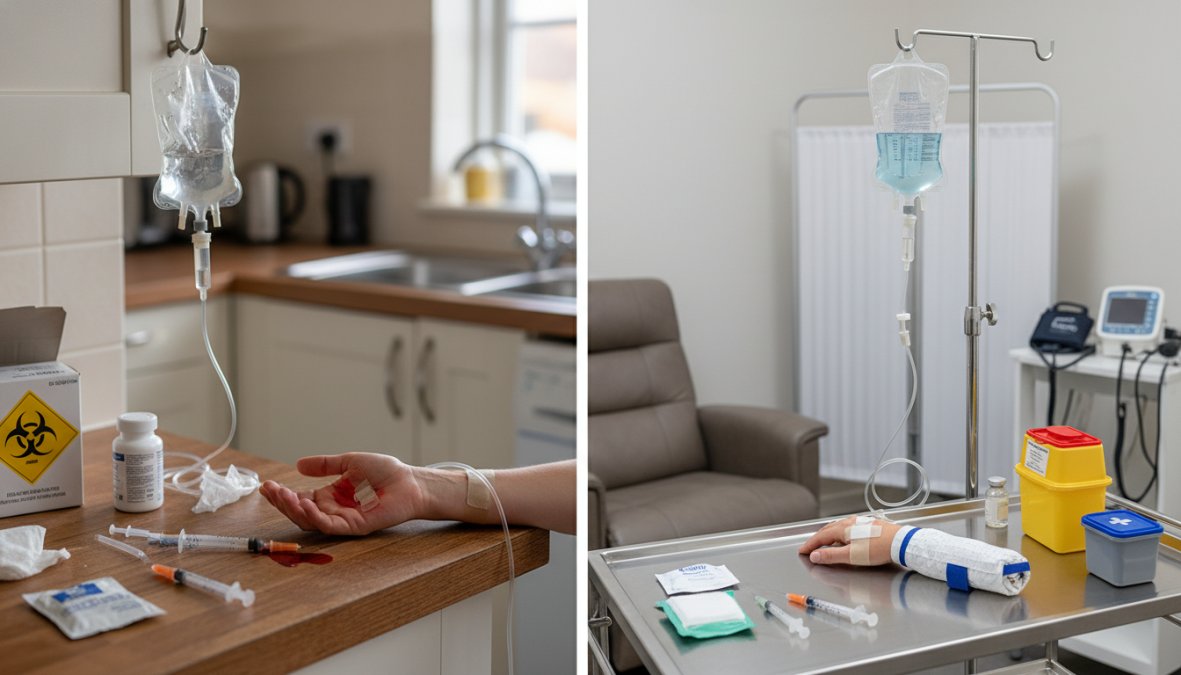
Never attempt IV self-administration at home. Intravenous therapy requires clinical setting standards, sterile technique, and trained oversight. Home IV kits marketed online carry serious infection and air embolism risks that are not present with subcutaneous injection protocols.
How Long Does NAD IV Therapy Last vs Injections?
The duration question has two dimensions: how long a single session takes, and how long the therapeutic effects persist before the next dose is needed.
Session Duration and Infusion Time
IV infusion time is the most significant logistical factor in the NAD IV therapy vs NAD injections price comparison. A 250mg IV drip typically runs 60 to 90 minutes. A 500mg session often takes two to three hours. High-dose 1,000mg loading infusions can run four hours or more, because pushing NAD+ too quickly causes common side effects including chest tightness, nausea, and flushing. The infusion must be titrated carefully.
Subcutaneous and IM injections, by contrast, take minutes. A self-administered subcutaneous shot at home requires only the time to prepare and inject. An in-clinic IM injection is typically complete within 30 minutes including prep.
Treatment Frequency and Maintenance Protocol
A typical NAD IV loading protocol runs three to five consecutive days of high-dose infusions, followed by monthly or bi-monthly maintenance sessions. This front-loaded structure is why the initial cost of IV therapy is substantial: you’re paying for multiple sessions before you transition to a maintenance cadence.
Subcutaneous injection protocols are usually structured as daily or weekly self-administered shots, consistent with the lower per-dose concentration. According to Cleveland Clinic overview of NAD+ therapy and dosing protocols, maintenance protocols vary significantly by individual health goals, and titration under physician guidance is recommended regardless of delivery method.
The practical implication: IV therapy costs more upfront, injections cost more over time if dosed frequently. Run the math for your full 12-month protocol before deciding which is cheaper in total.
Pain, Side Effects, and Home-Kit vs In-Clinic Safety
Pain tolerance and side effect profiles are real factors in the NAD IV therapy vs NAD injections price comparison that most guides underweight.
Injection Site Reactions and Infusion Discomfort
NAD IV infusions are generally well-tolerated when administered slowly, but a known set of systemic side effects occurs when infusion rate is too fast. These include chest pressure, nausea, dizziness, muscle cramping, and a flushing sensation. Experienced infusion nurses manage this by reducing the drip rate. Patients who have experienced a rapid infusion describe it as uncomfortable enough to want to stop the session.
Subcutaneous injections carry a different side effect profile. Local reactions at the injection site, including redness, mild swelling, or a burning sensation, are the most common complaints. These are generally transient and resolve within hours. Systemic side effects are less pronounced than with IV because peak plasma concentrations are lower.
Home Administration Safety Protocols vs Clinical Setting Standards
The safety gap between home and clinical administration is real and worth taking seriously.
Clinical settings provide sterile preparation, trained administration, real-time monitoring, and immediate access to emergency intervention if a reaction occurs. This is the standard that IV therapy requires and delivers.
Home subcutaneous injection programs, when prescribed through legitimate telehealth platforms like AgelessRx or Ivím Health, include training materials, physician oversight, and titration guidance. The risk profile for subcutaneous self-injection is genuinely low when protocols are followed correctly.
The thing nobody tells you about home injection kits is that the training quality varies considerably between providers. Before committing to a program, verify that the provider includes a proper injection technique walkthrough and a clear protocol for what to do if a reaction occurs.
Insurance, HSA, and FSA Eligibility for NAD Therapy
This is an angle most NAD comparisons skip entirely, and it changes the effective cost calculation meaningfully.
Traditional health insurance does not cover NAD+ therapy in either IV or injection form. These treatments are classified as wellness or anti-aging interventions rather than medically necessary procedures, which places them outside standard insurance coverage. Patients should not expect reimbursement through their health plan.
HSA (Health Savings Account) and FSA (Flexible Spending Account) eligibility is a different story. As documented by IRS guidelines on HSA and FSA eligible medical expenses, expenses for treatments prescribed by a licensed physician for a diagnosed medical condition can qualify. AgelessRx explicitly lists HSA/FSA as an accepted payment method for their NAD+ injection programs, which effectively reduces the cost by the patient’s marginal tax rate.
For IV therapy at a clinical setting, HSA/FSA eligibility depends on whether the treatment is prescribed for a specific medical condition versus purchased as a general wellness service. Patients should request a letter of medical necessity from their prescribing physician and confirm eligibility with their plan administrator before paying.
The practical takeaway: if you’re choosing between IV and injection routes and cost is a primary factor, the HSA/FSA angle alone can make the subcutaneous telehealth route substantially cheaper on an after-tax basis.
HSA and FSA payment options for NAD+ injections through telehealth platforms can reduce effective out-of-pocket costs by a meaningful margin, particularly for patients in higher tax brackets. This is one of the most underutilized cost-reduction strategies in the [NAD therapy](/nad-iv-therapy-anti-aging-benefits-cost/) space.
Which Option Wins the NAD IV Therapy vs NAD Injections Price Comparison?
There is no universal winner in the NAD IV therapy vs NAD injections price comparison. The right choice depends on your therapeutic goals, time availability, risk tolerance, and budget structure.
Choose IV Therapy If…
- You’re beginning a loading protocol and want maximum bioavailability in the shortest window
- You’re targeting significant cognitive function improvements or addressing substantial NAD+ depletion
- You prefer professional clinical oversight throughout treatment
- You have the time for one to four hour sessions and the budget for premium per-session pricing
- Your wellness clinic offers membership pricing that reduces the per-session cost to a manageable level
Choose Subcutaneous Injections If…
- You’re maintaining NAD+ levels after an initial loading phase
- Cost efficiency is a primary concern and you’re comfortable with self-administration
- You want the convenience of a home-based protocol without clinic visits
- You qualify for HSA/FSA reimbursement, which reduces the effective cost further
- You’re working with a telehealth platform that provides proper physician oversight and titration guidance
The real-world pattern many practitioners follow is a hybrid: start with a short IV loading protocol to establish elevated NAD+ levels quickly, then transition to subcutaneous injections for ongoing maintenance. This approach captures the bioavailability advantages of IV therapy for the acute phase while using the cost efficiency of injections for the long term.
Choosing between NAD IV therapy and injections is ultimately a clinical and financial decision that benefits from proper medical guidance, not just a price comparison. Ascend Vitality connects patients with specialized care pathways, offering medically-supported programs with prescriptions delivered directly to you, including access to hormone and metabolic health treatments tailored to your specific needs. If you’re ready to explore a NAD+ protocol designed around your goals, get started with Ascend Vitality and access targeted online care from providers who understand the full picture of your health.
Frequently Asked Questions
Is NAD IV therapy more expensive than NAD injections?
Yes, significantly. In the NAD IV therapy vs NAD injections price comparison, IV sessions at premium clinics like Next Health run around $500 for 300mg, while in-clinic IM shots at places like Onus IV start at $150 for 250mg. At-home subcutaneous injection programs through telehealth platforms can cost as little as $18 per shot. The convenience and bioavailability of IV infusions come at a steep premium over injection alternatives.
What is the average NAD IV therapy cost per session?
NAD IV therapy cost per session typically ranges from $150 to $1,000 or more depending on dosage and clinic type. A 250mg IV drip at a standard wellness clinic may start around $200-$300, while high-dose 1,000mg infusions at premium longevity centers can exceed $750. Mobile IV services often add a travel fee of $50-$100 on top of the base rate. Membership plans can reduce per-session costs by 20-30% at some providers.
Are NAD injections as effective as IV therapy for energy and cognitive function?
The benefits of NAD IV vs subcutaneous injections depend largely on bioavailability and dosage. IV infusions deliver NAD+ directly into the bloodstream, achieving near-100% systemic absorption. Subcutaneous injections also bypass the digestive system and offer high bioavailability, though the rate of absorption is slower. For acute loading doses or intensive protocols, IV therapy may produce faster results. For ongoing maintenance and cognitive function support, regular subcutaneous injections can be comparably effective at a fraction of the cost.
How long does NAD IV therapy last, and how often do you need treatments?
How long NAD IV therapy lasts depends on your goal. A single IV session can take 1-4 hours in a clinical setting. Initial loading protocols often involve 3-5 consecutive or weekly sessions, followed by monthly maintenance infusions. NAD+ levels naturally decline, so effects from a single session typically persist for days to a few weeks. Subcutaneous injections are usually administered weekly or bi-weekly for ongoing maintenance, making them more practical for long-term protocols.
Does insurance cover NAD IV therapy or NAD injections?
Standard health insurance plans generally do not cover NAD IV therapy or subcutaneous injections when used for anti-aging, biohacking, or general wellness purposes. However, some telehealth providers like AgelessRx accept HSA and FSA payments for prescription NAD+ injections, which can reduce out-of-pocket costs meaningfully. Always confirm HSA/FSA eligibility directly with your provider before purchasing, as eligibility can depend on how the prescription is coded and your plan’s specific rules.
What are the side effects of NAD IV therapy compared to injections?
NAD IV therapy commonly causes nausea, chest tightness, flushing, and headaches during infusion, especially at higher doses or faster drip rates, slowing the infusion usually resolves these. Subcutaneous injections tend to have milder systemic reactions but may cause localized redness, swelling, or bruising at the injection site. At-home injection kits carry additional risk if sterile technique is not followed correctly, making proper training and clinical-grade protocols essential for safe self-administration.