

Last Updated: July 7, 2026
According to recent healthcare technology research, the digital health market is expanding rapidly, with telehealth platforms now serving as critical infrastructure for startups entering the space. At Ascend Vitality, we understand that the benefits of white-label telehealth for digital health startups represent one of the most strategic decisions founders make when launching virtual care services. Rather than building infrastructure from scratch, startups can use existing telehealth platforms to accelerate their path to market while maintaining complete control over branding, clinical workflows, and patient experience.
Below, we’ll walk you through exactly why white-label solutions have become the default playbook for health-tech founders, and what separates a smart implementation from one that creates long-term technical debt.
What Is a White-Label Telehealth Platform and Why It Matters for Startups
A white-label telehealth platform is pre-built software infrastructure that a vendor operates on behalf of your startup, fully customized with your branding, logo, and domain. Your patients see only your brand, not the underlying vendor. You maintain the clinical relationship while the vendor handles servers, security patches, compliance infrastructure, and system uptime.
This is fundamentally different from building in-house. When you build, you own every line of code, every database decision, and every security vulnerability. When you white-label, you own the patient relationship and clinical strategy. The vendor owns the technical debt.
Core features of white-label software
White-label telehealth platforms typically include video consultation capabilities, appointment scheduling systems, patient portal access, provider dashboards, and integration hooks for electronic health records. Most offer multi-tenancy architecture, meaning the underlying infrastructure serves multiple independent practices while keeping data completely segregated.
Key architectural components include:
- Video infrastructure with HIPAA-compliant encryption, bandwidth optimization for poor connections, and automatic failover
- Appointment scheduling with calendar management, automated reminders, no-show handling, and payment processing at booking
- Patient portal for medical history access, prescription management, lab results viewing, and secure messaging
- Provider dashboard displaying patient queue, notes templates, prescription workflows, and clinical documentation
- EHR/EMR integration via HL7 or FHIR APIs, allowing bidirectional data flow with existing hospital systems
- Compliance infrastructure handling HIPAA audit logs, BAA agreements, data residency requirements, and encryption key management
The difference between a mature white-label platform and an immature one shows up immediately in deployment. A mature vendor handles compliance configuration for you. An immature one asks you to “configure your own HIPAA settings”, which is a red flag that they don’t fully understand healthcare infrastructure.
When evaluating white-label vendors, ask specifically: “What compliance configurations do you handle by default, and what requires our team’s input?” If they say everything is configurable, they’re shifting compliance responsibility to you.
Time to Market for Digital Health Startups: Speed as a Competitive Advantage
The most immediate benefit of white-label telehealth for digital health startups is velocity. A startup building custom telehealth infrastructure typically requires 9-14 months before the first patient consultation. A startup deploying a white-label platform can see patients in 4-8 weeks.
This matters because the healthcare market rewards speed to clinical validation. You can test whether your specific care pathway works, whether your weight loss program, hormonal health focus, or men’s vitality services actually drive patient outcomes, before spending millions on custom development.
Consider the timeline difference:
Build-from-scratch approach:
- Month 1-2: Architecture and vendor selection for cloud hosting, video infrastructure, security frameworks
- Month 3-5: Core video consultation and scheduling development
- Month 6-8: EHR integration and compliance configuration
- Month 9-11: Security audit and penetration testing
- Month 12-14: Beta testing and production deployment
White-label approach:
- Week 1-2: Vendor contract and onboarding
- Week 3-4: Branding customization and domain configuration
- Week 5-6: Clinical workflow setup and staff training
- Week 7-8: Initial patient cohort and live testing
The compressed timeline means you reach market before competitors, gather real patient data faster, and prove your business model works before raising Series A funding. This speed advantage often translates to market share in emerging care categories.
Speed to market isn’t just about launching first, it’s about gathering clinical evidence that your care model works before competitors arrive. White-label platforms compress that timeline from over a year to under two months.
Cost of Building vs Buying Telehealth Software: The Financial Reality
This is where many founders make their first mistake. They see white-label pricing (typically $2,000-$8,000 monthly plus per-patient fees) and think, “We could build this ourselves for less.” They’re wrong, but they don’t realize it until month eight of development.
Building custom telehealth software requires:
- Engineering team: Two senior backend engineers ($180K-$220K each), one frontend engineer ($140K-$180K), one DevOps engineer ($160K-$200K). Fully loaded cost: $600K-$800K annually.
- Compliance expertise: A dedicated person or contractor managing HIPAA, state telehealth regulations, and audit trails. Cost: $80K-$150K annually.
- Security infrastructure: Penetration testing, vulnerability management, encryption key rotation, and incident response. Cost: $40K-$100K annually.
- Video infrastructure: Bandwidth costs, redundant servers, failover systems. Cost: $30K-$80K annually depending on patient volume.
- Ongoing maintenance: Bug fixes, security patches, framework updates, dependency management. Cost: 20-30% of initial development annually.
Total cost of ownership comparison
The financial comparison becomes stark when you model total cost of ownership over three years:
| Cost Category | Build In-House | White-Label Platform |
|---|---|---|
| Initial development | $900K-$1.2M | $15K-$30K (setup) |
| Year 1 operations | $750K-$1M | $24K-$96K (annual) |
| Year 2 operations | $800K-$1.1M | $24K-$96K (annual) |
| Year 3 operations | $850K-$1.2M | $24K-$96K (annual) |
| 3-Year Total | $3.3M-$4.5M | $87K-$318K |
The white-label approach costs 10-50x less over three years. Even accounting for per-patient fees (typically $5-$20 per active patient monthly), the math heavily favors buying.
But cost isn’t the only factor. The real advantage is what your engineering team does instead of maintaining telehealth infrastructure. If you’re hiring engineers to build your own platform, those same engineers could be building AI-powered clinical decision support, predictive patient engagement tools, or proprietary analytics that actually differentiate your startup from competitors.
A common mistake is underestimating maintenance burden. Founders assume “we’ll build it once and it’s done.” In reality, maintaining HIPAA compliance alone requires constant vigilance as regulations evolve. One missed security update can result in patient data exposure and regulatory fines exceeding $100K.
HIPAA Compliant Telehealth Solutions for Startups: Security and Regulatory Foundation
HIPAA compliance isn’t a feature you add after launch, it’s the foundation that everything else builds on. A single data breach can shut down a startup permanently.
White-label vendors handle the heavy lifting: Business Associate Agreements, encryption standards, audit logging, access controls, and breach notification procedures. But not all white-label vendors are equally rigorous. The difference between a vendor that “checks the HIPAA box” and one that truly operates under healthcare-grade security is significant.
Data security and multi-tenancy architecture
The core security challenge in white-label platforms is multi-tenancy: multiple independent practices sharing the same underlying infrastructure. If the vendor’s isolation mechanisms are weak, patient data from Practice A could leak into Practice B’s system.
Mature white-label vendors implement:
- Database-level isolation where each practice’s data lives in logically separate schemas with role-based access controls preventing cross-tenant queries
- Encryption at rest using AES-256 encryption with encryption keys managed separately from the database
- Encryption in transit using TLS 1.2+ for all data movement, including API calls and video streams
- Audit logging capturing every data access event: who accessed what, when, from which IP address, and why
- Role-based access control limiting staff to only the patient records and functions they need for their job
The vendor should provide you with a SOC 2 Type II report, demonstrating that an independent auditor has verified their security controls. If they don’t have one, that’s a major red flag.
According to research from HHS Office for Civil Rights breach notification data, healthcare data breaches have increased significantly, with most breaches traced to inadequate access controls or unencrypted data. White-label vendors that invest in multi-tenancy security reduce your breach risk substantially compared to building your own systems.
When evaluating white-label vendors, request their SOC 2 Type II report and ask specifically about their multi-tenancy isolation testing. A vendor that can’t produce independent security audits hasn’t invested in real security.
Telehealth Software Integration Best Practices: Connecting Your Healthcare Infrastructure
No telehealth platform exists in isolation. Your platform needs to integrate with electronic health records, pharmacy systems, insurance verification tools, and lab ordering systems. Poor integration design creates data silos and forces staff to manually enter information twice, a recipe for errors and staff burnout.
EHR/EMR integration and API-first design
White-label platforms that support proper EHR integration use standards-based APIs: HL7 v2 for legacy systems, FHIR for modern systems. The vendor should provide clear API documentation, sandbox environments for testing, and support for common EHR platforms (Epic, Cerner, Athena, etc.).
Integration patterns that work:
- Bidirectional patient sync: When a patient books an appointment in your telehealth platform, their demographics automatically flow to your EHR. When the provider documents the visit, the note flows back to the EHR.
- Medication reconciliation: The platform queries your EHR for current medications before the visit, displaying them to the provider and flagging drug interactions.
- Lab result integration: New lab results from your EHR appear in the patient portal automatically, triggering alerts to the provider if critical values appear.
- Prescription routing: When a provider issues a prescription in the telehealth platform, it routes directly to the patient’s pharmacy, eliminating manual faxing.
The difference between a platform with good integration and poor integration shows up in staff efficiency. A clinic using proper bidirectional EHR sync saves 15-20 minutes per provider per day on data entry and reconciliation. Over a year, that’s 60-80 hours of recovered time per provider.
HL7 FHIR standard documentation defines modern healthcare data exchange standards. Vendors that build to these standards make your platform future-proof. Vendors that use proprietary APIs lock you in and make future migrations painful.
Custom Branding and Patient Engagement: Building Your Digital Health Identity
White-label platforms let you control the entire patient experience. Your logo, your colors, your domain, your messaging. This matters more than many founders realize, patient perception of your brand directly impacts engagement and retention.
A white-label platform should allow:
- Custom domain: Patients access your telehealth platform at yourcompany.com, not a vendor subdomain
- Branded patient portal: Your logo and colors throughout the patient interface, not generic vendor branding
- Customizable workflows: Intake forms, questionnaires, and consent documents tailored to your specific care model
- Branded communications: Email confirmations, appointment reminders, and follow-up messages use your branding and tone
- Provider customization: Each provider can have a custom profile page with their photo, credentials, and bio
Patient engagement metrics improve measurably with strong branding. Patients who see your brand consistently are more likely to complete pre-visit questionnaires, attend appointments on time, and complete follow-up care. A platform that forces patients to see vendor branding throughout their experience undermines your brand authority.
The most sophisticated white-label platforms also support customizable patient engagement features: automated appointment reminders (SMS and email), post-visit surveys, medication adherence tracking, and secure messaging between visits. These features drive higher engagement and better clinical outcomes.
Build vs. Buy Decision Framework: A Structured Approach for Founders
This decision will define your startup’s first two years. Get it wrong and you’ll spend all your resources maintaining infrastructure instead of serving patients. Here’s a structured framework to make this decision.
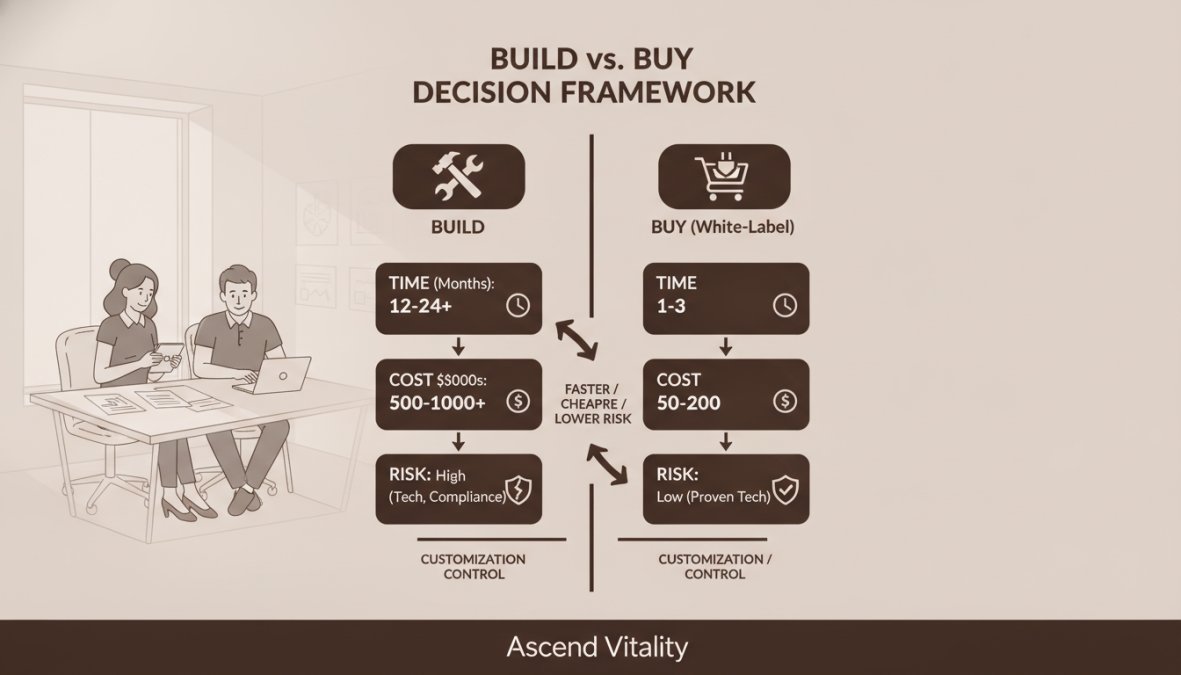
Step 1: Assess your engineering resources. Do you have experienced backend engineers who understand HIPAA, healthcare data standards, and cloud infrastructure? If not, building is not an option. Period. You’ll hire inexperienced engineers, they’ll make architectural mistakes, and you’ll spend your Series A fixing their work.
Step 2: Calculate your runway impact. How much runway do you have? How many months can you survive without revenue? If you have 18 months of runway and need 14 months to build a platform, you have four months to find product-market fit. That’s not realistic. If you have 30 months of runway, building becomes more feasible, but it’s still risky.
Step 3: Define your differentiation. What’s your actual competitive advantage? Is it the telehealth platform itself, or is it your clinical expertise, your patient acquisition strategy, or your care model? If your differentiation is NOT the platform, you should white-label. If your differentiation IS the platform (e.g., you’re building AI-powered clinical decision support), then building makes sense.
Step 4: Model your patient growth. How many patients will you have in year one? Year two? Year three? Use these numbers to model white-label costs. If you’re projecting 1,000 active patients by year one, white-label costs are $60K-$240K annually. If you’re projecting 10,000 patients, white-label costs are $600K-$2.4M annually. At that scale, building your own platform becomes financially defensible.
Vendor due diligence checklist
If you decide to white-label, here’s your evaluation checklist. Don’t skip any of these.
- Compliance: Does the vendor have SOC 2 Type II certification? Can they provide a BAA? Do they support HIPAA, state telehealth regulations, and GDPR?
- Integration: What EHR systems do they support? Do they offer HL7 and FHIR APIs? Can you test integration in a sandbox?
- Scalability: What’s their maximum concurrent video sessions? What happens when you exceed capacity? What are their SLA guarantees?
- Customization: How much can you customize the patient portal, provider interface, and workflows? Are customizations done by them or by your team?
- Pricing transparency: What are the base fees? Per-patient fees? Setup costs? Are there hidden costs for support, integration, or customization?
- Support model: What’s their response time for critical issues? Do they have 24/7 support? Do they have healthcare-specific support staff or generic tech support?
- Data ownership: Who owns patient data if you leave the vendor? Can you export all patient data in standard formats (HL7, FHIR)? How long is the data migration window?
- Roadmap: What features are they building in the next 12 months? Do those features align with your needs? How often do they release updates?
- References: Can you speak with 3-5 other healthcare startups using their platform? What do they like? What do they complain about?
- Financial stability: How long has the vendor been in business? Do they have sustainable funding? What’s their burn rate? (A vendor that goes out of business leaves you stranded.)
Don’t choose a vendor based on price alone. The cheapest white-label platform often lacks the compliance rigor, integration depth, or customer support you need. A vendor that’s $2,000/month more expensive but has better EHR integration might save you $200K in staff time over two years.
The build vs. buy decision isn’t about which option is objectively better, it’s about which option lets you focus on what actually differentiates your startup. If your differentiation is clinical expertise and patient acquisition, white-label. If your differentiation is platform technology, build.
Post-Launch Maintenance and Technical Debt: Planning for Long-Term Success
Here’s what most founders don’t anticipate: launch is not the finish line. It’s the starting line. After you go live, the real work begins.
With a white-label platform, your maintenance burden is lighter but not zero. You still need to monitor platform performance, manage integrations when vendors update their APIs, handle patient support issues, and stay compliant as regulations evolve.
Common maintenance challenges:
- Integration drift: Your EHR vendor releases an API update that breaks your integration. If your white-label vendor doesn’t update quickly, patient data stops syncing. You need someone on your team monitoring this.
- Compliance updates: State telehealth regulations change. HIPAA guidance evolves. Your white-label vendor should handle most of this, but you need to verify they’ve implemented changes.
- Scaling issues: Your patient volume grows faster than expected. The white-label platform starts hitting performance limits. You need to work with the vendor to optimize or upgrade your infrastructure.
- Feature gaps: You discover that a key feature you need isn’t available in the platform. You have to choose between building a custom workaround, requesting the vendor add it, or switching platforms.
The vendors that succeed long-term are those that invest in their product roadmap and respond quickly to customer needs. The vendors that fail are those that treat their white-label offering as a “set it and forget it” cash cow.
When evaluating vendors, ask directly: “What’s your roadmap for the next 12-24 months? How do you prioritize feature requests from customers?” If they can’t give you a clear answer, they’re not investing enough in their product.
Build vs. buy isn’t a one-time decision, it’s a continuous evaluation. Every six months, reassess: Is this vendor still meeting our needs? Are we growing faster than their platform can handle? Would building our own features now make sense given our scale?
The benefits of white-label telehealth for digital health startups ultimately come down to this: you get to focus on medicine and patients, while the vendor focuses on infrastructure and compliance. At Ascend Vitality, we’ve seen startups that white-labeled their platform reach profitability 18-24 months faster than startups that built custom infrastructure. They deployed faster, iterated based on real patient feedback, and used their engineering resources to build features that actually differentiated their business. Choose a vendor that invests in security, compliance, and integration depth, and you’ll have a foundation that scales with your clinical ambitions.
Frequently Asked Questions
What is a white-label telehealth platform and how does it differ from building custom software?
A white-label telehealth platform is pre-built software you rebrand and customize to match your company identity. Unlike custom development, it provides ready-made features like video consultations, appointment scheduling, patient portals, and provider dashboards. This approach eliminates months of development, reduces technical risk, and lets you focus on clinical workflows and patient acquisition instead of infrastructure.
How much faster is deployment with white-label telehealth solutions compared to building from scratch?
White-label platforms typically deploy in weeks to 2-3 months, depending on customization needs and integration complexity. Building custom telehealth software from scratch usually takes 12-18+ months. This speed to market advantage lets digital health startups launch, validate their business model, and begin generating revenue significantly faster than competitors building proprietary solutions.
Are white-label telehealth solutions HIPAA compliant and secure for patient data?
Reputable white-label telehealth platforms are built with HIPAA compliance as a foundation, including data encryption, multi-tenancy architecture, and audit trails. However, compliance responsibility is shared, you must verify the vendor’s certifications, review their security documentation, and implement proper access controls. Always request their compliance documentation and conduct vendor due diligence before selecting a platform.
What are the main risks of using white-label telehealth software for a digital health startup?
Key risks include vendor lock-in, limited customization flexibility, ongoing platform dependency, and potential technical debt if the vendor doesn’t maintain their infrastructure. Additionally, if the vendor experiences downtime or discontinues service, your operations are affected. Mitigate these risks by thoroughly evaluating vendors, ensuring strong API-first design for interoperability, reviewing SLA commitments, and planning for potential migration scenarios during your selection process.