
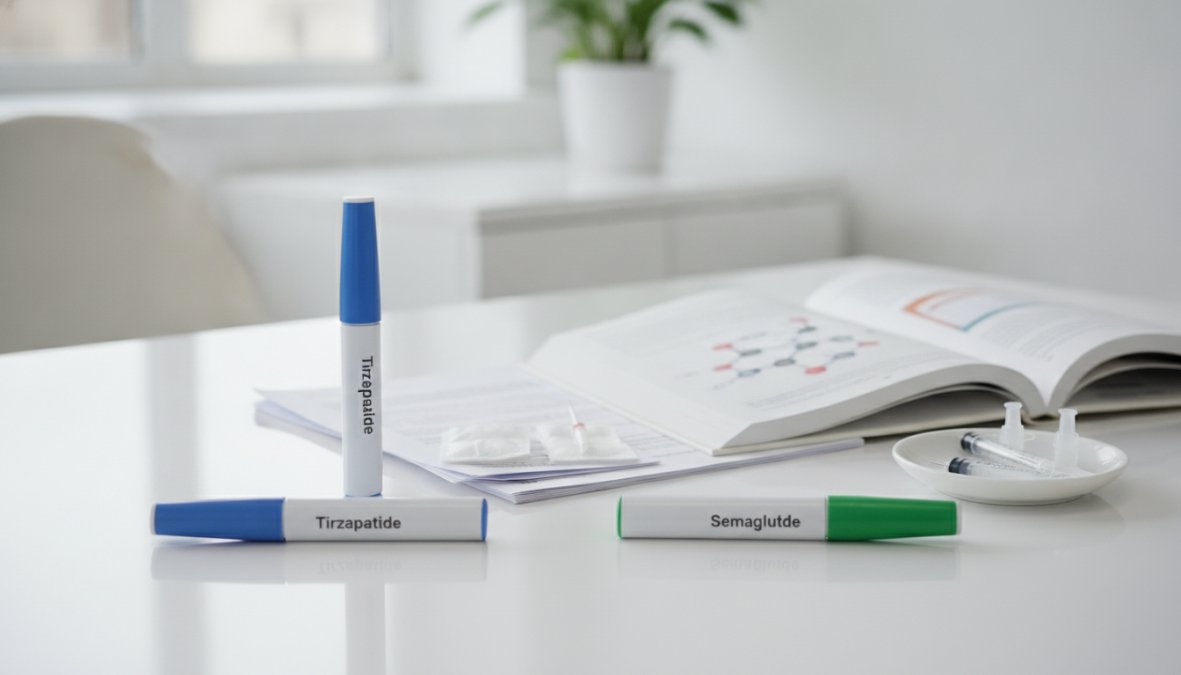
Tirzepatide vs Semaglutide for Weight Loss: A Clinical Comparison
Last Updated: July 16, 2026
Tirzepatide vs Semaglutide for Weight Loss: Key Differences at a Glance
Tirzepatide acts as a dual GIP/GLP-1 receptor agonist, while semaglutide functions as a single GLP-1 receptor agonist. Both are FDA-approved for chronic weight management in adults with obesity or overweight status, yet their pharmacological differences create meaningful variations in weight loss results and tolerability.
The comparison extends beyond efficacy numbers. Cost, insurance coverage, dosing schedules, and long-term maintenance strategies all influence which medication works best for individual patients.
Quick Comparison Table
| Feature | Tirzepatide (Zepbound) | Semaglutide (Wegovy) |
|---|---|---|
| Receptor Type | Dual GIP/GLP-1 agonist | Single GLP-1 agonist |
| Administration | Weekly subcutaneous injection | Weekly subcutaneous injection |
| Average Weight Loss (72 weeks) | ~21% body weight | ~18% body weight |
| FDA Approval | 2023 (weight loss) | 2021 (weight loss) |
| Dosing Frequency | Once weekly | Once weekly |
| Starting Dose | 2.5 mg | 0.25 mg |
| Maximum Dose | 15 mg | 2.4 mg |
| Best For | Patients seeking maximal weight loss | Patients with cardiovascular concerns |
| Primary GI Side Effects | Nausea, vomiting, diarrhea | Nausea, vomiting, diarrhea |
How Tirzepatide and Semaglutide Work: GLP-1 vs GLP-1/GIP Agonists
GLP-1 receptor agonists like semaglutide bind to glucagon-like peptide-1 receptors in the brain and gut, slowing gastric emptying and increasing satiety. Tirzepatide’s dual-agonist approach activates both GIP and GLP-1 receptors simultaneously, enhancing weight loss through multiple metabolic pathways. The GIP component independently reduces appetite and may improve insulin sensitivity, while the GLP-1 component provides satiety benefits.
Semaglutide’s Single-Receptor Mechanism
Semaglutide delivers weight loss through a well-characterized GLP-1 pathway, triggering reduced food cravings and improved portion control within 2-3 weeks. The single-receptor mechanism produces consistent results across patient populations through behavioral appetite suppression rather than metabolic acceleration.
Semaglutide also offers cardiovascular benefits beyond weight reduction, reducing the risk of major adverse cardiovascular events in patients with established heart disease.
Semaglutide’s FDA approval for cardiovascular risk reduction gives it an advantage for patients with prior heart disease or multiple cardiac risk factors.
Tirzepatide’s Dual-Receptor Advantage
Tirzepatide’s simultaneous GIP and GLP-1 activation creates a synergistic effect exceeding either pathway alone. The GIP component may improve insulin secretion, enhance glucose control, and potentially increase energy expenditure. Clinical evidence shows tirzepatide consistently produces greater weight loss than semaglutide at equivalent time points.
Tirzepatide’s dual-receptor mechanism produces approximately 3-5% greater weight loss than semaglutide in most patient populations, a clinically meaningful difference for aggressive weight management.
Tirzepatide Weight Loss Results: Clinical Trial Data
Tirzepatide demonstrated substantial weight loss in the SURMOUNT clinical trial program. Over 72 weeks, patients receiving the highest dose (15 mg) achieved approximately 21% average weight loss of baseline body weight. Dose-dependent responses were evident: 5 mg achieved ~15% weight loss, 10 mg reached ~19% weight loss.

Long-term data shows sustained weight loss maintenance over 2 years. Weight loss benefits appeared consistent across demographic categories, suggesting tirzepatide’s mechanism works reliably across diverse patient populations.
Semaglutide Side Effects: What to Expect
Gastrointestinal adverse events dominate semaglutide’s side-effect profile. Nausea affects 25-40% of patients, vomiting occurs in 5-10%, and diarrhea affects 20-30%. Most symptoms emerge within 2-4 weeks of initiation or dose increases, peaking during the first week then gradually diminishing. By 8-12 weeks, most patients report significant improvement despite continuing treatment.
Non-gastrointestinal side effects include fatigue, headache, and dizziness in 10-15% of patients. Serious adverse events remain rare.
Gastrointestinal Adverse Events
Nausea typically manifests as mild queasiness rather than severe vomiting. Vomiting occurs less frequently but carries greater impact on adherence, typically resolving within 5-7 days after dose escalation. Diarrhea develops in 20-30% of patients and tends to persist longer than nausea, usually resolving within 2-3 weeks.
Constipation paradoxically affects some patients due to decreased caloric intake combined with reduced GI motility.
Managing Side Effects During Titration
Titration protocols minimize side-effect severity. Semaglutide dosing begins at 0.25 mg weekly for 4 weeks, then increases to 0.5 mg weekly, with subsequent increases every 4 weeks: 1.0 mg, 1.7 mg, and 2.4 mg maintenance dose.
Slower titration schedules reduce nausea incidence significantly. Patients escalating over 16-20 weeks experience substantially fewer GI symptoms. Dietary strategies complement medication titration: smaller, frequent meals reduce nausea compared to three large meals; avoiding high-fat foods minimizes GI distress; staying well-hydrated supports tolerance.
Ginger supplementation, vitamin B6, and prescription antiemetics like ondansetron help manage nausea when dietary modifications prove insufficient.
Severe, persistent vomiting lasting more than 24-48 hours requires medical evaluation, as it may indicate medication intolerance or other underlying conditions requiring dose adjustment.
Tirzepatide Cost vs Semaglutide Cost: Pricing Breakdown
Both medications carry substantial list prices exceeding $1,000 monthly without insurance. Real-world costs depend heavily on insurance status, coverage policies, and patient assistance programs.
List Price and Cash-Pay Options
Cash-pay pricing through specialty pharmacies ranges from $200-$400 monthly for tirzepatide (2.5-5 mg) and $250-$450 for semaglutide, depending on dose and pharmacy. Direct-to-consumer telehealth platforms often negotiate lower pricing, reducing costs by 30-50%. GoodRx and similar discount programs reduce tirzepatide to $150-$300 monthly and semaglutide to $180-$350 monthly.
Insurance Coverage Landscape
Approximately 60-70% of commercial insurance plans cover either tirzepatide or semaglutide for weight management, though many impose BMI thresholds or comorbidity requirements. Copayments typically range from $50-$300 monthly.
Medicaid coverage varies by state. Approximately 35 states cover at least one GLP-1 agonist for weight loss; 15 states explicitly exclude weight loss as a covered indication. Medicare Part D coverage remains limited, covering these medications primarily for type 2 diabetes rather than weight management.
Prior Authorization: Timeline and Documentation Requirements
Prior authorization delays treatment initiation by 5-14 days on average. Typical requirements include:
- Current weight and BMI (within 30 days)
- Baseline metabolic panel or recent labs
- Documentation of at least one failed weight-loss attempt within 12 months
- Physician attestation of FDA-approved indications
- Confirmation of no contraindications
Expedited review (3-5 days) is available for patients with multiple comorbidities. Submitting complete documentation on first submission reduces approval time by 50%.
Patient Assistance Programs and Cost Reduction Strategies
Manufacturer-operated patient assistance programs provide free or reduced-cost medication for uninsured and underinsured patients.
Eli Lilly Tirzepatide Savings Program: Eligible patients pay as little as $25 monthly; income limits up to 400% of federal poverty level; approval within 24-48 hours.
Novo Nordisk Semaglutide Savings Program: Eligible patients pay $0-$250 monthly; income limits up to 500% of federal poverty level; permanent approval within 5-7 business days.
Patients with commercial insurance facing high copayments can use manufacturer copay cards capping out-of-pocket costs at $25-$100 monthly. Some employers negotiate preferred pricing for GLP-1 agonists; checking your employer’s formulary can reveal these opportunities.
Insurance Denial and Appeals Process
Approximately 10-15% of initial prior authorization requests receive denial, typically citing insufficient documentation or BMI below plan thresholds. Denials are often reversible through appeals.
If denied, request written explanation, gather additional documentation, submit formal appeal with physician cover letter, and request expedited review (72 hours). Appeals succeed in 40-60% of cases. If denied again, request external independent review through your state’s insurance commissioner’s office.
Request your prescriber’s office handle prior authorization and appeals directly, most specialty pharmacies manage this without patient involvement, accelerating approval.
Do not delay treatment while awaiting insurance approval. Many patients qualify for manufacturer assistance programs providing medication at minimal cost within 24-48 hours.
Dosing, Administration, and Maintenance Schedules
Both medications use once-weekly subcutaneous injection. Tirzepatide begins at 2.5 mg and escalates in 2.5 mg increments every 4 weeks to maximum 15 mg. Semaglutide starts at 0.25 mg and increases every 4 weeks to maximum 2.4 mg.
Both come in pre-filled pens simplifying self-administration. Patients inject into abdomen, thigh, or upper arm, rotating sites weekly. Maintenance therapy continues long-term, as weight regain typically occurs within months of discontinuation.
Injecting at consistent times weekly, such as every Monday morning, improves adherence and reduces missed doses.
Long-Term Weight Maintenance After Stopping Medication
Weight regain represents the primary challenge following discontinuation. Clinical data shows patients regain approximately 50-70% of lost weight within 12 months post-discontinuation. However, strategic lifestyle modifications initiated during treatment can substantially reduce regain rates.
The Physiology of Weight Regain
Weight regain involves multiple mechanisms. First, appetite regulation returns to baseline as medication-induced GLP-1 signaling ceases within 2-4 weeks. Second, metabolic adaptation reduces energy expenditure as weight loss occurs; the body burns 10-15% more calories at rest during treatment, then returns to baseline. Third, behavioral patterns may not persist without medication reinforcement.
Lifestyle Integration During Treatment: Building Sustainable Habits
The 12-24 months on GLP-1 agonists provide a critical window to establish dietary and exercise patterns persisting after medication stops.
Dietary strategies:
- Protein prioritization: Consume 25-35 grams per meal. Protein provides superior satiety persisting after medication discontinuation. Focus on Greek yogurt, lean meats, fish, and legumes.
- Whole-food emphasis: Use reduced appetite to transition from processed to whole foods, which provide greater satiety per calorie.
- Meal structure and timing: Establish consistent meal timing rather than grazing, helping regulate hunger hormones and reduce impulsive snacking.
- Hydration and fiber: Increase water to 80-100 ounces daily and fiber to 30-40 grams daily for satiety independent of medication.
Exercise integration:
- Resistance training (3-4 days weekly): Preserves muscle mass during weight loss, maintaining metabolic rate. Patients performing resistance training maintain 5-10% more weight loss long-term.
- Cardiovascular activity (150+ minutes weekly): Walking, cycling, or swimming at moderate intensity for 30 minutes, 5 days weekly, establishes sustainable patterns.
- Non-exercise activity thermogenesis (NEAT): Daily movement beyond structured exercise, parking farther away, taking stairs, standing during calls, accounts for 15-30% of daily energy expenditure.
Psychological and Behavioral Preparation for Discontinuation
Begin psychological preparation 3-6 months before planned discontinuation.
Food noise and cravings management:
- Mindfulness and urge surfing: Practice observing cravings without immediately acting. During treatment when cravings are minimal, develop this mental skill for post-discontinuation use.
- Environmental modification: Remove trigger foods, modify shopping routes, and plan alternative activities for high-risk times.
- Social support and accountability: Establish relationships with others pursuing weight maintenance. Social support predicts long-term success more strongly than any dietary approach.
Maintenance Therapy: A Realistic Long-Term Strategy
Continuing medication indefinitely at lower maintenance doses represents the most reliable approach for sustained weight loss, acknowledging obesity as a chronic condition requiring ongoing treatment.
Maintenance dosing strategies:
- Tirzepatide maintenance: After reaching therapeutic weight loss on 10-15 mg weekly, reduce to 5-7.5 mg weekly for maintenance, preserving 80-90% of weight loss while reducing side effects and costs by 30-40%.
- Semaglutide maintenance: Reduce from 2.4 mg to 1.0-1.7 mg weekly for maintenance, preserving most weight-loss benefits.
Cost-benefit analysis: Continuing medication at maintenance doses costs $100-$200 monthly, compared to substantial costs of weight regain complications including increased healthcare utilization, potential bariatric surgery ($15,000-$35,000), and lost productivity.
Patients establishing strong dietary habits, consistent exercise, and psychological coping strategies during treatment maintain 30-50% more weight loss long-term compared to those relying on medication alone.
Consider maintenance therapy as realistic long-term strategy rather than viewing discontinuation as the goal. Obesity is chronic; ongoing pharmacotherapy is evidence-based management.
Patient Eligibility and Contraindications
FDA approval requires BMI ≥30 kg/m² or BMI ≥27 kg/m² with at least one weight-related comorbidity (hypertension, type 2 diabetes, dyslipidemia, obstructive sleep apnea, cardiovascular disease).
Personal or family history of medullary thyroid carcinoma (MTC) or multiple endocrine neoplasia syndrome type 2 (MEN2) represents absolute contraindication. Pregnancy is also absolute contraindication; women of childbearing age should use effective contraception during treatment and for at least 2 months after final injection.
Severe renal impairment (eGFR <15 mL/min) requires careful consideration. Moderate renal impairment (eGFR 15-60) typically permits use with monitoring. History of pancreatitis warrants caution. Diabetic retinopathy, particularly severe cases, is a relative contraindication, as rapid weight loss and improved glycemic control can transiently worsen retinopathy.
Which Medication Should You Choose?
The choice depends on individual clinical factors, side-effect tolerance, and treatment goals. Tirzepatide consistently produces 3-5% greater weight loss than semaglutide. Cost and insurance coverage often determine the practical choice. Side-effect tolerance influences selection significantly.
Choose Tirzepatide If
Maximal weight loss represents your primary goal and you can tolerate gastrointestinal side effects. Tirzepatide’s 21% average weight loss substantially exceeds typical semaglutide outcomes.
You have concurrent type 2 diabetes or metabolic dysfunction. The dual mechanism addresses both weight and glycemic control.
Insurance coverage and cost present no barriers, or you’ve previously failed semaglutide therapy.
Choose Semaglutide If
You have established cardiovascular disease or multiple cardiac risk factors. Semaglutide’s FDA approval for cardiovascular risk reduction provides benefits independent of weight loss.
Gastrointestinal side effects concern you significantly. Semaglutide’s more gradual titration and milder GI profile improve tolerability.
Insurance coverage favors semaglutide or cost barriers limit tirzepatide access. Semaglutide’s longer market presence provides 5+ years of real-world safety data.
Tirzepatide suits patients seeking maximal weight loss without cardiovascular disease concerns. Semaglutide suits patients with cardiac history or those prioritizing GI side-effect minimization.
Conclusion: Making Your Decision on Tirzepatide vs Semaglutide
The decision ultimately rests on balancing efficacy, tolerability, cost, and individual medical circumstances. Tirzepatide offers superior weight loss outcomes through its dual-receptor mechanism, while semaglutide provides cardiovascular benefits and a gentler side-effect profile.
Both medications require long-term commitment. Weight regain occurs predictably after discontinuation, necessitating either indefinite medication continuation or exceptionally strong lifestyle modifications. The most effective medication is the one you’ll use consistently. Work with your healthcare provider to assess your individual circumstances, review contraindications, and select the medication that maximizes benefit while minimizing burden.
Frequently Asked Questions
What is the main difference between tirzepatide vs semaglutide for weight loss?
The primary difference lies in their mechanism of action. Semaglutide is a GLP-1 receptor agonist that mimics one natural hormone to reduce appetite. Tirzepatide is a dual-agonist, targeting both GIP and GLP-1 receptors, which may provide enhanced metabolic effects. This dual action in tirzepatide may contribute to greater weight reduction compared to semaglutide in clinical trials.
Which medication produces better tirzepatide weight loss results compared to semaglutide?
Clinical trial data suggests tirzepatide may lead to greater weight loss. Tirzepatide demonstrated approximately 21% average weight reduction over 72 weeks in trials, while semaglutide typically shows slightly lower percentages. However, individual results vary based on baseline weight, lifestyle factors, and adherence to dosing schedules. Your healthcare provider can discuss which may be more suitable for your specific situation.
What are the common semaglutide side effects, and how do they compare to tirzepatide?
Both medications share similar gastrointestinal adverse events, including nausea, vomiting, and diarrhea, particularly during initial titration phases. These effects typically diminish as your body adjusts. Tirzepatide may have a slightly higher incidence of nausea due to its dual-agonist mechanism. Side effect severity often depends on dosing schedules and individual tolerance. Gradual dose escalation can help minimize these adverse events.
How do tirzepatide cost vs semaglutide cost compare for uninsured patients?
List prices are similar, with both medications costing approximately $1,200-$1,350 monthly without insurance. However, pricing varies significantly based on dosage, pharmacy, and available patient assistance programs. Semaglutide (Wegovy) offers savings programs starting at $25/month with eligible commercial insurance. Tirzepatide (Zepbound) has similar programs. For current pricing and insurance navigation, contact Ascend Vitality or your healthcare provider directly for personalized quotes.
Can I switch from semaglutide to tirzepatide if I’m not seeing results?
Switching between GLP-1 and dual-agonist medications is possible but requires medical supervision. Your healthcare provider will assess your response, any adverse events, and contraindications before recommending a switch. Typically, you should allow at least 12-16 weeks on a stable maintenance dose to fairly evaluate efficacy. Ascend Vitality’s specialized care pathways can help coordinate this transition with appropriate medical oversight and monitoring.
Ready to explore weight-loss medication options tailored to your health profile? Ascend Vitality connects you with specialized care pathways providing medically-supported programs and prescriptions delivered directly to you. Our team navigates insurance coverage, manages side effects, and optimizes your treatment plan for sustained weight loss success. Start your consultation today to determine whether tirzepatide or semaglutide aligns best with your goals.