

Table of Contents
- How Many Pounds Per Month Can You Lose on GLP-1? Realistic Expectations
- GLP-1 Weight Loss Timeline: Understanding the Progression
- Factors Affecting GLP-1 Weight Loss: Why Results Vary
- How GLP-1 Medications Work: Mechanism Behind Weight Loss
- GLP-1 Diet Plan: Nutritional Strategy for Maximum Results
- GLP-1 Side Effects and Weight Loss: Managing Nausea, Vomiting, and Digestive Issues
- Types of GLP-1 Medications: Semaglutide, Tirzepatide, Liraglutide Compared
- Weight Regain After Stopping GLP-1s: Long-Term Maintenance Strategies
- Mental Health and Psychological Support During GLP-1 Treatment
- Cost and Insurance Coverage for GLP-1 Weight Loss Medications
Last Updated: July 23, 2026
How Many Pounds Per Month Can You Lose on GLP-1? Realistic Expectations
Most people lose between 1 to 2 pounds per week during the first three months on GLP-1 receptor agonists, translating to roughly 4 to 8 pounds monthly. However, weight loss typically slows after the first few months as your body adapts. The key insight: GLP-1 medications don’t create uniform results. A person starting at 250 pounds will see dramatically different monthly weight loss than someone starting at 180 pounds. Individual factors like metabolic rate, diet quality, exercise frequency, medication dosage, and stress levels all influence outcomes.
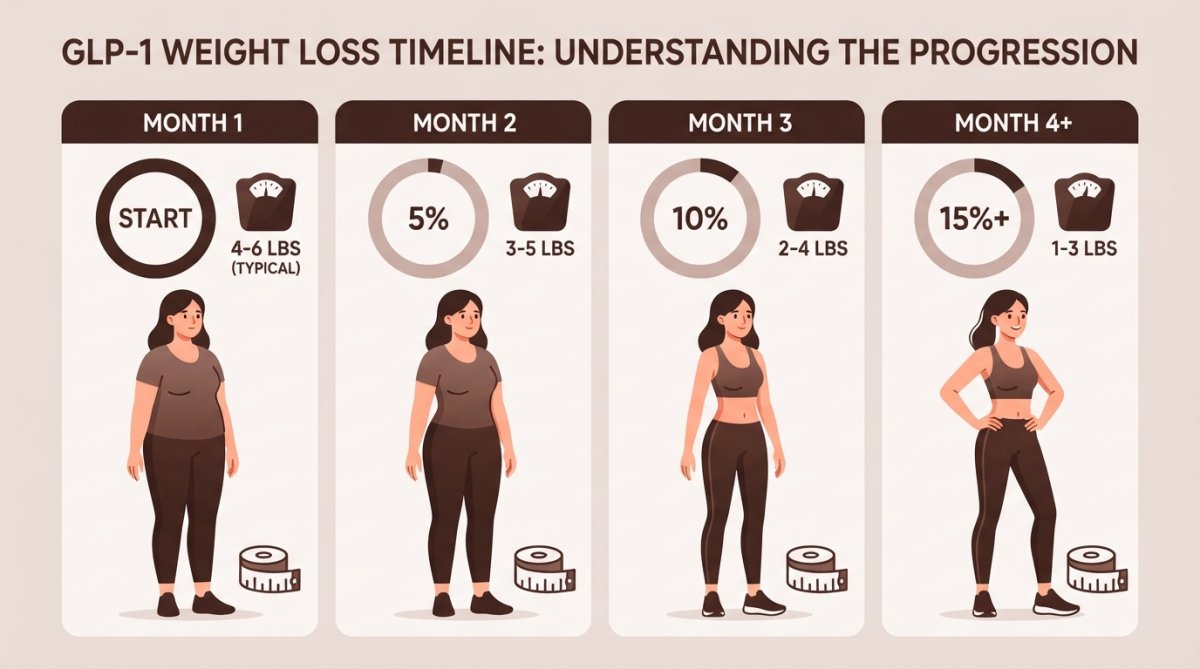
Most people lose 4-8 pounds per month in the first three months on GLP-1s, with weight loss slowing to 1-3 pounds monthly after month six. Results vary significantly based on starting weight, medication type, dosage, and lifestyle factors.
What the Clinical Data Shows
Clinical trials reveal consistent patterns in GLP-1 weight loss outcomes. Semaglutide trials showed participants losing roughly 15% of their starting body weight over 68 weeks. Tirzepatide demonstrated more aggressive results, with some participants achieving 20-22% total body weight loss. Liraglutide typically produced 5-10% body weight reduction.
A person weighing 300 pounds losing 15% of their body weight means 45 pounds total, roughly 7-8 pounds monthly if spread across 6 months. That same person losing 20% equals 60 pounds, or about 10 pounds monthly. But a person starting at 180 pounds with the same medication might lose only 27 pounds total, or 4-5 pounds monthly. This is why absolute pound-per-month figures can be misleading without context.
GLP-1 medications work primarily through appetite suppression and delayed gastric emptying. What varies is how aggressively each person’s body responds to these signals and how strictly they adhere to reduced calorie intake.
Be skeptical of claims that “everyone loses 10 pounds per month” on GLP-1s. Slower weight loss (1-2 pounds weekly) is normal and healthy. Anything faster typically indicates either extremely high starting weight or unsustainable calorie restriction.
Month-by-Month Weight Loss Timeline on GLP-1s
Months 1-3: Initial Weight Loss Phase
The first three months represent the most dramatic weight loss period. Appetite suppression kicks in quickly, with many people feeling full after eating just half their normal meal portions within 1-2 weeks. This creates a natural calorie deficit without requiring willpower.
During months 1-3, expect to lose roughly 4-8 pounds monthly. Someone starting at 250 pounds might lose 8-10 pounds in month one, then 6-8 pounds in month two, then 4-6 pounds in month three. Your dosage is also increasing during this period, starting at 0.25mg and escalating weekly or biweekly. Higher doses correlate with stronger appetite suppression.
This phase is psychologically powerful, but side effects like nausea, vomiting, and digestive changes are most pronounced. Managing these side effects becomes critical to maintaining the calorie deficit that drives weight loss.
Months 4-6: Plateau and Adjustment Period
Many people experience a noticeable slowdown in weight loss between months 4-6. This is adaptation, not failure. Your body has adjusted to lower calorie intake, and the appetite suppression, while still present, no longer feels as novel. Expect to lose 1-4 pounds monthly during this phase.
Diet quality matters most during this phase. People who’ve shifted to higher-protein, whole-food eating continue losing steadily. Side effects typically improve during months 4-6, and exercise becomes more feasible. Adding 150-300 minutes of moderate weekly activity can reignite weight loss momentum.
Months 6-12: Sustained Loss and Maintenance
By month 6, most people have achieved 50-70% of their total expected weight loss. The remaining months show slower but steady progress, typically 1-3 pounds monthly. Many people reach a plateau around month 8-10 where weight loss stalls for 4-8 weeks. This is normal and temporary.
By month 12, total weight loss typically ranges from 10-25% of starting body weight, depending on starting weight, medication type, and lifestyle adherence.
Factors Affecting GLP-1 Weight Loss: Why Results Vary
Medication Type and Dosage
Tirzepatide (Mounjaro, Zepbound) consistently outperforms semaglutide (Ozempic, Wegovy) in clinical trials, typically producing 20-22% total body weight loss versus semaglutide’s 15-17%. Liraglutide (Saxenda) lags behind both, usually delivering 5-10% total body weight reduction.
Dosage escalation also matters significantly. People who reach higher maintenance doses (7-10mg for semaglutide, 15mg for tirzepatide) see faster weight loss than those who stop at lower doses due to side effects. However, higher doses also correlate with more pronounced nausea and digestive issues.
Some people use compounded GLP-1s, lower-cost versions made by specialty pharmacies. Compounded versions can vary in concentration and purity, which may affect results.
Individual Metabolic and Lifestyle Factors
Starting body weight is perhaps the strongest predictor of monthly weight loss. Heavier individuals typically lose more pounds per month in absolute terms because they have a larger calorie deficit at any given intake level.
Metabolic rate varies significantly between individuals based on age, sex, muscle mass, and genetics. GLP-1s don’t change this fundamental difference; they just reduce appetite, making it easier to achieve a deficit.
Diet quality dramatically affects results, especially after month 3. People eating primarily whole foods, lean proteins, and vegetables continue losing steadily. Exercise frequency matters more after month 6. Strength training is particularly valuable because it preserves muscle mass during weight loss.
:::pro-tip
Track body composition, not just scale weight. Many people lose 2-3 pounds monthly on GLP-1s while simultaneously gaining 1-2 pounds of muscle through exercise. The scale stalls, but body fat percentage continues dropping.
:::
How GLP-1 Medications Work: Mechanism Behind Weight Loss
GLP-1 Receptor Agonists and Appetite Suppression
GLP-1 receptor agonists work by mimicking glucagon-like peptide-1, a hormone your body naturally produces after eating. This hormone signals your brain that you’re full, reducing hunger and food cravings. GLP-1 medications amplify this signal dramatically.
The appetite suppression mechanism is why calorie restriction on GLP-1s feels different than traditional dieting. You’re not white-knuckling through hunger. You’re genuinely not hungry. This distinction matters for long-term adherence.
Tirzepatide also activates GIP receptors (glucose-dependent insulinotropic polypeptide), which amplifies the appetite suppression effect. This dual-receptor activation explains why tirzepatide produces faster weight loss than semaglutide. Semaglutide activates only GLP-1 receptors, making it somewhat less potent but still highly effective.
Gastric Emptying and Satiety
GLP-1 medications slow gastric emptying, the rate at which food moves from your stomach into your small intestine. This delayed emptying extends the feeling of fullness after eating. You eat a smaller meal, but because it sits in your stomach longer, you feel satisfied for extended periods.
Delayed gastric emptying also reduces blood sugar spikes after eating, which stabilizes energy levels and reduces cravings for sugary foods. Many people report that their desire for sweets simply disappears on GLP-1s because the urge is gone.
GLP-1 Diet Plan: Nutritional Strategy for Maximum Results
Dietary Recommendations While on GLP-1s
The best diet while on GLP-1s is one you can actually eat given reduced appetite and digestive sensitivity. Protein becomes critical because you’re eating less food overall. Aim for 25-35 grams of protein per meal to maximize satiety and preserve muscle mass.
Whole foods are non-negotiable after month 3. The initial appetite suppression masks poor nutrition, but by month 4, diet quality becomes the limiting factor. Lean meats, fish, eggs, legumes, vegetables, and whole grains should form the foundation of your eating.
Hydration matters more on GLP-1s because nausea and constipation are common side effects. Drinking 80-100 ounces of water daily helps manage both. Eat when hungry and stop when full rather than forcing yourself to eat on a schedule.
Managing Calorie Intake Without Restriction
Most people naturally land at 1,200-1,800 calories daily on GLP-1s without tracking, which creates the deficit needed for weight loss. Tracking calories isn’t necessary if you’re eating whole foods and stopping when full.
Meal prep becomes valuable for convenience and ensuring adequate nutrition. When you’re only eating 1,500 calories daily, every bite matters nutritionally. Having prepared meals with known nutrition makes it easier to ensure you’re getting adequate protein, fiber, and micronutrients.
GLP-1 Side Effects and Weight Loss: Managing Nausea, Vomiting, and Digestive Issues
Common Side Effects and Their Timeline
Nausea is the most common GLP-1 side effect, affecting 25-40% of people during the first three months. It typically peaks 2-4 days after a dose injection and improves by day 6-7. It usually resolves by month 3-4 as your body adapts.
Vomiting occurs less frequently (10-15% of people) and is usually mild. It’s more common when people eat too quickly or eat larger portions than their stomach can tolerate. Slowing down eating and eating smaller bites prevents most vomiting episodes.
Constipation affects 20-30% of people and can be severe. This typically peaks around week 2-3 of treatment and improves by month 2-3. Diarrhea is less common (5-10%) but can occur, particularly with tirzepatide.
Dietary Strategies to Minimize Side Effects
Eating smaller, more frequent meals prevents nausea. Instead of three normal meals, try five or six smaller eating occasions of 200-300 calories each. Avoiding high-fat and high-fiber foods simultaneously reduces digestive distress.
Ginger, peppermint tea, and small amounts of lemon water help manage nausea for many people. For constipation, increase water intake to 100+ ounces daily and add soluble fiber gradually. Magnesium supplements (200-400mg daily) help many people. Eating slowly and chewing thoroughly prevents both nausea and vomiting.
If you experience severe vomiting (multiple times daily), inability to keep food down, or signs of dehydration, contact your prescribing doctor immediately.
Types of GLP-1 Medications: Semaglutide, Tirzepatide, Liraglutide Compared
| Medication | Brand Names | Typical Monthly Loss (Months 1-3) | Total Expected Loss (12 months) | Starting Dose | Maintenance Dose |
|---|---|---|---|---|---|
| Semaglutide | Ozempic, Wegovy | 4-8 lbs | 15-17% body weight | 0.25mg | 2.4mg |
| Tirzepatide | Mounjaro, Zepbound | 6-10 lbs | 20-22% body weight | 2.5mg | 15mg |
| Liraglutide | Saxenda | 2-4 lbs | 5-10% body weight | 0.6mg | 3.0mg |
Semaglutide (Ozempic, Wegovy)
Semaglutide is the most widely used GLP-1 for weight loss, injected once weekly. The standard titration schedule increases the dose every week for four weeks, then every four weeks until reaching maintenance.
Weight loss with semaglutide typically follows the pattern described earlier: 4-8 pounds monthly for months 1-3, then 1-4 pounds monthly for months 4-6, then 1-3 pounds monthly for months 6-12. Total weight loss averages 15-17% of starting body weight over one year.
Side effects with semaglutide are generally manageable. Nausea occurs in about 30% of people but is usually mild. Most side effects improve significantly by month 3-4. Ozempic (the diabetes formulation) costs less than Wegovy for the same medication, which is why many people use it off-label for weight loss.
Tirzepatide (Mounjaro, Zepbound)
Tirzepatide is the newer dual GIP/GLP-1 receptor agonist, injected once weekly. It produces faster weight loss, typically 6-10 pounds monthly during months 1-3 and 20-22% total body weight loss over one year.
The trade-off is that tirzepatide produces more pronounced side effects, particularly nausea and diarrhea. Roughly 40% of people experience nausea, and it tends to be more severe than with semaglutide. These side effects usually improve by month 3-4.
Tirzepatide is newer, so long-term safety data is less extensive than semaglutide’s. Insurance coverage is evolving, and cost is typically higher than semaglutide.
Liraglutide (Saxenda) and Other Options
Liraglutide is the oldest GLP-1 medication for weight loss, approved in 2014. It requires daily injections rather than weekly, which is less convenient. Weight loss is slower, typically 5-10% total body weight loss over one year.
Liraglutide has the longest safety track record and is well-tolerated by most people. Side effects are generally mild, making it an option for people who don’t tolerate semaglutide or tirzepatide well.
Compounded GLP-1s are lower-cost versions made by specialty pharmacies. The trade-off is less quality control and consistency. Results are less predictable than with FDA-approved brands.
Weight Regain After Stopping GLP-1s: Long-Term Maintenance Strategies
Why Weight Returns and How to Prevent It
Most people regain weight after stopping GLP-1s. Studies show that 50-70% of weight lost returns within one to two years of discontinuing medication. This isn’t failure; it’s biology. The GLP-1 medication was suppressing appetite. Stop the medication, and appetite returns to baseline.
However, weight regain isn’t inevitable. People who’ve built sustainable eating habits during GLP-1 treatment maintain more of their loss than those who simply ate less without changing their relationship with food. The medication created a window of opportunity to establish new habits.
The key is distinguishing between weight loss and habit formation. The first three to six months create weight loss. Months 6-12 should focus on habit formation: establishing exercise routines, learning to eat whole foods, managing stress, and developing satiety awareness that persists after medication stops.
Lifestyle Changes That Stick Beyond GLP-1 Treatment
Exercise becomes non-negotiable for long-term maintenance. People who exercise 150-300 minutes weekly while on GLP-1s and continue that exercise after stopping maintain significantly more weight loss than those who remain sedentary.
Strength training is particularly valuable. It preserves muscle mass during weight loss, preventing the metabolic slowdown that typically accompanies dieting. Three sessions weekly of 30-45 minutes, focusing on major muscle groups, provides enough stimulus to maintain muscle.
Whole-food eating becomes habit rather than restriction. People who’ve spent 6-12 months eating primarily vegetables, lean proteins, and whole grains develop genuine preferences for these foods. This preference shift is real and durable.
Stress management and sleep quality matter significantly. Poor sleep increases hunger hormones and decreases satiety hormones. People sleeping 7-9 hours nightly with managed stress maintain weight loss better than those sleeping 5-6 hours.
Social support structures matter. People who’ve built accountability with friends, family, or support groups maintain weight loss better than those trying to do it alone.
The most important habit to build during GLP-1 treatment is exercise, specifically strength training. People who exercise 150+ minutes weekly while on GLP-1s and continue afterward maintain 60-70% of their weight loss. Those who don’t exercise regain most of it.
Mental Health and Psychological Support During GLP-1 Treatment
Body Image and Identity Shifts with Rapid Weight Loss
Rapid weight loss creates psychological changes that many people don’t anticipate. Your body is changing faster than your self-image can adjust. Some people experience body dysmorphia during rapid weight loss, seeing themselves as still overweight despite objective evidence they’re not.
Loose skin becomes a physical and psychological issue for people losing significant weight (30+ pounds). The loose skin is real, and it can feel defeating. Skin tightens somewhat over 6-12 months post-weight loss, but significant loose skin may require surgical intervention.
Social reactions to weight loss can be surprisingly difficult. Some people receive unwanted comments or questions. Others experience relationship changes, with partners or friends feeling threatened or jealous.
Building a Support System for Long-Term Success
Professional mental health support during GLP-1 treatment is underutilized but valuable. A therapist familiar with weight loss and body image changes can help you process the psychological aspects of rapid weight change.
Peer support groups, whether in-person or online, provide connection with others experiencing the same journey. Family and partner involvement matters significantly. Partners who understand that you’re managing both physical and psychological change are more supportive.
Ascend Vitality provides medically-supervised programs that include access to healthcare providers who understand both the physical and psychological aspects of GLP-1 treatment. This integrated approach produces better long-term outcomes than medication alone.
Cost and Insurance Coverage for GLP-1 Weight Loss Medications
Understanding Your Coverage Options
Insurance coverage for GLP-1 medications varies dramatically by plan, employer, and indication. Ozempic (the diabetes formulation) is often covered for type 2 diabetes. Wegovy (the weight loss formulation) may or may not be covered depending on your plan’s stance on weight loss medications.
Medicare coverage is evolving. As of 2026, Medicare covers GLP-1s for people with type 2 diabetes, but coverage for weight loss alone is limited and plan-dependent. Private insurance varies, and Medicaid coverage varies by state.
You need to check your specific plan. Call your insurance company or check your plan documents to understand whether GLP-1s are covered, whether there are prior authorization requirements, and whether the specific medication is covered.
Out-of-pocket cost for GLP-1s without insurance ranges from $900-$1,500 monthly for brand medications. Manufacturer savings programs can reduce your out-of-pocket cost to $0-$250 monthly if you qualify based on income.
Manufacturer Savings Programs and Alternatives
Manufacturer savings programs can reduce your out-of-pocket cost significantly if you qualify. Novo Nordisk (semaglutide manufacturer) and Eli Lilly (tirzepatide manufacturer) both offer copay assistance programs.
Compounded GLP-1s cost $200-$400 monthly, significantly less than brand medications. The trade-off is less quality control and consistency. If cost is your primary barrier, compounded options are worth discussing with your doctor.
Generic versions don’t yet exist for semaglutide or tirzepatide, though patents expire in the coming years. Once generics become available (likely 2027-2028), costs will drop significantly.
Some people use GLP-1s prescribed for diabetes off-label for weight loss. These formulations cost less than their weight-loss-indicated counterparts because insurance is more likely to cover them for diabetes.
Losing weight on GLP-1 medications is achievable, but realistic expectations matter. Most people lose 4-8 pounds monthly initially, with weight loss slowing to 1-3 pounds monthly after six months. Your total weight loss depends on starting weight, medication type, dosage, diet quality, and exercise consistency. Focus on sustainable habits, exercise, whole-food eating, stress management, and sleep, that will maintain your weight loss after medication stops. Ascend Vitality specializes in medically-supervised GLP-1 programs that address not just the medication but the lifestyle changes, side effect management, and psychological support that determine long-term success.
Frequently Asked Questions
How many pounds per month can you realistically lose on GLP-1 medications?
Most people using GLP-1 receptor agonists for weight loss lose between 1-2 pounds per week, or roughly 4-8 pounds per month on average. This translates to approximately 5-15% of total body weight loss over 6-12 months. However, results vary significantly based on the specific GLP-1 medication, dosage, individual metabolism, diet adherence, and exercise habits. Some people experience faster initial weight loss during the first 3 months, while others see more gradual, steady progress.
What factors affect how much weight you lose on GLP-1s each month?
Key factors affecting GLP-1 weight loss include the medication type (semaglutide, tirzepatide, or liraglutide have different efficacy rates), your starting weight and metabolic rate, adherence to dietary changes, exercise frequency, stress levels, sleep quality, and any underlying health conditions like type 2 diabetes or thyroid issues. Dosage titration also matters, people on maintenance doses typically lose more weight than those still titrating. Additionally, your individual response to GLP-1 receptor agonists varies based on genetics and how your body processes appetite suppression and gastric emptying.
Does weight loss slow down after the first few months on GLP-1?
Yes, it's common for weight loss to slow after the initial 3-month period. This plateau typically occurs as your body adapts to the medication and you've lost a significant percentage of body weight. Many people experience rapid loss in months 1-3, then 1-2 pounds per week in months 4-6, and slower progress thereafter. This is normal and not a sign the medication has stopped working. Adjusting your diet, increasing exercise intensity, or working with a healthcare provider to optimize your GLP-1 dosage can help overcome plateaus.
How does a GLP-1 diet plan support weight loss and minimize side effects?
A GLP-1 diet plan focuses on high-protein, nutrient-dense foods that work with appetite suppression and gastric emptying effects. Eating smaller portions, choosing lean proteins, whole grains, and non-starchy vegetables helps manage side effects like nausea and vomiting. Staying hydrated, avoiding high-fat and sugary foods, and eating slowly can reduce digestive discomfort. Since GLP-1 medications naturally reduce calorie intake through satiety, the diet plan emphasizes quality calories over restriction, making it sustainable long-term and easier to maintain weight loss after stopping the medication.