
Last Updated: July 20, 2026
Why GLP-1 Weight Loss Results Plateau, and How to Break Through
The most effective weight loss medications work by suppressing appetite and improving blood sugar control, but many people find their initial results slow after several months. At Ascend Vitality, we’ve helped thousands navigate this critical phase by implementing 7 ways to improve GLP-1 weight loss results that go far beyond simply taking the medication as prescribed. The difference between someone who loses 15 pounds and someone who loses 50 pounds often comes down to nutrition strategy, exercise programming, and behavioral consistency, not the medication itself.
GLP-1 receptor agonists like Semaglutide and Tirzepatide are powerful tools, but they’re tools nonetheless. Without the right foundation, you’ll hit a wall. Below, we’ll show you exactly how to optimize your results through targeted protein intake, strategic food choices, hydration protocols, exercise programming, side effect management, mindful eating practices, and the psychological factors that determine whether you actually keep the weight off.
1. Prioritize Protein Intake to Preserve Muscle Mass
Protein becomes non-negotiable when you’re taking GLP-1 medications. Here’s why: as you lose weight rapidly on these drugs, your body doesn’t automatically preserve muscle tissue. Without adequate protein and resistance training, you’ll lose muscle alongside fat, which tanks your metabolism and makes future weight gain more likely.
Most people on GLP-1 medications underestimate how much protein they actually need. The standard recommendation of 0.8 grams per kilogram of body weight is insufficient during rapid weight loss. Aim for 1.2 to 1.6 grams per kilogram of your current body weight, distributed across 4-5 meals throughout the day.
Practical Protein Targets and Timing
If you weigh 200 pounds, that’s roughly 109 to 145 grams of protein daily. The key is spacing it out. Your body can only synthesize about 25-40 grams of protein per meal, so consuming 100 grams at dinner and nothing at breakfast wastes the excess.
A practical framework:
- Breakfast: 25-30g protein (eggs, Greek yogurt, cottage cheese)
- Mid-morning snack: 15-20g protein (protein shake, string cheese)
- Lunch: 30-40g protein (chicken breast, fish, tofu)
- Afternoon snack: 15-20g protein (nuts, protein bar)
- Dinner: 30-40g protein (lean beef, salmon, legumes)
The challenge on GLP-1 medications is that reduced appetite makes hitting these targets difficult. This is where meal delivery services like Factor or ModifyHealth become genuinely useful, they remove the decision-making burden and ensure every meal contains adequate protein without requiring you to eat massive portions.
Time your protein intake within 30-60 minutes after resistance training. This window maximizes muscle protein synthesis and helps your body prioritize muscle preservation over fat loss during your workout recovery.
2. Build a Natural GLP-1 Diet Plan Around Whole, Nutrient-Dense Foods
The medications suppress appetite, but they don’t discriminate between junk calories and nutrient-dense calories. You can lose weight eating processed foods, but you’ll feel terrible, develop nutrient deficiencies, and struggle with energy levels.
A natural GLP-1 diet plan centers on whole foods that maximize satiety with minimal volume. These foods are calorie-light but nutrient-dense, which matters because you’re eating less overall.
Foods That Support Satiety and Blood Sugar Regulation
Fiber-rich whole grains, lean proteins, and healthy fats create the perfect combination for sustained fullness. Research from American Journal of Clinical Nutrition shows that high-fiber foods slow gastric emptying and promote stable blood glucose, which amplifies GLP-1’s natural effects.
Your foundation should include:
- Leafy greens and cruciferous vegetables (broccoli, cauliflower, Brussels sprouts)
- Berries and whole fruits (not juice, the fiber matters)
- Fatty fish (salmon, mackerel, sardines) for omega-3s and satiety
- Legumes and beans for fiber and plant-based protein
- Whole grains in measured portions (brown rice, quinoa, oats)
- Fermented foods (yogurt, kefir, sauerkraut, kimchi) for digestive health
The fermented foods deserve special attention. Your gut microbiome shifts during rapid weight loss, and fermented foods support healthy bacterial populations that improve digestion and reduce bloating, a common GLP-1 side effect.
Foods to Avoid: Ultra-Processed and Greasy Options
Ultra-processed foods and high-fat fried foods are your enemies on GLP-1 medications. They’re calorie-dense, nutrient-poor, and they sit in your stomach longer, causing nausea and discomfort.
Specifically avoid:
- Fried foods and foods cooked in excess oil
- Sugary beverages and desserts
- Processed snack foods (chips, cookies, candy)
- High-fat dairy products consumed in large quantities
- Alcohol (especially early in your GLP-1 journey)
The reason is physiological. GLP-1 medications slow gastric emptying, your stomach empties more slowly. Greasy foods exacerbate this, causing the nausea and discomfort many people experience. Lean proteins and fiber move through your system more comfortably.
Many people on GLP-1 medications experience “dumping syndrome”, rapid stomach emptying, if they consume high-sugar foods. This causes bloating, cramping, and diarrhea. One sugary meal can derail your week. Eliminate added sugars entirely [in the first](/how-to-manage-glp-1-nausea-at-home/) 3 months.
3. Master Hydration Strategies for Optimal Metabolism
Dehydration is insidious on GLP-1 medications. The appetite suppression makes you forget to drink water. Simultaneously, reduced food intake means you’re getting fewer electrolytes from food, and your body’s water retention patterns shift.

Most people on GLP-1 medications are chronically under-hydrated without realizing it. This slows metabolism, increases fatigue, and worsens constipation, one of the most common side effects.
Your target is straightforward: half your body weight in ounces of water daily, plus an additional 16-32 ounces for every hour of exercise. If you weigh 200 pounds, that’s 100 ounces baseline (roughly 3 liters), plus additional water around workouts.
The strategy that works best is preemptive hydration. Drink 16-20 ounces of water first thing in the morning before eating anything. Drink another 16 ounces mid-morning. Continue this pattern before meals and snacks, not during or after. Drinking water with meals can increase bloating on GLP-1 medications because your stomach is already processing food more slowly.
Consider adding electrolytes, sodium, potassium, magnesium, especially if you’re exercising regularly. A simple electrolyte drink (without added sugar) supports cellular hydration better than plain water alone. This is particularly important because rapid weight loss depletes electrolytes, and GLP-1 medications affect sodium regulation.
Track your hydration like you track food. Use a water bottle with time markers or a simple app. Thirst is an unreliable indicator when you’re on appetite-suppressing medications, you need to drink on schedule, not on demand.
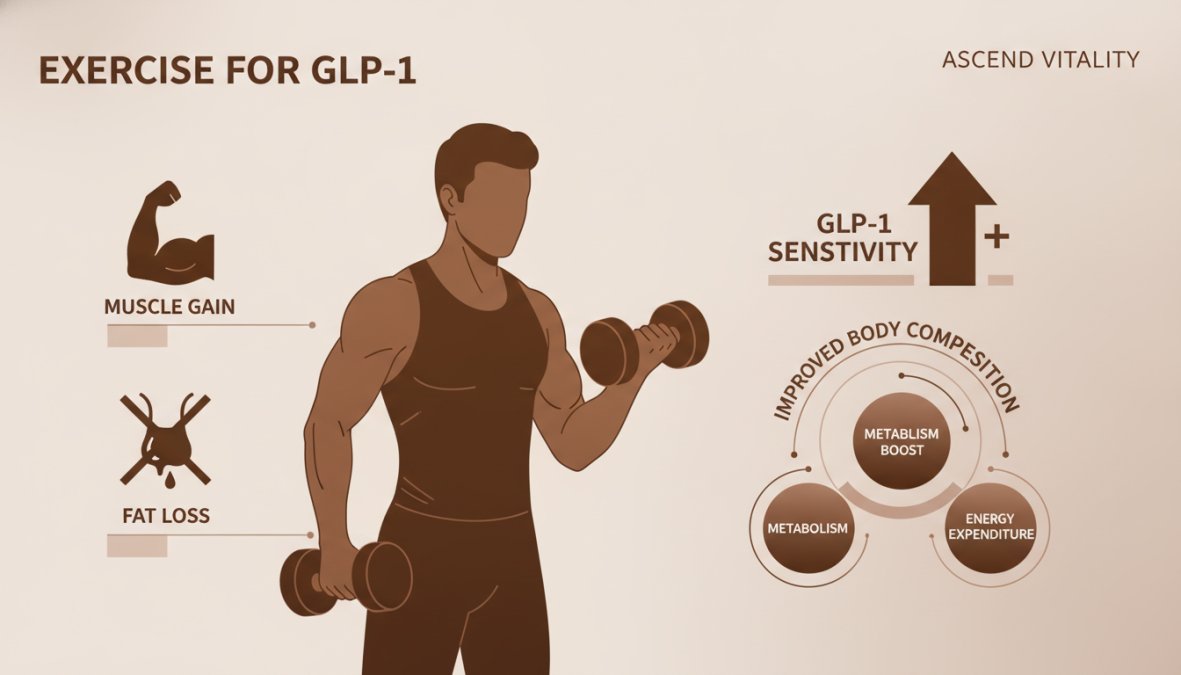
4. Incorporate Exercise for GLP-1 Weight Loss and Body Composition
Exercise on GLP-1 medications requires a different approach than traditional weight loss. You’re not exercising primarily to burn calories, you’re exercising to preserve muscle mass and improve metabolic health. The calorie deficit is created through reduced food intake, not through exercise.
This distinction changes everything. You should prioritize strength training over cardio, especially in the first 3-6 months of your GLP-1 journey.
Strength Training to Combat Muscle Atrophy
Resistance training sends a signal to your body: “Keep this muscle. We need it.” Without that signal, your body preferentially burns muscle tissue during a calorie deficit because muscle is metabolically expensive to maintain.
A practical strength program for GLP-1 users:
- 3-4 days per week of resistance training
- Focus on compound movements: squats, deadlifts, bench press, rows
- 8-12 repetitions per set, 3-4 sets per exercise
- Progressive overload: gradually increase weight or reps week-to-week
- 48 hours rest between training the same muscle groups
The intensity matters more than duration. A 30-minute focused strength session beats a 60-minute low-intensity cardio session for preserving muscle during GLP-1 treatment.
Balancing Cardio and Resistance Work
Cardio has a role, but it’s secondary. Once you’ve built your strength foundation, add 2-3 days of moderate-intensity cardio: walking, cycling, swimming, or elliptical work. Keep sessions to 20-30 minutes. The goal is cardiovascular health and metabolic support, not calorie burning.
Many people make the mistake of doing excessive cardio while on GLP-1 medications, thinking more exercise equals faster weight loss. This backfires. Excessive cardio combined with reduced calorie intake accelerates muscle loss. You end up lighter but weaker, with a slower metabolism.
Start conservatively. If you haven’t exercised regularly, begin with 2 days per week of strength training and walking on off-days. Progress gradually. Your reduced calorie intake means you have less energy for intense training, that’s normal and expected. Listen to your body.
5. Manage GLP-1 Side Effects Through Strategic Nutrition
Nausea, constipation, and digestive discomfort are the most common reasons people stop GLP-1 medications. These aren’t failures, they’re manageable through nutrition strategy.
Addressing Nausea, Constipation, and Digestive Issues
Nausea typically peaks in the first 2-4 weeks and improves as your body adapts. But it can persist if you’re eating the wrong foods. The solution is eating smaller, more frequent meals of easily digestible foods.
When nausea is present:
- Eat 4-5 small meals instead of 2-3 large ones
- Choose bland, protein-rich foods: plain chicken, white fish, eggs
- Avoid strong flavors and aromatic foods
- Eat slowly and chew thoroughly
- Ginger tea and peppermint tea can reduce nausea
- Avoid lying down for 30 minutes after eating
Constipation is the opposite problem. Reduced food intake plus slower gastric emptying equals constipation for most people. This is where fiber becomes critical, but you need to introduce it gradually.
Fiber-Rich and Fermented Foods for Digestive Health
Fiber is your primary tool for managing constipation, but the timing matters. Don’t suddenly jump to 40 grams of fiber daily, your digestive system can’t handle it. Increase gradually: add 5 grams per week until you reach 25-35 grams daily.
Best sources of fiber on GLP-1 medications:
- Ground flaxseed (1-2 tablespoons daily)
- Chia seeds (1 tablespoon daily)
- Psyllium husk (1 teaspoon in water, 1-2 times daily)
- Oats and whole grains
- Beans and legumes (introduce slowly)
- Vegetables, especially leafy greens and broccoli
Fermented foods support your microbiome, which directly impacts digestion and constipation. Include daily servings of plain yogurt, kefir, sauerkraut, or kimchi. The beneficial bacteria in these foods improve your gut’s ability to process food and regulate bowel movements.
Many people find that a simple probiotic supplement (10+ billion CFU daily) plus fermented foods plus gradual fiber introduction eliminates constipation entirely within 3-4 weeks.
6. Practice Mindful Eating and Calorie Deficit Management
GLP-1 medications suppress appetite, but they don’t eliminate the psychological relationship with food. Many people still experience cravings, emotional eating, and the impulse to eat beyond fullness, especially after the initial appetite suppression wears off.
Mindful eating is the antidote. It’s not about willpower or restriction. It’s about awareness.
Start by eating without distractions. No phone, no TV, no work. Just you and your food. Eat slowly, aim for 20-30 minutes per meal. Your brain needs 20 minutes to register fullness signals, and GLP-1 medications slow these signals further.
Notice the difference between physical hunger and psychological hunger. Physical hunger builds gradually. Psychological hunger is sudden and specific (“I want chocolate”). On GLP-1 medications, psychological hunger often disappears when you pause and drink water or take a walk.
Track your food intake, but not obsessively. A simple food journal or app helps you understand your patterns without becoming neurotic about calories. Most people find that once they hit their protein target and eat whole foods, calorie management happens naturally.
The calorie deficit on GLP-1 medications is typically 500-1000 calories below your maintenance level. This produces 1-2 pounds of weight loss per week, sustainable and healthy. You don’t need to calculate exact calories; eating whole foods and hitting your protein target naturally creates this deficit.
Use a tracking app like MeAgain or MyNetDiary specifically designed for GLP-1 users. These apps track medication, food, side effects, and progress in one place, reducing the cognitive load and increasing adherence.
7. Address Psychological and Behavioral Factors for Long-Term Adherence
This is the part most guides skip, and it’s why most people regain weight after stopping GLP-1 medications. The medication works, but only if you use it consistently and build habits that persist after you stop.
Adherence is the real challenge. Missing doses, skipping meals, abandoning your exercise routine, these are behavioral failures, not medication failures. GLP-1 medications don’t fix the underlying behaviors that created weight gain in the first place.
Start by identifying your specific barriers to adherence. Is it cost? Side effects? Inconvenience? Lack of motivation? Once you name the barrier, you can solve it.
Cost barriers: Work with Ascend Vitality to explore options. They connect you with specialized care pathways and can discuss medication options that fit your budget. Many insurance plans cover GLP-1 medications, and patient assistance programs exist for those without coverage.
Side effect barriers: These are temporary and manageable through the nutrition strategies above. Give yourself 4-6 weeks to adapt before deciding the medication isn’t working.
Motivation barriers: This is psychological work. Why did you gain weight? Stress? Habit? Lack of knowledge? Identify the root cause and address it directly. Working with a therapist or health coach can accelerate this process.
Building Sustainable Habits Beyond the Medication
The goal is not to stay on GLP-1 medications forever. The goal is to use the medication as a tool to build new habits, then maintain those habits independently.
This means:
- Establishing a consistent exercise routine (3-4 days per week minimum)
- Building a sustainable eating pattern around whole foods
- Developing stress management practices (meditation, journaling, therapy)
- Creating accountability through community or coaching
- Celebrating non-scale victories (strength gains, energy improvements, clothes fitting better)
Many people find that group support accelerates behavior change. Whether it’s an online community, a local gym class, or coaching with Ascend Vitality, having others on the same journey increases adherence significantly.
Sleep and Recovery: Often-Overlooked Pillars of Weight Loss Success
Sleep quality directly impacts weight loss success. Poor sleep increases cortisol, impairs glucose regulation, and increases hunger hormones. On GLP-1 medications, sleep becomes even more critical because your body is undergoing significant metabolic changes.
Target 7-9 hours of consistent sleep per night. Establish a sleep routine: consistent bedtime, cool dark room, no screens 30 minutes before bed. If you struggle with sleep, address it directly. Sleep deprivation will sabotage your weight loss results faster than almost anything else.
Recovery also includes stress management. High stress increases cortisol, which promotes fat storage and muscle loss. Implement daily stress practices: 10 minutes of meditation, journaling, or simply walking outside. These practices are as important as your nutrition and exercise.
| Strategy | Duration | Frequency | Expected Impact |
|---|---|---|---|
| Strength training | 30-45 min | 3-4x/week | Preserves 2-3 lbs muscle per 10 lbs fat loss |
| Protein intake | Distributed | Every meal | Supports muscle synthesis and satiety |
| Fiber introduction | Gradual | Daily | Resolves constipation within 3-4 weeks |
| Hydration | Ongoing | Daily | Improves energy and reduces side effects |
| Sleep optimization | 7-9 hours | Nightly | Increases weight loss by 30% vs poor sleep |
| Mindful eating | 20-30 min | Every meal | Reduces overeating and emotional eating |
| Stress management | 10-15 min | Daily | Reduces cortisol and supports metabolism |
Supplementation Protocols to Support Your GLP-1 Journey
Beyond whole foods, certain supplements address specific deficiencies common in rapid weight loss. These aren’t magic, they’re insurance.
A basic supplementation protocol:
- Multivitamin: Covers micronutrient gaps from reduced food intake
- Vitamin B12: GLP-1 medications can impair B12 absorption; supplementation prevents fatigue and cognitive issues
- Omega-3 fatty acids: Supports heart health, reduces inflammation
- Magnesium: Supports sleep, digestion, and muscle recovery
- Calcium and Vitamin D: Bone health is critical during rapid weight loss
- Probiotics: Support digestive health and microbiome balance
Work with your Ascend Vitality provider to test for specific deficiencies before supplementing. A simple blood panel reveals which nutrients you’re actually depleted in, preventing unnecessary supplementation.
Breaking Through Weight Loss Plateaus on GLP-1 Medication
Most people hit a plateau around month 4-6 of GLP-1 treatment. Weight loss slows or stops entirely. This is normal, your body adapts to the medication, and your calorie deficit naturally shrinks as you lose weight.
Breaking through a plateau requires one of three interventions:
Increase medication dose (with your provider’s guidance): Your provider may increase your dose, which re-establishes appetite suppression and the calorie deficit.
Increase exercise intensity: Add an extra strength training day or increase the weight you’re lifting. This signals your body to maintain muscle and can restart fat loss.
Tighten nutrition: Review your food intake. Portion creep is common, you’re eating slightly more than you realize. Return to strict tracking for 2-3 weeks to recalibrate.
Most plateaus resolve within 2-3 weeks with one of these adjustments. If your plateau persists beyond 4 weeks, consult with your provider. Some people require additional support or medication adjustments.
Research from New England Journal of Medicine on GLP-1 medications shows that people who combine medication with behavioral interventions (exercise, nutrition, therapy) lose significantly more weight and maintain losses better than those relying on medication alone.
The 7 ways to improve GLP-1 weight loss results outlined here represent the complete picture: nutrition, exercise, hydration, side effect management, mindful eating, psychological factors, and sleep. Miss any one of these, and your results will suffer. Master all seven, and you’ll achieve the transformation you’re seeking.
Losing weight and keeping it off requires more than medication, it requires a complete lifestyle shift. Ascend Vitality connects you with specialized care pathways that provide medically-supported programs, targeted nutrition guidance, and ongoing coaching. Their providers can adjust your medication, monitor your progress, and help you build the habits that create lasting results. Get started with Ascend Vitality and access the personalized care and prescription delivery that makes sustainable weight loss achievable.
Frequently Asked Questions
How can I maximize my GLP-1 weight loss results?
To improve GLP-1 weight loss results, focus on protein intake (25-35g per meal), maintain a consistent calorie deficit, incorporate strength training to preserve muscle mass, stay hydrated with at least 8-10 glasses of water daily, and eat whole, nutrient-dense foods. Managing side effects through strategic nutrition, practicing mindful eating, and ensuring adequate sleep (7-9 hours) also significantly enhance outcomes. Medical guidance from a qualified provider is essential for long-term success.
What is the best GLP-1 diet plan to follow?
An effective GLP-1 diet plan emphasizes lean proteins, high-fiber vegetables, whole grains, and healthy fats while avoiding ultra-processed and greasy foods that trigger nausea. Prioritize nutrient-dense options like salmon, chicken breast, leafy greens, berries, and fermented foods to support digestion and satiety. Meal frequency should be adjusted to your tolerance, many users find 3-4 smaller meals work better than traditional portions. Consulting a registered dietitian familiar with GLP-1 medications can personalize your plan.
How does exercise support weight loss on GLP-1 medications?
Exercise for GLP-1 weight loss works through multiple mechanisms: strength training preserves muscle mass during calorie deficit (preventing metabolic slowdown), cardio enhances fat loss, and physical activity improves blood sugar regulation and metabolic health. Aim for 150 minutes of moderate cardio weekly plus 2-3 strength sessions. Exercise also reduces appetite-suppressing medication dependence long-term and supports psychological well-being, improving adherence to your weight loss program.
What are common GLP-1 side effects and how do I manage them through diet?
Common GLP-1 side effects include nausea, constipation, and reduced appetite. Manage these through smaller, frequent meals; prioritizing fiber-rich foods and fermented options (yogurt, sauerkraut) for constipation; consuming ginger tea and bland proteins for nausea; and staying well-hydrated. Avoid greasy, spicy, and overly sweet foods that worsen symptoms. If side effects persist despite dietary adjustments, inform your healthcare provider, they may adjust your dose or recommend additional support strategies.
Why do weight loss results plateau on GLP-1, and how do I restart progress?
Weight loss plateaus occur when your body adapts to the medication and calorie deficit. To break through, reassess your protein intake (ensure 1.6-2.2g per kg body weight), increase strength training intensity, vary your cardio routine, verify you’re maintaining a true calorie deficit, and review sleep quality and stress levels. Some users benefit from supplementation protocols targeting nutrient gaps. Consulting your healthcare provider about dose adjustments or exploring behavioral support can also reignite progress.