

GLP-1 Benefits for Insulin Resistance: A Complete Guide
Last Updated: July 21, 2026
Understanding what are the benefits of glp-1 for insulin resistance has become essential for millions managing metabolic dysfunction. At Ascend Vitality, we’ve tracked how GLP-1 receptor agonists transform insulin sensitivity and metabolic health in patients who’ve struggled with conventional approaches. This guide explores the mechanisms, benefits, and practical implementation of GLP-1 therapy for insulin resistance.
Insulin resistance underlies metabolic syndrome, Type 2 diabetes, and cardiovascular disease. Most treatment approaches address symptoms rather than root causes. GLP-1 receptor agonists are different. They restore insulin signaling, reduce pancreatic stress, and trigger metabolic remodeling that extends far beyond simple weight loss.
The real advantage of GLP-1 therapy isn’t just weight loss, it’s metabolic restoration. Patients often see improvements in blood pressure, lipid profiles, and liver health within weeks, even before significant weight reduction occurs.
Understanding GLP-1 and Insulin Resistance: What You Need to Know
GLP-1 (glucagon-like peptide-1) is a naturally occurring hormone that regulates blood glucose, appetite, and metabolic function. In insulin-resistant individuals, the signaling chain breaks down: the pancreas works harder, cells ignore insulin signals, and glucose accumulates in the bloodstream.
GLP-1 receptor agonists are synthetic versions of this hormone. Medications like semaglutide and liraglutide bind to GLP-1 receptors throughout your body, restoring the communication pathways that insulin resistance has damaged. The benefits of glp-1 for insulin resistance stem from this restoration of hormonal signaling rather than forcing the pancreas to produce more insulin.
Traditional diabetes medications increase insulin output, pushing the system harder. GLP-1 works upstream, fixing the broken communication between your gut, pancreas, and cells. This explains why patients on GLP-1 often discontinue other medications, the underlying dysfunction improves rather than being masked.
Research from the American Diabetes Association clinical guidelines confirms that GLP-1 receptor agonists improve insulin sensitivity markers across multiple organ systems.
How GLP-1 Mechanism of Action Improves Insulin Resistance
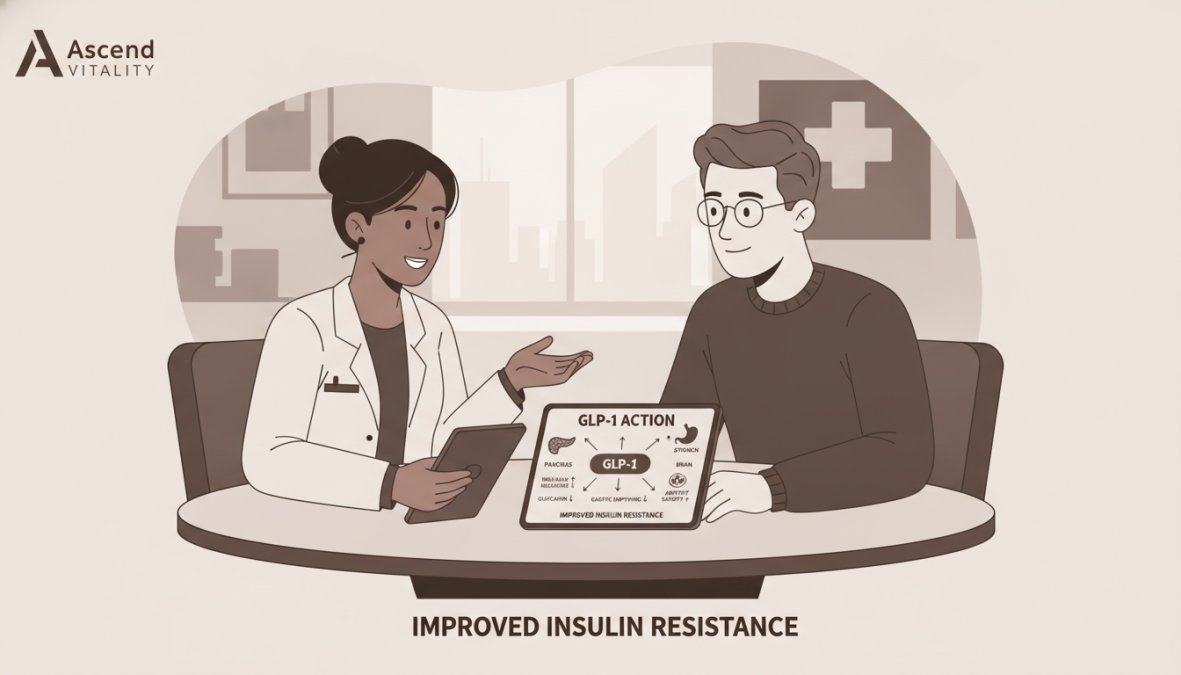
GLP-1 receptor agonists operate through multiple pathways simultaneously. When you inject semaglutide or liraglutide, the medication activates GLP-1 receptors on pancreatic beta cells, gut cells, and neurons throughout your brain and body. This triggers improved glucose-dependent insulin secretion, slowed gastric emptying, reduced appetite signaling, and restoration of insulin sensitivity in adipose tissue and muscle.
Restoring Insulin Signaling and Glucose Homeostasis
Insulin resistance occurs when cells stop responding to insulin signals. GLP-1 restores this communication by reducing pro-inflammatory cytokines that block insulin signaling pathways. Inflammation is the hidden driver of insulin resistance; GLP-1 addresses it directly.
At the molecular level, GLP-1 improves the insulin signaling pathway by enhancing glucose uptake in muscle cells and reducing hepatic glucose production. Your liver stops dumping glucose into the bloodstream when it shouldn’t. Your muscles start accepting glucose more readily. Within days of starting therapy, fasting glucose levels often improve, before any weight loss occurs.
The postprandial glucose response (blood sugar spikes after eating) improves dramatically. Patients report more stable energy throughout the day and reduced cravings. Each time glucose spikes, it damages blood vessels and triggers inflammation. GLP-1 flattens these spikes.
GLP-1 restores the insulin signaling pathway by reducing inflammation and improving glucose uptake in muscle tissue. This happens independently of weight loss, making it a true metabolic treatment rather than just an appetite suppressant.
Reducing Pancreatic Beta Cell Stress
Your pancreatic beta cells are the insulin factories. In insulin resistance, they work overtime, pumping out more and more insulin in a futile attempt to overcome cellular resistance. This exhaustion is called beta cell burnout.
GLP-1 gives these overworked cells a break. By improving insulin sensitivity throughout your body, GLP-1 reduces the demand on beta cells. They produce less insulin because cells actually respond to it. C-peptide levels (a marker of insulin production) typically decline as beta cell stress decreases. Patients often see their fasting insulin drop by 30-50% within three months.
The Key Benefits of GLP-1 for Insulin Resistance
Understanding what are the benefits of glp-1 for insulin resistance requires looking beyond single metrics. These medications reshape metabolic function across multiple systems. The benefits compound: weight loss improves insulin sensitivity, which reduces inflammation, which further improves glucose control.
Enhanced Insulin Sensitivity and Glycemic Control
The primary benefit of GLP-1 for insulin resistance is restored insulin sensitivity. Patients typically see HOMA-IR scores (a measure of insulin resistance) drop by 40-60% within 12 weeks. HOMA-IR below 2.0 is considered healthy; most insulin-resistant individuals start above 4.0.
Glycemic control improves across all measures. HbA1c (three-month average blood glucose) typically drops 1-2 percentage points. Fasting glucose normalizes. Postprandial glucose spikes flatten. For diabetic patients, this often means discontinuing other medications entirely.
GLP-1 improves insulin sensitivity in adipose tissue (fat cells), reducing the inflammatory signals that fat tissue releases. Obese individuals have chronically elevated levels of pro-inflammatory cytokines from dysfunctional adipose tissue. GLP-1 reverses this, allowing fat cells to function more healthily.
Weight Reduction and Metabolic Syndrome Reversal
Weight loss on GLP-1 is substantial, typically 10-15% of body weight over 6-12 months. Metabolic syndrome (the cluster of high blood pressure, high triglycerides, low HDL, high fasting glucose, and abdominal obesity) often resolves completely.
The weight loss mechanism combines reduced appetite with improved metabolic efficiency. GLP-1 slows gastric emptying, keeping you fuller longer. It also acts on appetite centers in the brain, reducing the drive to eat. Patients report that food cravings diminish through biological changes in hunger signaling.
The weight that’s lost is preferentially visceral fat (the dangerous fat around organs). Subcutaneous fat (under the skin) is preserved. This distinction matters because visceral fat is metabolically active and pro-inflammatory. Losing it has outsized benefits for insulin sensitivity and cardiovascular health.
Cardiovascular and Liver Protection
The benefits of glp-1 for insulin resistance extend to organs damaged by metabolic dysfunction. Cardiovascular protection is substantial. GLP-1 reduces blood pressure, improves lipid profiles, and reduces atherosclerotic cardiovascular disease risk. Patients on semaglutide show 26% reduction in major cardiovascular events according to the SUSTAIN-6 cardiovascular outcomes trial.
Fatty liver disease (NAFLD), which affects 30% of the general population and 80% of obese individuals, improves dramatically on GLP-1. Liver fat content typically decreases 30-40% over six months. This matters because NAFLD drives insulin resistance through hepatic inflammation and impaired glucose metabolism.
Patients with advanced liver disease should monitor liver enzymes closely when starting GLP-1. While [the medication](/long-term-safety-weight-loss-injections/)s improve NAFLD, rapid fat mobilization in severely cirrhotic livers can occasionally cause transient enzyme elevations.
Anti-Inflammatory Effects and Reduced Disease Progression
Chronic inflammation is the root cause of insulin resistance. Pro-inflammatory cytokines like TNF-alpha and IL-6 block insulin signaling and promote beta cell dysfunction. GLP-1 reduces these cytokines directly, lowering systemic inflammation markers like CRP and IL-6.
This anti-inflammatory effect explains why patients feel better on GLP-1 beyond just weight loss. Joint pain improves. Energy stabilizes. Brain fog clears. Insulin resistance progresses to prediabetes, then Type 2 diabetes, then diabetic complications. GLP-1 arrests this progression at multiple points, representing true disease modification rather than symptom management.
GLP-1 Weight Loss and Insulin Resistance: The Metabolic Connection
Weight loss on GLP-1 is the consequence of restored metabolic function, not the cause of it. Understanding this distinction changes how you approach the medication.
How Weight Reduction Restores Metabolic Function
Excess weight, particularly visceral obesity, drives insulin resistance through multiple mechanisms. Enlarged fat cells release inflammatory signals. Excess fatty acids impair insulin signaling in muscle. This vicious cycle perpetuates insulin resistance even if calorie intake remains constant.
Weight loss breaks this cycle. As you lose weight on GLP-1, adipose tissue becomes less inflamed. Fatty acid spillover decreases. Insulin sensitivity improves proportionally to weight lost. A 10% weight reduction typically improves insulin sensitivity by 30-40%.
The weight loss on GLP-1 is different from weight loss from calorie restriction alone. GLP-1 preferentially mobilizes visceral fat. Patients often lose 15% of body weight while preserving muscle mass. Traditional calorie restriction causes 25% of weight loss to come from muscle. This metabolic preservation matters long-term because muscle is metabolically active tissue, making weight regain less likely.
Adipose Tissue Remodeling and Inter-Organ Communication
Adipose tissue isn’t just an energy storage depot, it’s an endocrine organ. It secretes hormones (adiponectin, leptin) and inflammatory signals that regulate metabolism throughout your body. Dysfunctional adipose tissue in obesity and insulin resistance sends constant pro-inflammatory signals.
GLP-1 remodels adipose tissue at the cellular level. Fat cells shrink. Inflammatory macrophages infiltrating the tissue decrease. Adiponectin secretion increases (adiponectin improves insulin sensitivity). The tissue shifts from pro-inflammatory to anti-inflammatory signaling.
This remodeling improves inter-organ communication. Your adipose tissue stops flooding your liver with inflammatory signals. Your liver stops producing excess glucose. Your pancreas stops working overtime. Your muscles start accepting glucose normally. Research from Stanford’s metabolic research program shows that GLP-1 improves adipokine profiles within weeks, before significant weight loss.
Who Is a Good Candidate for GLP-1 Therapy for Insulin Resistance?
GLP-1 therapy works best for specific patient populations. Ideal candidates have documented insulin resistance with metabolic dysfunction: elevated fasting insulin (>12 mIU/L), elevated HOMA-IR (>2.5), or evidence of metabolic syndrome.
Patients with Type 2 diabetes benefit substantially, particularly those early in disease progression. Prediabetic patients (fasting glucose 100-125 mg/dL or HbA1c 5.7-6.4%) see dramatic benefits. Progression to diabetes is prevented in most cases. Cardiovascular disease or significant cardiovascular risk factors strengthen the case for GLP-1.
Baseline assessment should include fasting glucose, fasting insulin, HOMA-IR calculation, HbA1c, lipid panel, liver enzymes, and kidney function. These establish your starting point and allow you to measure improvement objectively.
GLP-1 works best when combined with lifestyle changes. The medication isn’t a substitute for movement and nutrition, it’s a partner with them. Patients who exercise regularly while on GLP-1 see better insulin sensitivity improvements than those who remain sedentary.
Long-term maintenance typically requires continuing the medication. Insulin resistance doesn’t resolve permanently, it’s a chronic condition. Stopping GLP-1 usually leads to gradual return of insulin resistance within months. The maintenance dose is often lower than the induction dose. Many patients maintain on 1 mg weekly indefinitely.
GLP-1 therapy works best as a long-term treatment combined with regular movement and whole-food nutrition. It’s not a temporary fix, it’s a tool for sustained metabolic restoration in patients with documented insulin resistance.
GLP-1 Side Effects and Insulin Resistance Management
GLP-1 medications are generally well-tolerated, but side effects are common, particularly during dose escalation.
Common Side Effects and Symptom Tracking
Gastrointestinal side effects are the most frequent: nausea, vomiting, constipation, and diarrhea. These typically occur during dose escalation and improve as your body adjusts. Nausea is most common in the first 1-2 weeks after a dose increase, then gradually resolves over 2-3 weeks.
Managing these requires patience and conservative dosing. Slower titration (staying at each dose for 2-4 weeks before increasing) allows adaptation. Most patients tolerate the medication well once adjusted.
Appetite suppression is the intended effect, but it can be excessive. Some patients eat so little that they become nutritionally deficient. Tracking protein intake is essential, aim for at least 100-120g daily to preserve muscle mass. Any severe abdominal pain requires immediate evaluation. Gallbladder problems occur more frequently with rapid weight loss; staying hydrated and eating adequate fat helps prevent gallstone formation.
Symptom tracking should include: weekly nausea severity (1-10 scale), appetite level, weight, blood glucose (if diabetic), and any unusual symptoms.
Drug Interactions and Safety Considerations
GLP-1 medications have few serious drug interactions, but several warrant attention. Oral medications that require gastric acid (like bisphosphonates for bone health) may be poorly absorbed when GLP-1 slows gastric emptying. Spacing these medications 30+ minutes apart helps.
Medications for diabetes require adjustment. Sulfonylureas (glyburide, glipizide) increase hypoglycemia risk when combined with GLP-1. SGLT-2 inhibitors (empagliflozin, dapagliflozin) work synergistically with GLP-1 and are often combined. ACE inhibitors and ARBs (for blood pressure) are compatible and often beneficial.
Kidney function monitoring is important. GLP-1 improves kidney function in many patients, but rapid volume depletion from nausea-induced low intake can stress kidneys. Patients with personal or family history of medullary thyroid cancer should avoid GLP-1.
Popular GLP-1 Options: Semaglutide, Liraglutide, and Ozempic
Multiple GLP-1 receptor agonists are available, each with distinct characteristics.
Semaglutide (brand names Ozempic for diabetes, Wegovy for weight loss) is the most potent GLP-1 agonist available. It has the longest half-life (7 days), allowing weekly dosing. Typical therapeutic dose is 1-2 mg weekly. Semaglutide produces the most weight loss (15-18% of body weight) among available agents.
Liraglutide (Victoza for diabetes, Saxenda for weight loss) is less potent than semaglutide but still effective. It requires daily injection. Therapeutic dose is 1.8 mg daily. Weight loss is somewhat less than semaglutide (8-10% of body weight), but still substantial.
Tirzepatide (Zepbound, Mounjaro) is technically a GLP-1 and GIP receptor agonist (not pure GLP-1), but it’s increasingly used for insulin resistance. It’s more potent than semaglutide, producing 20-22% weight loss. Weekly dosing is convenient.
| Medication | Dosing | Max Dose | Weight Loss | Half-Life | Best For |
|---|---|---|---|---|---|
| Semaglutide | Weekly injection | 2 mg/week | 15-18% | 7 days | Maximum efficacy, convenience |
| Liraglutide | Daily injection | 1.8 mg/day | 8-10% | 13 hours | Gradual onset, daily routine |
| Tirzepatide | Weekly injection | 15 mg/week | 20-22% | 5 days | Superior weight loss, dual action |
Optimizing Your GLP-1 Therapy: Practical Implementation
Starting GLP-1 is straightforward, but optimization requires attention to dosing, timing, and lifestyle integration. Most patients see benefits within weeks, but maximum benefits take 3-6 months.
Building a Sustainable Treatment Plan
Successful GLP-1 therapy begins with clear goals. Are you targeting diabetes prevention? Reversing metabolic syndrome? Cardiovascular protection? Weight loss? Your specific goal shapes dosing strategy and monitoring frequency.
Dose escalation should be conservative. Start at the lowest dose (0.25 mg weekly for semaglutide) and increase every 4 weeks. Many patients see substantial benefits at 0.5-1 mg weekly and don’t need the maximum 2 mg dose.
Timing matters. Inject semaglutide on the same day each week. Take liraglutide at the same time daily. Consistent timing helps your body adapt and makes it easier to track side effects.
Nutrition becomes critical. GLP-1 reduces appetite, but you still need adequate calories and protein. Aim for 100-120g protein daily, distributed across meals. Eat whole foods: vegetables, lean proteins, healthy fats, and whole grains.
Movement should increase gradually. Start with 10-15 minutes of walking daily, progressing to 30-45 minutes. Add strength training 2-3 times weekly. The combination of GLP-1, movement, and nutrition creates a synergistic effect on insulin sensitivity.
Monitoring Progress and Adjusting Dosage
Objective monitoring prevents guessing about whether therapy is working. Check fasting glucose and insulin monthly initially, then quarterly once stable. Calculate HOMA-IR to track insulin resistance directly. Most patients see HOMA-IR drop by 40-60% within 12 weeks.
HbA1c should be checked every 3 months. Expect 1-2 percentage point reductions. Weight should be tracked weekly initially, then monthly. Expect 0.5-1 lb weekly weight loss, totaling 10-15% over 6-12 months.
Blood pressure and lipids should be rechecked every 3 months. Both typically improve substantially. Patients often can reduce or discontinue blood pressure medications. Triglycerides typically drop 30-40%, HDL increases, and LDL often improves.
Side effects should be tracked systematically. If nausea is severe, consider slowing dose escalation. If nausea is minimal, escalate as planned. Most patients find their optimal dose (often 1-1.5 mg weekly for semaglutide) and maintain it indefinitely.
Track your fasting glucose and insulin monthly for the first three months. This data shows whether metabolic improvements are happening independent of weight loss. Most patients see glucose and insulin normalize before significant weight loss occurs, a sign that the medication is truly restoring insulin sensitivity.
Conclusion: Taking the Next Step with GLP-1 Therapy
Insulin resistance is reversible when you address the underlying metabolic dysfunction rather than just managing symptoms. GLP-1 receptor agonists do far more than suppress appetite, they restore the hormonal communication that insulin resistance has broken.
The evidence is clear: GLP-1 receptor agonists improve insulin sensitivity, reduce cardiovascular risk, protect liver health, and prevent disease progression. Combined with movement and whole-food nutrition, they represent the most effective current approach to metabolic restoration.
If you have documented insulin resistance, prediabetes, metabolic syndrome, or Type 2 diabetes, GLP-1 therapy deserves serious consideration. At Ascend Vitality, we connect you with specialized care pathways and provide medically-supported programs that include GLP-1 prescriptions delivered directly to you. Our providers assess your individual metabolic profile, select the right medication for your situation, and monitor your progress with objective markers that matter: insulin levels, glucose control, and cardiovascular health markers.
Starting GLP-1 therapy means committing to sustained metabolic healing. Get started with Ascend Vitality and transform your metabolic health with evidence-based care tailored to your specific needs.
Frequently Asked Questions
How do GLP-1 receptor agonists improve insulin sensitivity?
GLP-1 receptor agonists enhance insulin sensitivity by stimulating pancreatic beta cells to release insulin in response to glucose, improving glucose homeostasis. They also reduce hepatic glucose production and enhance the insulin signaling pathway in adipose tissue and muscle. Additionally, they reduce pro-inflammatory cytokines that contribute to insulin resistance, helping restore normal metabolic function.
Can GLP-1 medications reverse insulin resistance and metabolic dysfunction?
GLP-1 therapies like semaglutide and liraglutide can significantly improve insulin resistance and metabolic dysfunction through sustained weight reduction, improved glycemic control, and reduced inflammation. While complete reversal depends on individual factors and adherence to lifestyle changes, clinical trials show substantial improvements in insulin sensitivity, lipid profiles, and markers of metabolic syndrome when combined with diet and exercise.
What are the most common GLP-1 side effects for insulin resistance management?
Common side effects include nausea, vomiting, constipation, and reduced appetite, particularly in early treatment phases. These often diminish over time. Patient-centric symptom tracking helps identify which side effects persist. Serious but rare complications include pancreatitis. Drug interactions with other medications require careful review. Discuss your full medication list with your healthcare provider to ensure safe pharmacotherapy.
Who qualifies for GLP-1 therapy for insulin resistance treatment?
Good candidates typically have Type 2 diabetes mellitus, prediabetes, or metabolic syndrome with documented insulin resistance. Ideal candidates struggle with weight management despite lifestyle efforts, have cardiovascular risk factors, or show signs of fatty liver disease. A qualified healthcare provider will review your glucose homeostasis markers, assess drug interactions with existing medications, and determine if you’re suitable for long-term GLP-1 maintenance therapy.